
Top Stories
China Surprises With Cuts to Key Rates to Support Weak Economy
Published by Uma Rajagopal
Posted on July 22, 2024
3 min readLast updated: January 29, 2026
Add as preferred source on Google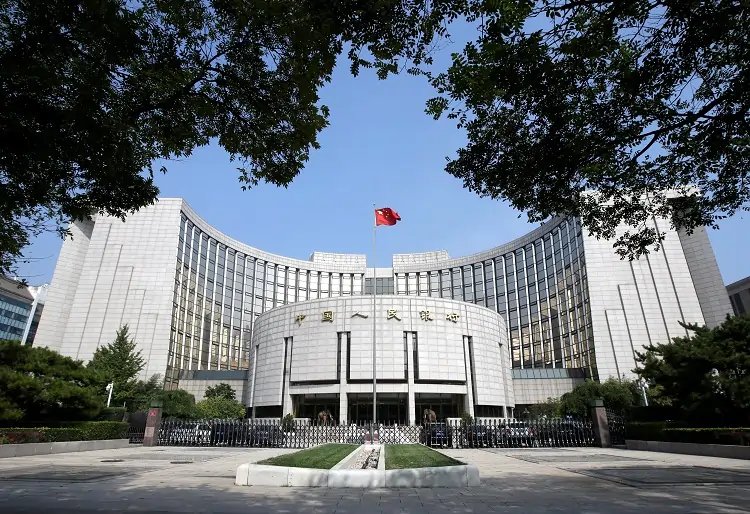
Published by Uma Rajagopal
Posted on July 22, 2024
3 min readLast updated: January 29, 2026
Add as preferred source on GoogleSHANGHAI (Reuters) -China surprised markets by lowering a key short-term policy rate and its benchmark lending rates on Monday, in efforts to boost growth in the world’s second-largest economy.
SHANGHAI (Reuters) -China surprised markets by lowering a key short-term policy rate and its benchmark lending rates on Monday, in efforts to boost growth in the world’s second-largest economy.
The cuts come after China last week reported weaker-than-expected second-quarter economic data and its top leaders met for a plenum that occurs roughly every five years.
The country is verging on deflation and faces a prolonged property crisis, surging debt and weak consumer and business sentiment. Trade tensions are also flaring, as global leaders grow increasingly wary of China’s export dominance.
The People’s Bank of China (PBOC) said on Monday it would cut the seven-day reverse repo rate to 1.7% from 1.8%, and would also improve the mechanism of open market operations.
Minutes later, China cut benchmark lending rates by the same margin at the monthly fixing. The one-year loan prime rate (LPR) was lowered to 3.35% from 3.45% previously, while the five-year LPR was reduced to 3.85% from 3.95%.
The cut today is an unexpected move, likely due to the sharp slowdown in growth momentum in the second quarter as well as the call for ‘achieving this year’s growth target’ by the third plenum,” said Larry Hu, chief China economist at Macquarie.
Ju Wang, head of Greater China FX & rates strategy at BNP Paribas, said that rising expectations for the Federal Reserve to start cutting interest rates also gave the PBOC room to manoeuvre its monetary easing.
The official Xinhua news agency cited unnamed sources close to the PBOC as saying the “decisive” rate cut showed its determination to bolster the recovery and it was in response to the plenum’s aims to achieve this year’s growth target.
Following the rate cuts, China’s yuan dropped to a near two-week low of 7.2750 per dollar before paring some losses.
Chinese sovereign bond yields fell across the curve, with 10-year and 30-year down as much as 3 basis points, before stabilising at 2.24% and 2.45%, respectively.
China’s 30-year treasury futures for Sept 2024 delivery rose roughly 0.3% in early trade on Monday.
The fact that PBOC didn’t wait for the Fed to cut first indicates that the government recognises the downward pressure on China’s economy,” said Zhang Zhiwei, president and chief economist at Pinpoint Asset Management.
He expects more rate reductions in China after the Fed enters its rate cut cycle.
China’s rate cuts are aimed at “strengthening counter-cyclical adjustments to better support the real economy,” the PBOC said in a statement.
The announcement also comes after the PBOC said it would revamp its monetary policy transmission channel. PBOC Governor Pan Gongsheng said last month the seven-day reverse repo basically serves the function of the main policy rate.
“This is also a reflection of the improvement of the market-oriented interest rate mechanism,” Xinhua quoted the source as saying.
(Reporting by Shanghai and Beijing newsroom; Editing by Jamie Freed and Jacqueline Wong)
Monetary policy refers to the actions taken by a central bank to manage the money supply and interest rates to achieve macroeconomic objectives such as controlling inflation, consumption, growth, and liquidity.
Interest rates are the cost of borrowing money, expressed as a percentage of the total loan amount. They are set by central banks and influence economic activity by affecting consumer and business spending.
Economic growth is an increase in the production of goods and services in an economy over a period of time, typically measured by the rise in Gross Domestic Product (GDP).
A central bank is a financial institution that manages a country's currency, money supply, and interest rates. It also oversees the banking system and implements monetary policy.
Financial markets are platforms where buyers and sellers engage in the trade of financial assets, such as stocks, bonds, currencies, and derivatives, facilitating the flow of capital in the economy.
Explore more articles in the Top Stories category











