Top Stories
Calculated Risk: The Insurance Sector Is Choosing InsurTech Collaboration Over Competition in a Bid to Innovate
Published by Gbaf News
Posted on May 13, 2018
10 min readLast updated: January 21, 2026

Published by Gbaf News
Posted on May 13, 2018
10 min readLast updated: January 21, 2026
By Nick Pike, VP UK and Ireland, OutSystems
Just 18 months ago, the insurance sector appeared to be in turmoil. Nine out of ten insurers surveyed by PWC feared losing part of their businesses to FinTechs or InsurTechs while there was “little responsiveness to emerging innovation waves” and “few organisations were putting InsurTech at the heart of their strategy.” Fast forward to 2018, and the message has hit home, kickstarting a transformation that is seeing insurers turn risk into opportunity by engaging with InsurTech companies. The upshot is that they’re choosing collaboration over competition to deliver innovative services for customers.
It’s a logical move that delivers benefits to both parties: where InsurTech has the “brain” to come up with innovative solutions, big insurers have the “brand” that is trusted by customers. Traditional insurers also have the experience of the regulatory environment that is a huge part of doing business in the sector. This realisation of the possibilities of partnership now sees more than half of insurers putting disruption at the heart of their strategy. So what kind of innovation are we seeing in the sector and what are the lingering challenges?
Data-driven Risk Insights Opening More Products to More Customers
Big data is the currency of the information economy. For insurers, being able to analyse up-to-the-minute risk data based on customer and policyholder requirements means they can offer individually tailored products while also taking into account the customer’s appetite for risk. It also means that some risks that were previously incalculable and therefore technically uninsurable can be assessed and specialist products offered.
We’ve also seen products that turn the system on its head such as “pay as you use” insurance. LAKA provides bike insurance whereby customers pay nothing until claims are made with the monthly premium never exceeding an agreed maximum. The power here lies in the fellowship of the biking community, which helps fellow cyclists get back on the road when they suffer theft or accident. It appeals to customers on an emotional as well as an economical level – something that can’t often be said for financial products! Signing up for its app takes just five minutes: another customer win for a time-poor world. LAKA is an example of an InsurTech innovator that is partnering with a traditional brand, Zurich in this case, as part of the latter’s newly launched Innovation Foundry, designed to foster exactly the sort of lateral thinking that will transform the industry.
Multiplatform Delivery and Portfolio Diversification
Insurers recognise that customers live multiple technology lives and expect to move seamlessly between platforms and devices. But the devices themselves offer intrinsic benefits when it comes to claims handling and processing, thanks to the tech power that is now in customers’ hands. Take car insurance, for example. Gone are the days of scrambling for a pen and paper to exchange details with other drivers. Now, when an accident takes place, the stranded customer can start the claims process from their insurance app, taking photos of the damage and submitting them directly to the claims portal. The claims process is automated, minimising the risk of human error and speeding up the entire experience. Mobile location data can be used to pinpoint the customer’s location and recovery or medical services despatched without delay. Offering a service like this builds brand loyalty. Customers see the insurer as a reliable partner in times of trouble – very appealing for a sector that previously was in a race to the bottom to compete on price.
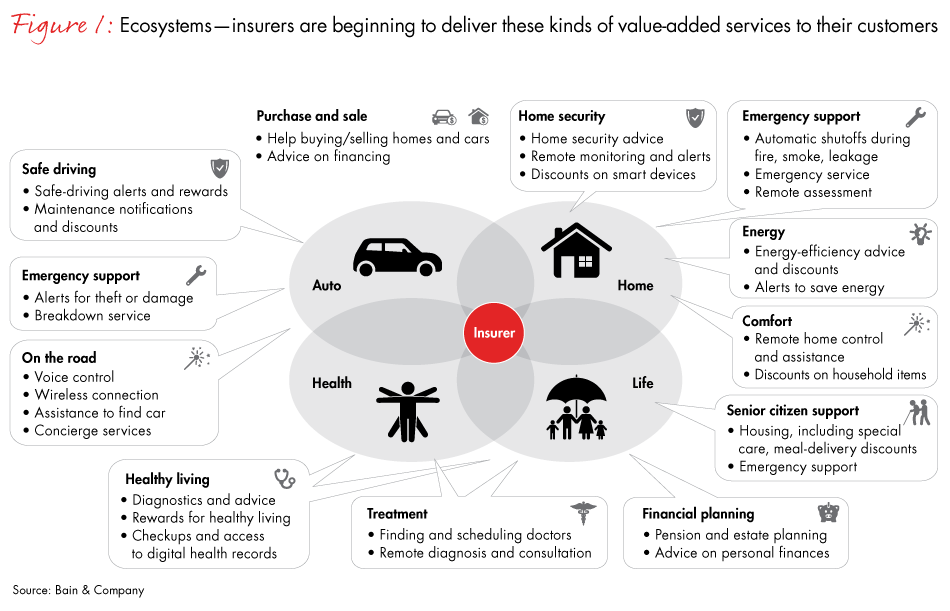
We’re also seeing insurers start to diversify beyond their core offering by building ecosystems of complementary products that trade off data from IoT devices such as home security monitoring, apps that promote healthy living, and safe driving rewards. This is all possible through application development and integration, and it all helps build customer loyalty and insights in a notoriously challenging sector.
Closing the Gap Between Insurers and InsurTech
Cementing the partnership between InsurTech and traditional insurers requires flexibility on both sides. InsurTechs need to come to grips with the insurance regulatory environment. Insurers need to find ways to unlock their legacy systems so they can be integrated with new applications. There’s also a cultural divide to conquer. Insurers can lack flexibility and manoeuvrability, and their cumbersome processes can be a source of frustration for InsurTechs who are used to surfing the front of the innovation wave.
Basically, insurers need to act more like InsurTechs, and InsurTechs need a way to align the advantages of their approach with insurers. An answer to this conundrum lies in digital factories, a way of working that brings together the relevant skills and knowledge from both sides of the equation to solve a problem or pain point. Using a low-code development platform, small teams can quickly scope out a product or process improvement, develop it, integrate it with legacy systems and test it, all in a short space of time. Experts in user experience, regulatory requirements, and business processes can be brought in as needed to keep the project on target and the results are transforming insurers. For example, a team at leading global insurer AXA built a web portal for its 3000+ brokers capable providing real-time claim tracking for 260,000 claims per year and integrating with legacy systems in just three months. Better customer experience, pain point elimination, streamlined processes – that’s an insurer acting like an InsurTech.
As the pace of transformation accelerates, we’ll see more insurers and InsurTechs partnering for mutual benefit. The digital factory approach and low-code development platforms allow them to start speaking a common language so that together they can bring a brave new world of tailored, personalised and practical insurance into existence.
By Nick Pike, VP UK and Ireland, OutSystems
Just 18 months ago, the insurance sector appeared to be in turmoil. Nine out of ten insurers surveyed by PWC feared losing part of their businesses to FinTechs or InsurTechs while there was “little responsiveness to emerging innovation waves” and “few organisations were putting InsurTech at the heart of their strategy.” Fast forward to 2018, and the message has hit home, kickstarting a transformation that is seeing insurers turn risk into opportunity by engaging with InsurTech companies. The upshot is that they’re choosing collaboration over competition to deliver innovative services for customers.
It’s a logical move that delivers benefits to both parties: where InsurTech has the “brain” to come up with innovative solutions, big insurers have the “brand” that is trusted by customers. Traditional insurers also have the experience of the regulatory environment that is a huge part of doing business in the sector. This realisation of the possibilities of partnership now sees more than half of insurers putting disruption at the heart of their strategy. So what kind of innovation are we seeing in the sector and what are the lingering challenges?
Data-driven Risk Insights Opening More Products to More Customers
Big data is the currency of the information economy. For insurers, being able to analyse up-to-the-minute risk data based on customer and policyholder requirements means they can offer individually tailored products while also taking into account the customer’s appetite for risk. It also means that some risks that were previously incalculable and therefore technically uninsurable can be assessed and specialist products offered.
We’ve also seen products that turn the system on its head such as “pay as you use” insurance. LAKA provides bike insurance whereby customers pay nothing until claims are made with the monthly premium never exceeding an agreed maximum. The power here lies in the fellowship of the biking community, which helps fellow cyclists get back on the road when they suffer theft or accident. It appeals to customers on an emotional as well as an economical level – something that can’t often be said for financial products! Signing up for its app takes just five minutes: another customer win for a time-poor world. LAKA is an example of an InsurTech innovator that is partnering with a traditional brand, Zurich in this case, as part of the latter’s newly launched Innovation Foundry, designed to foster exactly the sort of lateral thinking that will transform the industry.
Multiplatform Delivery and Portfolio Diversification
Insurers recognise that customers live multiple technology lives and expect to move seamlessly between platforms and devices. But the devices themselves offer intrinsic benefits when it comes to claims handling and processing, thanks to the tech power that is now in customers’ hands. Take car insurance, for example. Gone are the days of scrambling for a pen and paper to exchange details with other drivers. Now, when an accident takes place, the stranded customer can start the claims process from their insurance app, taking photos of the damage and submitting them directly to the claims portal. The claims process is automated, minimising the risk of human error and speeding up the entire experience. Mobile location data can be used to pinpoint the customer’s location and recovery or medical services despatched without delay. Offering a service like this builds brand loyalty. Customers see the insurer as a reliable partner in times of trouble – very appealing for a sector that previously was in a race to the bottom to compete on price.
We’re also seeing insurers start to diversify beyond their core offering by building ecosystems of complementary products that trade off data from IoT devices such as home security monitoring, apps that promote healthy living, and safe driving rewards. This is all possible through application development and integration, and it all helps build customer loyalty and insights in a notoriously challenging sector.
Closing the Gap Between Insurers and InsurTech
Cementing the partnership between InsurTech and traditional insurers requires flexibility on both sides. InsurTechs need to come to grips with the insurance regulatory environment. Insurers need to find ways to unlock their legacy systems so they can be integrated with new applications. There’s also a cultural divide to conquer. Insurers can lack flexibility and manoeuvrability, and their cumbersome processes can be a source of frustration for InsurTechs who are used to surfing the front of the innovation wave.
Basically, insurers need to act more like InsurTechs, and InsurTechs need a way to align the advantages of their approach with insurers. An answer to this conundrum lies in digital factories, a way of working that brings together the relevant skills and knowledge from both sides of the equation to solve a problem or pain point. Using a low-code development platform, small teams can quickly scope out a product or process improvement, develop it, integrate it with legacy systems and test it, all in a short space of time. Experts in user experience, regulatory requirements, and business processes can be brought in as needed to keep the project on target and the results are transforming insurers. For example, a team at leading global insurer AXA built a web portal for its 3000+ brokers capable providing real-time claim tracking for 260,000 claims per year and integrating with legacy systems in just three months. Better customer experience, pain point elimination, streamlined processes – that’s an insurer acting like an InsurTech.
As the pace of transformation accelerates, we’ll see more insurers and InsurTechs partnering for mutual benefit. The digital factory approach and low-code development platforms allow them to start speaking a common language so that together they can bring a brave new world of tailored, personalised and practical insurance into existence.
Explore more articles in the Top Stories category