
Top Stories
Boon or Bane? Malaysian Island Reclamation Plan Divides Residents
Published by linker 5
Posted on February 23, 2021
6 min readLast updated: January 21, 2026
Add as preferred source on Google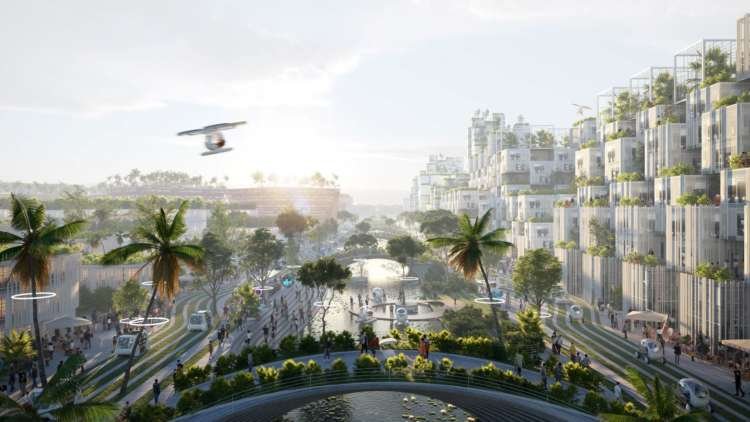
Published by linker 5
Posted on February 23, 2021
6 min readLast updated: January 21, 2026
Add as preferred source on GoogleBy Rina Chandran
(Thomson Reuters Foundation) – The island of Penang on the northwest coast of Malaysia is known for its sandy beaches, the colourful wall murals of its capital Georgetown, and its fiery street food.
In time, it will also be known for three man-made islands that state authorities say are needed to provide housing and economic opportunities for an expanding population, while also generating funds for a modern transport network.
But the Penang South Reclamation (PSR) project, dubbed BiodiverCity, has pitted the government and businesses against fishermen and environmentalists who say it will wreck the lives of residents, and damage the coast.
“The area is rich in prawns and fish. If you build islands, what we will see is permanent environmental degradation,” said Mahadi Md Rodzi, chairman of the Penang Fishermen’s Association that represents about 6,000 fisherman.
“Fishermen have been told to upskill or get another job, but many of us are born fishermen and depend on the sea to live. The proposed compensation from the state is too insufficient for something that will affect our livelihoods forever,” he said.
Many fishermen have rejected the 20,000-ringitt ($4,950) compensation offered, as well as the Environmental Impact Assessment report, which conservationists say does not reflect the potential damage or propose adequate mitigation measures.
Authorities say BiodiverCity, which is a part of the Penang 2030 vision of improving liveability and sustainability, will be a “socially and economically inclusive development” with an emphasis on green spaces, clean energy and car-free transport.
The 4,500-acre (1,821 hectares) project comprising three lilypad-shaped islands will house about 15,000 people each, and use natural and recycled materials such as bamboo and timber for construction of homes and offices, according to the plan.
But the scale of the dredging and reclamation work over more than a decade will cause “massive and long-term environmental destruction”, said Evelyn Teh, an environmental researcher in Penang.
“Fifteen years of land reclamation is a long onslaught to any marine ecology and the fishery industry that depends on it. The reclaimed islands will bury existing fishing areas while deteriorating the surrounding marine water quality,” she said.
“Coastal communities who rely on the marine and coastal area for their livelihood will experience an irreversible negative impact,” she told the Thomson Reuters Foundation.
‘COLOSSAL MISAPPROPRIATION’
From Denmark to Singapore, planners have reclaimed land from the sea for decades for offices, apartments and tourism.
Cities and island states that are running out of space are reclaiming land, expanding vertically or going underground.
A United Nations-backed partnership is studying the prospect of floating cities that can help coastal cities at risk of flooding from worsening climate-change impacts.
In Asia, land reclamation has become a contentious issue, with Cambodia and Malaysia banning sand exports, while Jakarta has suspended its reclamation project, and a plan to build an artificial island in Hong Kong has drawn fierce criticism.
Malaysia has two other major reclamation projects underway: Melaka Gateway, a deep-sea-port and cruise terminal that is part of China’s massive Belt and Road infrastructure plan, and Forest City in Johor near Singapore, aimed at foreign investors.
Large-scale reclamation allows more flexibility in city planning, but also lets governments engage “more ambitiously and aggressively with the business of land-banking,” said Keng-Khoon Ng, a lecturer at UCSI University Kuala Lumpur.
“These island-making projects are designed to boost state coffers. They represent a colossal misappropriation of resources at a time of intensifying housing unaffordability and social injustice,” he said.
But the PSR is needed as Penang has “run out of land”, resulting in ad-hoc developments, fewer economic opportunities, and a shortage of affordable housing, said Eddie Chan, executive director of SRS Consortium, the project developer.
A quarter of residential units will be earmarked for affordable housing in the average price range of 350,000 ringgit, and a fishermen’s taskforce set up by the state government is addressing any social impacts, he said.
“With proper design and construction methods applied to dredging and reclamation, and pollution prevention and mitigation measures to minimise environmental impact, we are confident that reclamation can be done sustainably,” Chan said.
RADICAL RETHINK
The PSR project, designed by Copenhagen-based Bjarke Ingels Group (BIG), is scheduled to break ground in March after approvals.
Reclamation has hugely benefited Penang, with parts of the Bayan Lepas industrial zone, as well as heritage clan jetties built on reclaimed land, said Joshua Woo, a former local councillor.
“There are fancy land reclamation projects for the wealthy, but there are also land reclamation projects for a city’s survival. PSR belongs to the latter group,” he said.
“The project will open up new economic opportunities and social spaces for us,” he added.
In fact, PSR is a “feasible solution” to address urgent environmental issues such as climate change and sea-level rises, said Farizan Darus, chief executive of government agency Penang Infrastructure Corporation that is overseeing the project.
“More than half of Penang island is hilly terrain, therefore the next best approach is land reclamation,” he said.
“Without strategic land, Penang’s growth will be stunted. Now is the best time to implement PSR to provide a much-needed economic boost to Penang, and prepare the state for the post-pandemic economy,” he added.
Meanwhile, an online petition by a local heritage advocate against the project, has garnered more than 115,000 signatures, while a group of residents have held several protests under the Penang Tolak Tambak (Penang Rejects Reclamation) banner.
In building PSR and using it to fund the 46-billion ringgit ($11.4 billion) transport network, the state is taking on a huge financial risk during an economic slowdown, and putting commercial interests above the environment and people, said Teh.
Particularly now, when the coronavirus pandemic has revealed deep-rooted inequalities in urbanisation, authorities should instead favour a “radical rethink on building back better”, she said, including low-carbon public transport networks.
“The government risks putting too much focus on a massively expensive and environmentally destructive project that will only benefit a small group of people at the expense of the wider population during an unprecedented economic crisis,” Teh said.
“Penang may be biting off more than it can chew.”
($1 = 4.03691 Malaysian ringgit)
(Reporting by Rina Chandran in Bangkok, with additional reporting by Beh Lih Yi in Kuala Lumpur; Editing by Astrid Zweynert. Please credit the Thomson Reuters Foundation, the charitable arm of Thomson Reuters, that covers the lives of people around the world who struggle to live freely or fairly. Visit http://news.trust.org)
Explore more articles in the Top Stories category











