Search
00
GBAF Logo
trophy
Top StoriesInterviewsBusinessFinanceBankingTechnologyInvestingTradingVideosAwardsMagazinesHeadlinesTrends

Subscribe to our newsletter

Get the latest news and updates from our team.

Global Banking & Finance Review®

Global Banking & Finance Review® - Subscribe to our newsletter

Company

    GBAF Logo
    • About Us
    • Profile
    • Privacy & Cookie Policy
    • Terms of Use
    • Contact Us
    • Advertising
    • Submit Post
    • Latest News
    • Research Reports
    • Press Release
    • Awards▾
      • About the Awards
      • Awards TimeTable
      • Submit Nominations
      • Testimonials
      • Media Room
      • Award Winners
      • FAQ
    • Magazines▾
      • Global Banking & Finance Review Magazine Issue 79
      • Global Banking & Finance Review Magazine Issue 78
      • Global Banking & Finance Review Magazine Issue 77
      • Global Banking & Finance Review Magazine Issue 76
      • Global Banking & Finance Review Magazine Issue 75
      • Global Banking & Finance Review Magazine Issue 73
      • Global Banking & Finance Review Magazine Issue 71
      • Global Banking & Finance Review Magazine Issue 70
      • Global Banking & Finance Review Magazine Issue 69
      • Global Banking & Finance Review Magazine Issue 66
    Top StoriesInterviewsBusinessFinanceBankingTechnologyInvestingTradingVideosAwardsMagazinesHeadlinesTrends

    Global Banking & Finance Review® is a leading financial portal and online magazine offering News, Analysis, Opinion, Reviews, Interviews & Videos from the world of Banking, Finance, Business, Trading, Technology, Investing, Brokerage, Foreign Exchange, Tax & Legal, Islamic Finance, Asset & Wealth Management.
    Copyright © 2010-2026 GBAF Publications Ltd - All Rights Reserved. | Sitemap | Tags | Developed By eCorpIT

    Editorial & Advertiser disclosure

    Global Banking & Finance Review® is an online platform offering news, analysis, and opinion on the latest trends, developments, and innovations in the banking and finance industry worldwide. The platform covers a diverse range of topics, including banking, insurance, investment, wealth management, fintech, and regulatory issues. The website publishes news, press releases, opinion and advertorials on various financial organizations, products and services which are commissioned from various Companies, Organizations, PR agencies, Bloggers etc. These commissioned articles are commercial in nature. This is not to be considered as financial advice and should be considered only for information purposes. It does not reflect the views or opinion of our website and is not to be considered an endorsement or a recommendation. We cannot guarantee the accuracy or applicability of any information provided with respect to your individual or personal circumstances. Please seek Professional advice from a qualified professional before making any financial decisions. We link to various third-party websites, affiliate sales networks, and to our advertising partners websites. When you view or click on certain links available on our articles, our partners may compensate us for displaying the content to you or make a purchase or fill a form. This will not incur any additional charges to you. To make things simpler for you to identity or distinguish advertised or sponsored articles or links, you may consider all articles or links hosted on our site as a commercial article placement. We will not be responsible for any loss you may suffer as a result of any omission or inaccuracy on the website.

    Home > Top Stories > Below a pyramid, a treasure trove sheds new light on ancient Mexican rites
    Top Stories

    Below a pyramid, a treasure trove sheds new light on ancient Mexican rites

    Published by Jessica Weisman-Pitts

    Posted on September 1, 2021

    9 min read

    Last updated: January 21, 2026

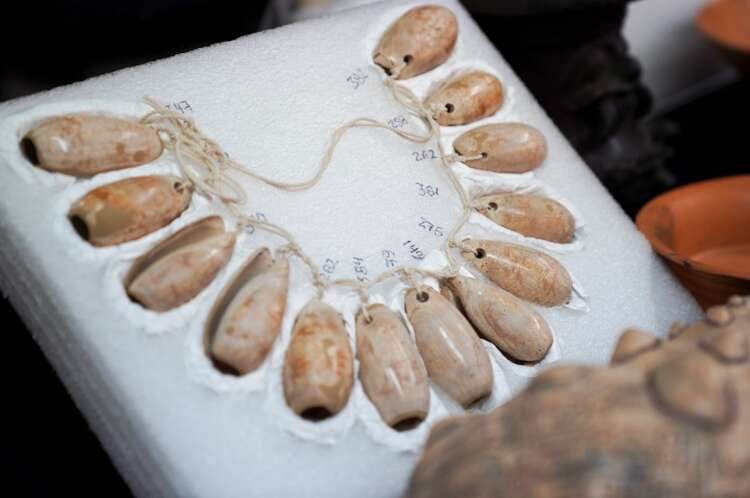
    This image captures the excavation site beneath the Feathered Serpent Pyramid in Teotihuacan, where over 100,000 sacred artifacts are being studied, revealing the rich cultural rituals of ancient Mexico.
    Excavation site under Teotihuacan pyramid showcasing ancient artifacts - Global Banking & Finance Review
    Why waste money on news and opinion when you can access them for free?

    Take advantage of our newsletter subscription and stay informed on the go!

    Subscribe

    By David Alire Garcia

    TEOTIHUACAN, Mexico (Reuters) – More than a decade after Sergio Gomez began excavating a tunnel under a towering Mexican pyramid, the archeologist still spends most of his time studying the massive cache of sacred artifacts carefully placed there by priests some 2,000 years ago.

    The volume and variety of objects hidden in the sealed tunnel under Teotihuacan’s ornate Feathered Serpent Pyramid has shattered records for discoveries at the ancient city, once the most populous metropolis of the Americas and now a top tourist draw just outside modern-day Mexico City.

    Over 100,000 artifacts from the tunnel have been cataloged so far, ranging from finely-carved statues, jewelry, shells, and ceramics as well as thousands of wooden and metallic objects that mostly survived the passage of time intact.

    On a recent tour of the tunnel and conservation workshops where his 30-member team pores over the trove, Gomez showed off some of the dig’s most spectacular and until now unreported finds – all part of ceremonial offerings left along the 100-meter-long (330 ft) tunnel, which ended in three chambers directly under the pyramid’s mid-point.

    “Can you see it?” Gomez asked, shining the light of his cellphone on a tennis-ball-sized carved amber sphere he picked up from a workshop table. Illuminated, it looks like molten lava.

    It is the first time an ornament made from amber has turned up in Teotihuacan. Found with a small top and residue inside that awaits further analysis – Gomez speculates it may be tobacco – it likely hung around a priest’s neck.

    As in other ancient Mexican societies, the priests who entered the tunnel likely ingested hallucinogenic plants or mushrooms as part of rituals, Gomez said.

    The tunnel, which is tall enough in most places to walk through and is around 12 meters (40 ft) underground, was designed to dazzle, he explained. The walls and even the floor were coated with fine bits of iron pyrite, popularly known as fool’s gold due to its resemblance to the precious metal.

    “We can imagine when the priests entered with a torch how it would have sparkled as the flame moved,” said Gomez, who believes the tunnel was made to recreate the underworld of their cosmovision and used to initiate new rulers.

    Scientific dating shows that the damp, never-looted space was in use for more than two centuries through 250 A.D.

    Teotihuacan, a wealthy contemporary of ancient Rome and Han China, thrived from about 100 B.C. to 550 A.D. and was home to up to 200,000 people mostly living in multi-family stone compounds painted with colorful murals.

    Much is unknown about them, including what language they spoke and whether they developed a system of writing https://www.reuters.com/article/us-mexico-tourism-teotihuacan-feature/beyond-public-view-scholars-unravel-mystery-of-writing-in-ancient-mexican-city-idUSKCN26D1AG akin to that of the Aztecs, who dominated the area some eight centuries after Teotihuacan’s fall and revered the ruins.

    FINAL DISCOVERY

    Walking through the now-empty tunnel, Gomez stops where a large offering was found. He describes 17 separate layers of shells meticulously laid down by priests, one on top of the other, with the bottom layers crushed.

    “But that’s because they themselves were stepping on them,” he said.

    Gomez stresses that his dozen-year excavation of the tunnel, which had filled with mud over the centuries, was equally meticulous, so much so that bits of human hair and even skin were likely recovered.

    It appears that ceremonies in the tunnel involved the offering of gifts to the lords of the underworld, and to the city’s main deity, the storm god. Several dozen nearly-identical shiny black jars sculpted to resemble the latter have been discovered.

    Among the richest offerings are hundreds of objects made of so-called imperial jade, one of the world’s most expensive gems, including ear spools, necklaces and pendants – one in the form of a crocodile.

    Several thousand once-glittering iron pyrite pieces were unearthed. Possibly imported from as far away as Honduras, they include beads, disks and even the bottom half of a cup.

    Around 8,000 wooden objects – plates, bowls and more – were unearthed, as well as the skulls and claws of some three dozen animal species, especially predators like jaguars and pumas.

    Beyond traditional restoration work, Gomez’s team is also developing three-dimensional digital recreations of the artifacts as they originally would have appeared, so they can eventually be accessed online.

    The final physical discovery made in late July proved especially satisfying for Gomez.

    In a circular pit carved into the tunnel floor previously missed by laser scans, priests had tossed four bunches of flowers. On top, they placed a heap of wood, handfuls of corn, chile, and nopal seeds, plus a miniature stone carved pyramid.

    Finally, they set it all on fire.

    Thanks to the charred wood, Gomez will soon be able to pinpoint the year the smoky ritual took place.

    The flowers were unprecedented, the first time intact plant remains have been found at Teotihuacan.

    “It’s just so unique,” he said, hunching down just off the pit, wiping his brow.

    “It makes you feel so close to the people who were here.”

    (Reporting by David Alire Garcia; Editing by Dave Graham and Rosalba O’Brien)

    By David Alire Garcia

    TEOTIHUACAN, Mexico (Reuters) – More than a decade after Sergio Gomez began excavating a tunnel under a towering Mexican pyramid, the archeologist still spends most of his time studying the massive cache of sacred artifacts carefully placed there by priests some 2,000 years ago.

    The volume and variety of objects hidden in the sealed tunnel under Teotihuacan’s ornate Feathered Serpent Pyramid has shattered records for discoveries at the ancient city, once the most populous metropolis of the Americas and now a top tourist draw just outside modern-day Mexico City.

    Over 100,000 artifacts from the tunnel have been cataloged so far, ranging from finely-carved statues, jewelry, shells, and ceramics as well as thousands of wooden and metallic objects that mostly survived the passage of time intact.

    On a recent tour of the tunnel and conservation workshops where his 30-member team pores over the trove, Gomez showed off some of the dig’s most spectacular and until now unreported finds – all part of ceremonial offerings left along the 100-meter-long (330 ft) tunnel, which ended in three chambers directly under the pyramid’s mid-point.

    “Can you see it?” Gomez asked, shining the light of his cellphone on a tennis-ball-sized carved amber sphere he picked up from a workshop table. Illuminated, it looks like molten lava.

    It is the first time an ornament made from amber has turned up in Teotihuacan. Found with a small top and residue inside that awaits further analysis – Gomez speculates it may be tobacco – it likely hung around a priest’s neck.

    As in other ancient Mexican societies, the priests who entered the tunnel likely ingested hallucinogenic plants or mushrooms as part of rituals, Gomez said.

    The tunnel, which is tall enough in most places to walk through and is around 12 meters (40 ft) underground, was designed to dazzle, he explained. The walls and even the floor were coated with fine bits of iron pyrite, popularly known as fool’s gold due to its resemblance to the precious metal.

    “We can imagine when the priests entered with a torch how it would have sparkled as the flame moved,” said Gomez, who believes the tunnel was made to recreate the underworld of their cosmovision and used to initiate new rulers.

    Scientific dating shows that the damp, never-looted space was in use for more than two centuries through 250 A.D.

    Teotihuacan, a wealthy contemporary of ancient Rome and Han China, thrived from about 100 B.C. to 550 A.D. and was home to up to 200,000 people mostly living in multi-family stone compounds painted with colorful murals.

    Much is unknown about them, including what language they spoke and whether they developed a system of writing https://www.reuters.com/article/us-mexico-tourism-teotihuacan-feature/beyond-public-view-scholars-unravel-mystery-of-writing-in-ancient-mexican-city-idUSKCN26D1AG akin to that of the Aztecs, who dominated the area some eight centuries after Teotihuacan’s fall and revered the ruins.

    FINAL DISCOVERY

    Walking through the now-empty tunnel, Gomez stops where a large offering was found. He describes 17 separate layers of shells meticulously laid down by priests, one on top of the other, with the bottom layers crushed.

    “But that’s because they themselves were stepping on them,” he said.

    Gomez stresses that his dozen-year excavation of the tunnel, which had filled with mud over the centuries, was equally meticulous, so much so that bits of human hair and even skin were likely recovered.

    It appears that ceremonies in the tunnel involved the offering of gifts to the lords of the underworld, and to the city’s main deity, the storm god. Several dozen nearly-identical shiny black jars sculpted to resemble the latter have been discovered.

    Among the richest offerings are hundreds of objects made of so-called imperial jade, one of the world’s most expensive gems, including ear spools, necklaces and pendants – one in the form of a crocodile.

    Several thousand once-glittering iron pyrite pieces were unearthed. Possibly imported from as far away as Honduras, they include beads, disks and even the bottom half of a cup.

    Around 8,000 wooden objects – plates, bowls and more – were unearthed, as well as the skulls and claws of some three dozen animal species, especially predators like jaguars and pumas.

    Beyond traditional restoration work, Gomez’s team is also developing three-dimensional digital recreations of the artifacts as they originally would have appeared, so they can eventually be accessed online.

    The final physical discovery made in late July proved especially satisfying for Gomez.

    In a circular pit carved into the tunnel floor previously missed by laser scans, priests had tossed four bunches of flowers. On top, they placed a heap of wood, handfuls of corn, chile, and nopal seeds, plus a miniature stone carved pyramid.

    Finally, they set it all on fire.

    Thanks to the charred wood, Gomez will soon be able to pinpoint the year the smoky ritual took place.

    The flowers were unprecedented, the first time intact plant remains have been found at Teotihuacan.

    “It’s just so unique,” he said, hunching down just off the pit, wiping his brow.

    “It makes you feel so close to the people who were here.”

    (Reporting by David Alire Garcia; Editing by Dave Graham and Rosalba O’Brien)

    More from Top Stories

    Explore more articles in the Top Stories category

    Image for Lessons From the Ring and the Deal Table: How Boxing Shapes Steven Nigro’s Approach to Banking and Life
    Lessons From the Ring and the Deal Table: How Boxing Shapes Steven Nigro’s Approach to Banking and Life
    Image for Joe Kiani in 2025: Capital, Conviction, and a Focused Return to Innovation
    Joe Kiani in 2025: Capital, Conviction, and a Focused Return to Innovation
    Image for Marco Robinson – CLOSE THE DEAL AND SUDDENLY GROW RICH
    Marco Robinson – CLOSE THE DEAL AND SUDDENLY GROW RICH
    Image for Digital Tracing: Turning a regulatory obligation into a commercial advantage
    Digital Tracing: Turning a regulatory obligation into a commercial advantage
    Image for Exploring the Role of Blockchain and the Bitcoin Price Today in Education
    Exploring the Role of Blockchain and the Bitcoin Price Today in Education
    Image for Inside the World’s First Collection Industry Conglomerate: PCA Global’s Platform Strategy
    Inside the World’s First Collection Industry Conglomerate: PCA Global’s Platform Strategy
    Image for Chase Buchanan Private Wealth Management Highlights Key Autumn 2025 Budget Takeaways for Expats
    Chase Buchanan Private Wealth Management Highlights Key Autumn 2025 Budget Takeaways for Expats
    Image for PayLaju Strengthens Its Position as Malaysia’s Trusted Interest-Free Sharia-Compliant Loan Provider
    PayLaju Strengthens Its Position as Malaysia’s Trusted Interest-Free Sharia-Compliant Loan Provider
    Image for A Notable Update for Employee Health Benefits:
    A Notable Update for Employee Health Benefits:
    Image for Creating Equity Between Walls: How Mohak Chauhan is Using Engineering, Finance, and Community Vision to Reengineer Affordable Housing
    Creating Equity Between Walls: How Mohak Chauhan is Using Engineering, Finance, and Community Vision to Reengineer Affordable Housing
    Image for Upcoming Book on Real Estate Investing: Harvard Grace Capital Founder Stewart Heath’s Puts Lessons in Print
    Upcoming Book on Real Estate Investing: Harvard Grace Capital Founder Stewart Heath’s Puts Lessons in Print
    Image for ELECTIVA MARKS A LANDMARK FIRST YEAR WITH MAJOR SENIOR APPOINTMENTS AND EXPANSION MILESTONES
    ELECTIVA MARKS A LANDMARK FIRST YEAR WITH MAJOR SENIOR APPOINTMENTS AND EXPANSION MILESTONES
    View All Top Stories Posts
    Previous Top Stories PostOne million without power as Ida leaves trail of destruction
    Next Top Stories PostJapan finds stainless steel particles in suspended doses of Moderna vaccine