Search
00
GBAF Logo
trophy
Top StoriesInterviewsBusinessFinanceBankingTechnologyInvestingTradingVideosAwardsMagazinesHeadlinesTrends

Subscribe to our newsletter

Get the latest news and updates from our team.

Global Banking & Finance Review®

Global Banking & Finance Review® - Subscribe to our newsletter

Company

    GBAF Logo
    • About Us
    • Profile
    • Privacy & Cookie Policy
    • Terms of Use
    • Contact Us
    • Advertising
    • Submit Post
    • Latest News
    • Research Reports
    • Press Release
    • Awards▾
      • About the Awards
      • Awards TimeTable
      • Submit Nominations
      • Testimonials
      • Media Room
      • Award Winners
      • FAQ
    • Magazines▾
      • Global Banking & Finance Review Magazine Issue 79
      • Global Banking & Finance Review Magazine Issue 78
      • Global Banking & Finance Review Magazine Issue 77
      • Global Banking & Finance Review Magazine Issue 76
      • Global Banking & Finance Review Magazine Issue 75
      • Global Banking & Finance Review Magazine Issue 73
      • Global Banking & Finance Review Magazine Issue 71
      • Global Banking & Finance Review Magazine Issue 70
      • Global Banking & Finance Review Magazine Issue 69
      • Global Banking & Finance Review Magazine Issue 66
    Top StoriesInterviewsBusinessFinanceBankingTechnologyInvestingTradingVideosAwardsMagazinesHeadlinesTrends

    Global Banking & Finance Review® is a leading financial portal and online magazine offering News, Analysis, Opinion, Reviews, Interviews & Videos from the world of Banking, Finance, Business, Trading, Technology, Investing, Brokerage, Foreign Exchange, Tax & Legal, Islamic Finance, Asset & Wealth Management.
    Copyright © 2010-2026 GBAF Publications Ltd - All Rights Reserved. | Sitemap | Tags | Developed By eCorpIT

    Editorial & Advertiser disclosure

    Global Banking & Finance Review® is an online platform offering news, analysis, and opinion on the latest trends, developments, and innovations in the banking and finance industry worldwide. The platform covers a diverse range of topics, including banking, insurance, investment, wealth management, fintech, and regulatory issues. The website publishes news, press releases, opinion and advertorials on various financial organizations, products and services which are commissioned from various Companies, Organizations, PR agencies, Bloggers etc. These commissioned articles are commercial in nature. This is not to be considered as financial advice and should be considered only for information purposes. It does not reflect the views or opinion of our website and is not to be considered an endorsement or a recommendation. We cannot guarantee the accuracy or applicability of any information provided with respect to your individual or personal circumstances. Please seek Professional advice from a qualified professional before making any financial decisions. We link to various third-party websites, affiliate sales networks, and to our advertising partners websites. When you view or click on certain links available on our articles, our partners may compensate us for displaying the content to you or make a purchase or fill a form. This will not incur any additional charges to you. To make things simpler for you to identity or distinguish advertised or sponsored articles or links, you may consider all articles or links hosted on our site as a commercial article placement. We will not be responsible for any loss you may suffer as a result of any omission or inaccuracy on the website.

    Home > Top Stories > Banking turmoil means recession fears are creeping back
    Top Stories

    Banking turmoil means recession fears are creeping back

    Published by Uma Rajagopal

    Posted on March 29, 2023

    4 min read

    Last updated: February 2, 2026

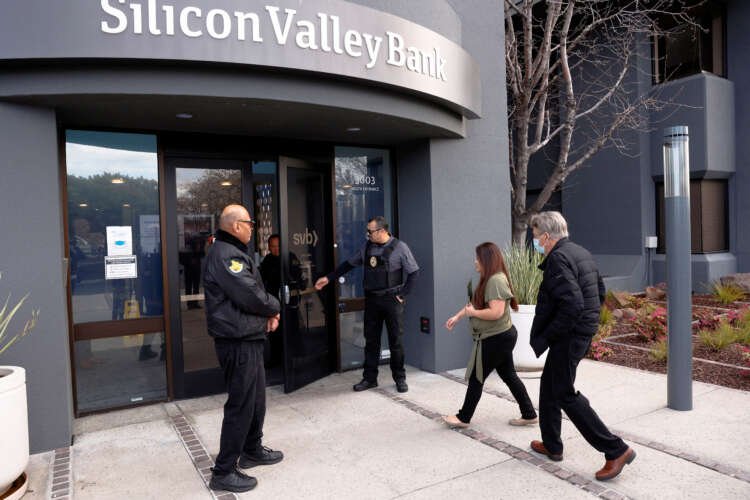
    Image of a Silicon Valley Bank branch in Santa Clara, CA, representing the recent banking turmoil and its implications for a potential recession, as discussed in the article.
    Silicon Valley Bank branch reflecting banking turmoil and recession fears - Global Banking & Finance Review
    Why waste money on news and opinion when you can access them for free?

    Take advantage of our newsletter subscription and stay informed on the go!

    Subscribe

    Tags:financial crisiseconomic growthcredit crunchinterest rates

    Quick Summary

    (Reuters) – The failures of U.S. lenders Silicon Valley Bank (SVB) and Signature Bank, followed by Credit Suisse’s rescue, and the ensuing turmoil in world markets have re-ignited the recession risks that appeared to have abated just a few weeks ago.

    (Reuters) – The failures of U.S. lenders Silicon Valley Bank (SVB) and Signature Bank, followed by Credit Suisse’s rescue, and the ensuing turmoil in world markets have re-ignited the recession risks that appeared to have abated just a few weeks ago.

    Traders now bet the Federal Reserve is practically done hiking interest rates. Optimism that followed China’s economic reopening and tumbling energy prices early this year has dimmed.

    “The bigger, medium-term implication, of what’s happened in the last month is that global growth will be far weaker in six months than we thought even just a few weeks ago,” said Mike Riddell, senior fixed income portfolio manager at Allianz Global Investors.

    Here’s what some closely watched market indicators say about recession risks:

    1/ CRUNCH TIME?

    Central bankers are closely monitoring the potential for banking stress, on top of lending conditions that were already tightening, to trigger a credit crunch.

    Fed chief Jerome Powell believes financial conditions have likely tightened more than traditional measures indicate. European Central Bank boss Christine Lagarde has also said the market turmoil may help fight inflation.

    Goldman Sachs reckons the tightening in bank lending standards it expects could subtract at least 0.25 to 0.5 percentage points from 2023 U.S. economic growth, equivalent to the impact of another 25-50 bps of Fed rate hikes.

    AXA Investment Managers Chief Economist Gilles Moec noted small and big U.S. banks were borrowing heavily and holding onto cash, citing Fed data showing bank asset and liability positions as of March 15.

    “There is a sizeable risk that the ongoing banking trouble triggers a ‘sudden stop’ in lending which would then send the economy into the sort of recession which would go beyond what is strictly needed to tame inflation,” he added.

    GRAPHIC: Bank stocks tumble after SVB, Signature Bank collapse- https://www.reuters.com/graphics/GLOBAL-BANKS/gdpzqkermvw/chart.png

    2/ CUTS NOT HIKES

    As the outlook darkens, traders were betting on Tuesday another Fed rate hike is a coin toss, with over 50 bps worth of rate cuts priced by year-end. ECB rates are seen peaking at around 3.4%, down from over 4% in early March

    This has pushed shorter-dated borrowing costs down. U.S. two-year bond yields have dropped 80 bps in March, so yield curves are less inverted than prior to SVB’s collapse.

    While inverted yield curves, where long-dated borrowing costs are lower than shorter-dated ones, are good recession predictors, inversion has been followed by steepening as past recessions neared.

    The U.S. two-year/10-year yield curve has steepened over 40 bps this month, the biggest monthly steepening since 2009.

    GRAPHIC: Inverted U.S. yield curve steepens sharply- https://www.reuters.com/graphics/GLOBAL-MARKETS/egvbyjerdpq/chart.png

    3/ BANK STOCK ROUT

    World shares down just 0.1% in March and still sitting on gains this year seem to signal little recession risk, but worries are mounting under the surface.

    Global bank stocks, which had outperformed the MSCI World Stock Index before the turmoil, are down nearly 15% this month. Sectors sensitive to the growth outlook such as real estate and oil and gas are also now underperforming.

    Banking woes have also pushed up the risk premium on corporate debt. Euro high yield spreads over risk-free rates for example jumped 140 basis points from March 9 to March 20.

    Still, those spreads remain below highs touched last year and far below levels reached during the 2020 COVID-19 pandemic, suggesting recession concerns in credit markets appear limited.

    GRAPHIC: Economically sensitive sectors falter- https://fingfx.thomsonreuters.com/gfx/mkt/myvmobwnmvr/stocks%20march%2028.png

    4/ DR. COPPER

    Copper, nicknamed “Dr Copper” for its track record as a boom-bust indicator, is still up 7% this year. But it has lost some of its early-January gusto, reflecting market uncertainty and as demand from China – the world’s largest commodity consumer – hasn’t rocketed as expected after its re-opening.

    The price ratio of copper to gold – seen as a gauge of risk appetite – hit its lowest in nearly seven months in March as investors ditched assets more closely linked to the underlying economy for safe havens.

    5/ WHAT RECESSION?

    Data is still delivering positive surprises at the highest rate since May 2022, a Citi index shows, suggesting economic statistics are not yet flashing a recession warning.

    U.S. and euro zone business activity meanwhile accelerated more than expected in March.

    “The (U.S.) data was largely collected after SVB’s collapse, which suggests that the initial negative impact from uncertainty has been modest,” said Kristoffer Kjær Lomholt, head of FX, corporate research and chief analyst at Danske Bank.

    GRAPHIC: Global business activity strengthened in March Global business activity strengthened in March- https://www.reuters.com/graphics/GLOBAL-ECONOMY/PMI/gkvlwbaonpb/chart.png

    (Reporting by Yoruk Bahceli, Naomi Rovnick, Chiara Elisei, Amanda Cooper, additional reporting by Peter Hobson; Compiled by Yoruk Bahceli; Graphics by Vincent Flasseur; Editing by Dhara Ranasinghe and Andrea Ricci)

    Frequently Asked Questions about Banking turmoil means recession fears are creeping back

    1What is a financial crisis?

    A financial crisis is a situation in which the value of financial institutions or assets drops significantly, leading to widespread economic instability and often resulting in bank failures.

    2What is economic growth?

    Economic growth refers to an increase in the production of goods and services in an economy over a period of time, typically measured by GDP.

    3What is a credit crunch?

    A credit crunch is a situation where there is a sudden reduction in the general availability of loans or credit, often due to economic downturns or banking crises.

    4What are interest rates?

    Interest rates are the cost of borrowing money or the return on savings, expressed as a percentage of the amount borrowed or saved.

    5What is banking turmoil?

    Banking turmoil refers to a period of instability in the banking sector, often characterized by bank failures, loss of confidence, and significant fluctuations in stock prices.

    More from Top Stories

    Explore more articles in the Top Stories category

    Image for Lessons From the Ring and the Deal Table: How Boxing Shapes Steven Nigro’s Approach to Banking and Life
    Lessons From the Ring and the Deal Table: How Boxing Shapes Steven Nigro’s Approach to Banking and Life
    Image for Joe Kiani in 2025: Capital, Conviction, and a Focused Return to Innovation
    Joe Kiani in 2025: Capital, Conviction, and a Focused Return to Innovation
    Image for Marco Robinson – CLOSE THE DEAL AND SUDDENLY GROW RICH
    Marco Robinson – CLOSE THE DEAL AND SUDDENLY GROW RICH
    Image for Digital Tracing: Turning a regulatory obligation into a commercial advantage
    Digital Tracing: Turning a regulatory obligation into a commercial advantage
    Image for Exploring the Role of Blockchain and the Bitcoin Price Today in Education
    Exploring the Role of Blockchain and the Bitcoin Price Today in Education
    Image for Inside the World’s First Collection Industry Conglomerate: PCA Global’s Platform Strategy
    Inside the World’s First Collection Industry Conglomerate: PCA Global’s Platform Strategy
    Image for Chase Buchanan Private Wealth Management Highlights Key Autumn 2025 Budget Takeaways for Expats
    Chase Buchanan Private Wealth Management Highlights Key Autumn 2025 Budget Takeaways for Expats
    Image for PayLaju Strengthens Its Position as Malaysia’s Trusted Interest-Free Sharia-Compliant Loan Provider
    PayLaju Strengthens Its Position as Malaysia’s Trusted Interest-Free Sharia-Compliant Loan Provider
    Image for A Notable Update for Employee Health Benefits:
    A Notable Update for Employee Health Benefits:
    Image for Creating Equity Between Walls: How Mohak Chauhan is Using Engineering, Finance, and Community Vision to Reengineer Affordable Housing
    Creating Equity Between Walls: How Mohak Chauhan is Using Engineering, Finance, and Community Vision to Reengineer Affordable Housing
    Image for Upcoming Book on Real Estate Investing: Harvard Grace Capital Founder Stewart Heath’s Puts Lessons in Print
    Upcoming Book on Real Estate Investing: Harvard Grace Capital Founder Stewart Heath’s Puts Lessons in Print
    Image for ELECTIVA MARKS A LANDMARK FIRST YEAR WITH MAJOR SENIOR APPOINTMENTS AND EXPANSION MILESTONES
    ELECTIVA MARKS A LANDMARK FIRST YEAR WITH MAJOR SENIOR APPOINTMENTS AND EXPANSION MILESTONES
    View All Top Stories Posts
    Previous Top Stories PostBritain’s Next sees lower clothing inflation, shares dip on cautious outlook
    Next Top Stories PostAsian stocks rally as bank jitters calm, Alibaba lifts mood