
Top Stories
Asian Stocks Edge up Before U.S. Jobs Data, Defying Wall Street Selloff
Published by Uma Rajagopal
Posted on January 6, 2023
3 min readLast updated: February 2, 2026
Add as preferred source on Google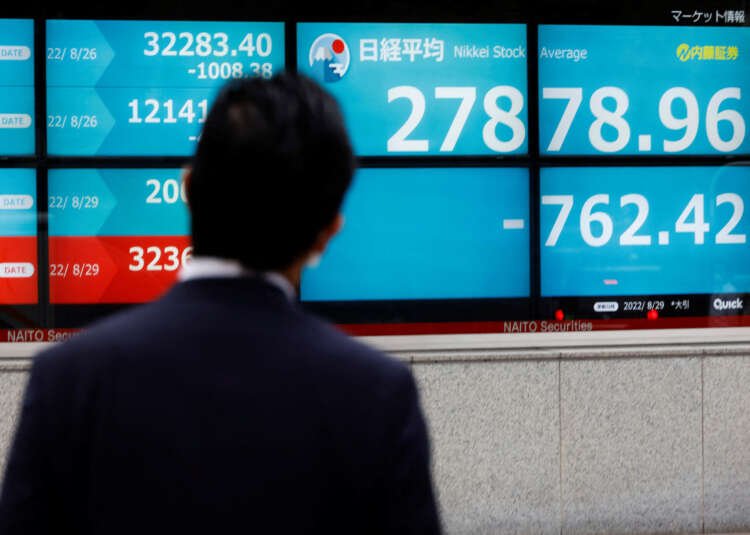
Published by Uma Rajagopal
Posted on January 6, 2023
3 min readLast updated: February 2, 2026
Add as preferred source on GoogleBy Kevin Buckland
TOKYO (Reuters) – Asian equities gained on Friday while the dollar hovered near a one-month high as investors braced for crucial U.S. jobs data later in the day that should provide clues on how aggressive the Federal Reserve will be in tightening policy.
Japan’s Nikkei rose 0.39%, while South Korea’s Kospi jumped 0.77%. Australia’s stock benchmark was 0.56% higher.
Hong Kong’s Hang Seng rallied 0.6%, although mainland blue chips <.CSI300) were flat in early trading.
MSCI’s broadest index of Asia-Pacific shares added 0.29%, putting it on track for a 1.55% advance for the first week of 2023, its best weekly performance in a month.
U.S. E-mini stock futures ticked up 0.35%, pointing to a small bounce after the 1.16% overnight slide for the S&P 500.
Wall Street sold off amid worries that a robustness in the jobs market would keep the Fed raising rates for longer, after data released on Thursday showed a bigger than expected rise in private payrolls and a drop in jobless claims.
“There is concern that the labor market isn’t showing any signs of cooling,” putting financial markets “very much on edge”, said Tony Sycamore, a market analyst at IG.
“But the important one is going to be tonight, and I don’t think the bogey man is going to be in the cupboard with tonight’s number.”
According to a Reuters survey of economists, non-farm payrolls are forecast to show on Friday that 200,000 jobs were created in December, easing from November’s 263,000 pace.
U.S. two-year Treasury yields spiked to a more than two-month high of 4.497% overnight but eased to 4.460% in Tokyo. The 10-year yield, which rose as high as 3.784% in New York, dropped to 3.726%.
The U.S. currency remained elevated versus major peers on Friday. The dollar index, which measures the greenback against six counterparts including the euro and yen, was trading little changed at 105.11 after jumping 0.91% overnight and touching 105.27 for the first time since Dec. 8.
The dollar index is up 1.57% this week, putting it on course to snap a streak of three losing weeks. It is shaping up for the best performance since late September.
The greenback added 0.27% to 133.755 yen, taking it back towards Thursday’s one-week high of 134.045.
The euro edged 0.09% higher to $1.05295, but remained close to the overnight low of $1.0515, a level last seen on Dec. 12.
Crude oil rose, extending gains from Thursday after data showed lower fuel inventories. [O/R]
Brent crude futures were last 79 cents, or 1%, higher at $79.48 a barrel. U.S. West Texas Intermediate crude futures were up 80 cents, or 1.1%, at $74.47 a barrel.
(Reporting by Kevin Buckland; Editing by Bradley Perrett)
Monetary policy refers to the actions taken by a country's central bank to control the money supply and interest rates to achieve macroeconomic objectives such as controlling inflation, consumption, growth, and liquidity.
Employment opportunities refer to the available jobs or positions within the labor market that individuals can apply for to earn income and contribute to the economy.
Economic growth is the increase in the production of goods and services in an economy over a period of time, typically measured by the rise in Gross Domestic Product (GDP).
The Federal Reserve, often referred to as the Fed, is the central bank of the United States, responsible for implementing monetary policy, regulating banks, and maintaining financial stability.
Explore more articles in the Top Stories category











