Search
00
GBAF Logo
trophy
Top StoriesInterviewsBusinessFinanceBankingTechnologyInvestingTradingVideosAwardsMagazinesHeadlinesTrends

Subscribe to our newsletter

Get the latest news and updates from our team.

Global Banking & Finance Review®

Global Banking & Finance Review® - Subscribe to our newsletter

Company

    GBAF Logo
    • About Us
    • Profile
    • Privacy & Cookie Policy
    • Terms of Use
    • Contact Us
    • Advertising
    • Submit Post
    • Latest News
    • Research Reports
    • Press Release
    • Awards▾
      • About the Awards
      • Awards TimeTable
      • Submit Nominations
      • Testimonials
      • Media Room
      • Award Winners
      • FAQ
    • Magazines▾
      • Global Banking & Finance Review Magazine Issue 79
      • Global Banking & Finance Review Magazine Issue 78
      • Global Banking & Finance Review Magazine Issue 77
      • Global Banking & Finance Review Magazine Issue 76
      • Global Banking & Finance Review Magazine Issue 75
      • Global Banking & Finance Review Magazine Issue 73
      • Global Banking & Finance Review Magazine Issue 71
      • Global Banking & Finance Review Magazine Issue 70
      • Global Banking & Finance Review Magazine Issue 69
      • Global Banking & Finance Review Magazine Issue 66
    Top StoriesInterviewsBusinessFinanceBankingTechnologyInvestingTradingVideosAwardsMagazinesHeadlinesTrends

    Global Banking & Finance Review® is a leading financial portal and online magazine offering News, Analysis, Opinion, Reviews, Interviews & Videos from the world of Banking, Finance, Business, Trading, Technology, Investing, Brokerage, Foreign Exchange, Tax & Legal, Islamic Finance, Asset & Wealth Management.
    Copyright © 2010-2026 GBAF Publications Ltd - All Rights Reserved. | Sitemap | Tags | Developed By eCorpIT

    Editorial & Advertiser disclosure

    Global Banking & Finance Review® is an online platform offering news, analysis, and opinion on the latest trends, developments, and innovations in the banking and finance industry worldwide. The platform covers a diverse range of topics, including banking, insurance, investment, wealth management, fintech, and regulatory issues. The website publishes news, press releases, opinion and advertorials on various financial organizations, products and services which are commissioned from various Companies, Organizations, PR agencies, Bloggers etc. These commissioned articles are commercial in nature. This is not to be considered as financial advice and should be considered only for information purposes. It does not reflect the views or opinion of our website and is not to be considered an endorsement or a recommendation. We cannot guarantee the accuracy or applicability of any information provided with respect to your individual or personal circumstances. Please seek Professional advice from a qualified professional before making any financial decisions. We link to various third-party websites, affiliate sales networks, and to our advertising partners websites. When you view or click on certain links available on our articles, our partners may compensate us for displaying the content to you or make a purchase or fill a form. This will not incur any additional charges to you. To make things simpler for you to identity or distinguish advertised or sponsored articles or links, you may consider all articles or links hosted on our site as a commercial article placement. We will not be responsible for any loss you may suffer as a result of any omission or inaccuracy on the website.

    Home > Top Stories > Analysis: Traders ready for wilder swings as rate rises stoke volatility
    Top Stories

    Analysis: Traders ready for wilder swings as rate rises stoke volatility

    Published by Wanda Rich

    Posted on May 13, 2022

    4 min read

    Last updated: February 7, 2026

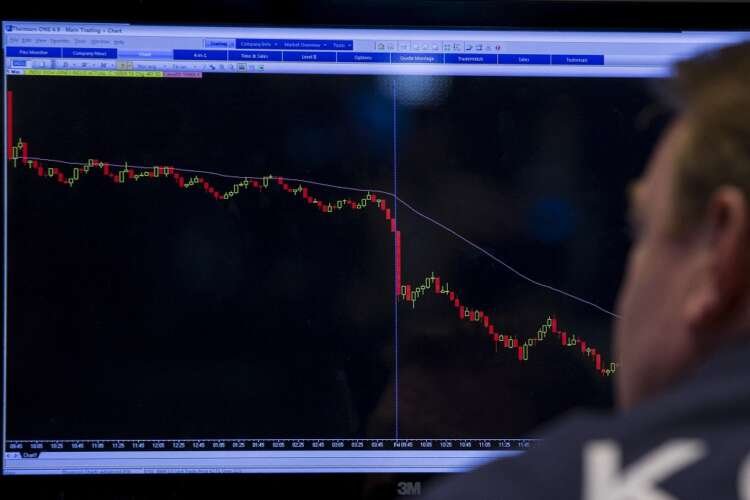
    A specialist trader on the New York Stock Exchange monitors fluctuating markets, reflecting the heightened volatility and shrinking deal sizes as central banks raise interest rates.
    Specialist trader on the New York Stock Exchange amid market volatility - Global Banking & Finance Review
    Why waste money on news and opinion when you can access them for free?

    Take advantage of our newsletter subscription and stay informed on the go!

    Subscribe

    Tags:monetary policyfinancial marketsLiquidity

    Quick Summary

    By Dhara Ranasinghe, Saikat Chatterjee and Davide Barbuscia

    By Dhara Ranasinghe, Saikat Chatterjee and Davide Barbuscia

    LONDON/NEW YORK (Reuters) – Traders in the world’s largest markets are having to navigate wild intra-day swings and shrinking deal sizes as central banks rapidly withdraw stimulus measures, in a small-scale reminder of a pandemic-driven financial seize-up just two years ago.

    The U.S. Federal Reserve said in a report this week that liquidity had “deteriorated” further than what might be expected at current levels of volatility, with noticeably poor conditions in treasury, commodity and equity markets.

    The onset of the coronavirus pandemic triggered a market crisis in March 2020 as investors dumped riskier assets, prompting global policymakers to pump in a total of $15 trillion, the equivalent of more than a sixth of the world economy, to help them regain stability.

    If markets are too unstable, the ability of central banks to transmit their monetary policy effectively is reduced and the Fed’s wording is being read as a warning by some.

    Liquidity had already been progressively more constrained after post-2008 regulations curbed the market-making and risk-taking ability of the world’s biggest banks.

    But this year’s pinch is down to rapid interest rate rises by central banks and their efforts to cut balance sheets swollen by huge bond-buying programmes, with liquidity shortfalls now particularly acute in bond markets.

    It is also evident in the Cboe Volatility Index, known as Wall Street’s “fear gauge” which is up 14% this week alone. But at just over 34 points, the VIX remains below peaks of almost 90 hit during the outbreak of the COVID-19 crisis in 2020 and the global financial crisis in 2008.

    DEPTH DEPRESSED

    As of next month the Fed will start selling down its bond holdings, which is likely to mean even thinner trading volumes.

    Bethany Payne, bond portfolio manager at Janus Henderson Investors, said “the risk of hitting bond market air-pockets has increased” of the possibility of big sudden price swings.

    “Bond market depth remains depressed year to date, as liquidity is withdrawn from the system,” she said, citing the combination of monetary tightening, inflation, Russia’s invasion of Ukraine, and the Fed’s bond sale plans.

    One indicator of the scale of the volatility are German 10-year bond futures, which are showing an average daily gap between the highest and lowest prices that is higher than any year in the past five, Refinitiv data shows, while Bund volatility in March was the highest since 2020.

    The picture is similar in the $20 trillion U.S. Treasury market, which Steven Abrahams at brokerage Amherst Pierpont said results from the Fed’s “withdrawal of liquidity by design”.

    “There are more investors that just aren’t sure where the curve is going to go next, that has taken some of the capital out of the market, and traders are seeing it in kind of jumpier moves in yields during the day as well,” Abrahams said.

    Various indexes illustrate the shape market liquidity is in, with Abrahams’ analysis showing Treasury liquidity at its tightest since March 2020.

    And a Goldman Sachs indicator based on inputs from over 30 different markets shows Treasuries leading recent liquidity tightening.

    Another from Cross-Border Capital, which the consultancy says leads markets by 6-12 months, is at a three-year low.

    ‘BE MORE CAREFUL’

    Greater volatility appears to be filtering into currency markets, where average daily turnover on the world’s most-traded exchange rate pair, euro/dollar, is down to 4,500 trades on the EBS multi-dealer platform, from nearly 6000 in March.

    Lower turnover can increase volatility, with a gauge of expected swings in the euro on a one-month horizon recently hitting two-year highs above 12%, Refinitiv data shows.

    That often leaves traders struggling to execute larger trades and can cause a small number of trades to move prices.

    “If you look at the screens, they are relatively normal. But we know that if anyone wants to trade a big size, that (market) depth will be challenged,” Chris Huddleston, CEO at brokerage FXD Capital in London, said, adding trading would get harder as interest rate hikes gather pace.

    Suhail Shaikh, CIO at Fulcrum Asset Management in London, estimates volatility is already between the 90th and 95th percentile in the context of asset classes’ own history.

    But market nervousness is partly because “risk officers are pointing out the Fed has been making loud noises about liquidity, which is not common for the Fed to do,” Shaikh said.

    “So we are just moving on from there being no worries to ‘be more careful,'” he added.

    (Reporting by Dhara Ranasinghe, Sujata Rao, Danilo Masoni and Saikat Chatterjee and Davide Barbuscia; Editing by Sujata Rao and Alexander Smith)

    Frequently Asked Questions about Analysis: Traders ready for wilder swings as rate rises stoke volatility

    1What is liquidity?

    Liquidity refers to how easily assets can be converted into cash without affecting their market price. High liquidity means assets can be sold quickly, while low liquidity can lead to price volatility.

    2What is monetary policy?

    Monetary policy is the process by which a central bank manages the supply of money and interest rates to achieve specific economic objectives, such as controlling inflation and stabilizing the currency.

    3What is market volatility?

    Market volatility refers to the rate at which the price of a security increases or decreases for a given set of returns. High volatility indicates a higher risk and potential for significant price swings.

    4What are interest rates?

    Interest rates are the cost of borrowing money or the return on savings, expressed as a percentage of the principal amount. They are influenced by central bank policies and economic conditions.

    5What is a central bank?

    A central bank is a national financial institution that oversees the monetary system for a country or group of countries, managing currency issuance, interest rates, and financial stability.

    More from Top Stories

    Explore more articles in the Top Stories category

    Image for Lessons From the Ring and the Deal Table: How Boxing Shapes Steven Nigro’s Approach to Banking and Life
    Lessons From the Ring and the Deal Table: How Boxing Shapes Steven Nigro’s Approach to Banking and Life
    Image for Joe Kiani in 2025: Capital, Conviction, and a Focused Return to Innovation
    Joe Kiani in 2025: Capital, Conviction, and a Focused Return to Innovation
    Image for Marco Robinson – CLOSE THE DEAL AND SUDDENLY GROW RICH
    Marco Robinson – CLOSE THE DEAL AND SUDDENLY GROW RICH
    Image for Digital Tracing: Turning a regulatory obligation into a commercial advantage
    Digital Tracing: Turning a regulatory obligation into a commercial advantage
    Image for Exploring the Role of Blockchain and the Bitcoin Price Today in Education
    Exploring the Role of Blockchain and the Bitcoin Price Today in Education
    Image for Inside the World’s First Collection Industry Conglomerate: PCA Global’s Platform Strategy
    Inside the World’s First Collection Industry Conglomerate: PCA Global’s Platform Strategy
    Image for Chase Buchanan Private Wealth Management Highlights Key Autumn 2025 Budget Takeaways for Expats
    Chase Buchanan Private Wealth Management Highlights Key Autumn 2025 Budget Takeaways for Expats
    Image for PayLaju Strengthens Its Position as Malaysia’s Trusted Interest-Free Sharia-Compliant Loan Provider
    PayLaju Strengthens Its Position as Malaysia’s Trusted Interest-Free Sharia-Compliant Loan Provider
    Image for A Notable Update for Employee Health Benefits:
    A Notable Update for Employee Health Benefits:
    Image for Creating Equity Between Walls: How Mohak Chauhan is Using Engineering, Finance, and Community Vision to Reengineer Affordable Housing
    Creating Equity Between Walls: How Mohak Chauhan is Using Engineering, Finance, and Community Vision to Reengineer Affordable Housing
    Image for Upcoming Book on Real Estate Investing: Harvard Grace Capital Founder Stewart Heath’s Puts Lessons in Print
    Upcoming Book on Real Estate Investing: Harvard Grace Capital Founder Stewart Heath’s Puts Lessons in Print
    Image for ELECTIVA MARKS A LANDMARK FIRST YEAR WITH MAJOR SENIOR APPOINTMENTS AND EXPANSION MILESTONES
    ELECTIVA MARKS A LANDMARK FIRST YEAR WITH MAJOR SENIOR APPOINTMENTS AND EXPANSION MILESTONES
    View All Top Stories Posts
    Previous Top Stories PostExplainer-How N.Korea’s COVID-19 outbreak could ignite a major health crisis
    Next Top Stories PostFineco Bank underscores UK growth with strong Q1