
Top Stories
Analysis-The Next Amazon? Congo Basin Faces Rising Deforestation Threat
Published by Jessica Weisman-Pitts
Posted on November 16, 2022
5 min readLast updated: February 3, 2026
Add as preferred source on Google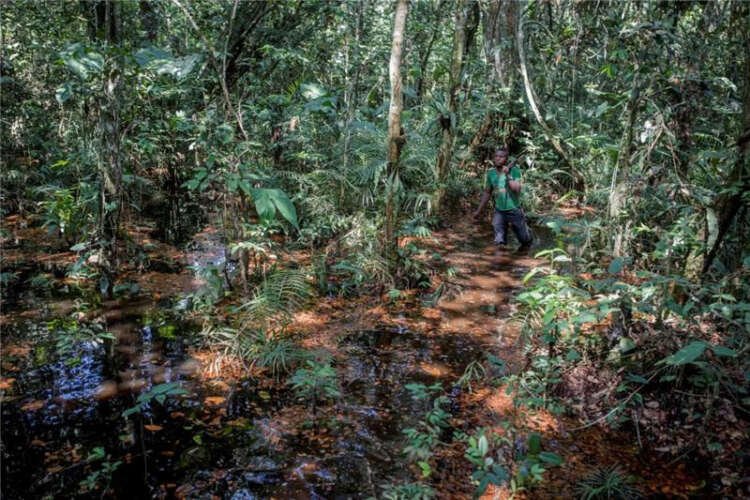
Published by Jessica Weisman-Pitts
Posted on November 16, 2022
5 min readLast updated: February 3, 2026
Add as preferred source on GoogleBy Jack Graham
LONDON (Thomson Reuters Foundation) – At the COP27 climate talks in Egypt this week, world leaders have sought to accelerate efforts to halt deforestation by 2030 – in line with a pledge 140 countries made last year to preserve forests.
A new group of nations was created to boost momentum on that promise, along with new funding commitments, including 90 million pounds ($106 million) from Britain to support conservation of the Congo Basin – the world’s second-largest rainforest.
A more intact forest than regions like the Amazon, Central Africa’s Congo Basin saw deforestation increase by 5% in 2021, according to a report released on Thursday by environmental group Climate Focus.
Marion Ferrat, a senior consultant at Climate Focus who co-authored the report, said the new pledges to protect the Congo Basin are encouraging, “but there needs to be funding that reaches communities on the ground.”
Many of the promises are “very high-level”, often lacking specific objectives and the mechanisms to track them, she added in a phone interview from the climate summit.
As COP27 delegates discuss how to reduce planet-heating emissions to avoid the worst impacts of climate change, conservationists at the meeting in Sharm el-Sheikh say the role of the Congo Basin as a “carbon sink” is being underestimated.
Carbon sinks are natural areas, such as oceans and forests, that absorb carbon dioxide (CO2) from the atmosphere, helping curb global warming.
With its dense tropical peatlands, the Basin pulls around 4% of global CO2 emissions out of the atmosphere each year, according to the Central African Forest Initiative.
Threats from logging and mining
Spread over six countries, including the Democratic Republic of Congo (DRC) and Cameroon, the rainforest is home to more than 75 million people and 10,000 tropical plant species, as well as endangered wildlife from forest elephants to mountain gorillas, according to the World Wildlife Fund (WWF).
“The Congo Basin is obviously crucial not only for local and national economies… but also its potential to combat global warming,” said Belmond Tchoumba, WWF’s Central Africa forest programme coordinator.
The Climate Focus report said the rainforest has been “passively” protected due to factors like low population density, political instability, a lack of infrastructure and high risks for private investors.
While other tropical forests have been severely degraded by industrial activities like mining and agriculture, the report said most of the Congo Basin’s deforestation has been due to small-scale subsistence farming – but this could be set to change.
The Basin faces major threats from fossil fuel exploration, illegal logging and, due to its abundance of rare metals such as cobalt, even from mining for materials that are crucial for the renewable energy transition.
New analysis released this week by Rainforest Foundation UK and Earth InSight revealed more than one-third of the Congo Basin now overlaps with existing or planned oil and gas exploration and production areas.
“The world isn’t paying remotely enough attention or investing sufficient resources to help the countries of the Congo Basin preserve their intact forests,” said Joe Walston, executive vice president at the Wildlife Conservation Society.
He said intact forests receive less funding as mechanisms like the United Nations’ REDD+ conservation scheme focus on responding to recent deforestation trends – which are lower in places like the Congo Basin.
“Intact forests are highly threatened and it is, perversely, only after they start getting logged for many years that the world steps in,” Walston said in a phone interview.
‘Playing defence’
The fundamental challenge, analysts say, is ensuring that economic development of the Congo Basin happens in a way that is ecologically sustainable.
This is particularly difficult in the DRC – by far the most populated nation in the region – where poverty rates are high and the government is looking to boost its oil output.
“The opportunity cost for forest conservation is so high given the alternative uses (for) forest lands,” said Jack Hurd, executive director of the Tropical Forest Alliance.
He said a significant amount of finance is needed to incentivise good behaviours, as well as time to create structures for sustainable development such as robust regulations and local capacity to manage the rainforest.
“Unless you’re looking at the whole ecosystem… you’re just playing defence – trying to keep things from happening in a protected area,” Hurd said.
A model for this kind of sustainable development may be found in Gabon, a sparsely populated nation in the Congo Basin where deforestation decreased by 28% in 2021, according to the Climate Focus report.
Marie-Claire Paiz, Gabon country director at environmental organisation The Nature Conservancy, said the country has benefitted from strict forest management standards.
For example, she said, forestry operators are required to develop a management plan to harvest trees on a 25-year rotation, based on a detailed inventory of tree species and size.
The country also hopes carbon markets can encourage further investment, with businesses paying for forest conservation to offset their emissions, and her organisation is supporting the government to ensure that carbon credits are robust.
At COP27 this week, a new Africa Carbon Markets Initiative was launched with the aim of developing the continent’s voluntary carbon markets for projects like biodiversity protection.
Even in Gabon, however, Paiz said there could be growing tensions if communities fail to benefit from nature protection, especially as the country is forced to move away from the oil industry – its primary source of revenue.
“We need to figure (out) ways of helping to maintain the forest cover that we have right now, and do it in a way that is totally supportive to the economies of those countries,” she said.
“The world will pay for it, otherwise.”
($1 = 0.8487 pounds)
Originally published on:
(Reporting by Jack Graham; Editing by Jumana Farouky. The Thomson Reuters Foundation is the charitable arm of Thomson Reuters. Visit https://www.context.news/)
Deforestation is the large-scale removal of trees from forested areas, often resulting in damage to the quality of the land. It can lead to loss of biodiversity and contribute to climate change.
A carbon sink is a natural system, such as forests or oceans, that absorbs more carbon dioxide from the atmosphere than it releases, helping to mitigate climate change.
Sustainable development is a method of using resources that meets current needs without compromising the ability of future generations to meet their own needs, balancing economic growth, environmental care, and social equity.
Explore more articles in the Top Stories category











