Search
00
GBAF Logo
trophy
Top StoriesInterviewsBusinessFinanceBankingTechnologyInvestingTradingVideosAwardsMagazinesHeadlinesTrends

Subscribe to our newsletter

Get the latest news and updates from our team.

Global Banking & Finance Review®

Global Banking & Finance Review® - Subscribe to our newsletter

Company

    GBAF Logo
    • About Us
    • Profile
    • Privacy & Cookie Policy
    • Terms of Use
    • Contact Us
    • Advertising
    • Submit Post
    • Latest News
    • Research Reports
    • Press Release
    • Awards▾
      • About the Awards
      • Awards TimeTable
      • Submit Nominations
      • Testimonials
      • Media Room
      • Award Winners
      • FAQ
    • Magazines▾
      • Global Banking & Finance Review Magazine Issue 79
      • Global Banking & Finance Review Magazine Issue 78
      • Global Banking & Finance Review Magazine Issue 77
      • Global Banking & Finance Review Magazine Issue 76
      • Global Banking & Finance Review Magazine Issue 75
      • Global Banking & Finance Review Magazine Issue 73
      • Global Banking & Finance Review Magazine Issue 71
      • Global Banking & Finance Review Magazine Issue 70
      • Global Banking & Finance Review Magazine Issue 69
      • Global Banking & Finance Review Magazine Issue 66
    Top StoriesInterviewsBusinessFinanceBankingTechnologyInvestingTradingVideosAwardsMagazinesHeadlinesTrends

    Global Banking & Finance Review® is a leading financial portal and online magazine offering News, Analysis, Opinion, Reviews, Interviews & Videos from the world of Banking, Finance, Business, Trading, Technology, Investing, Brokerage, Foreign Exchange, Tax & Legal, Islamic Finance, Asset & Wealth Management.
    Copyright © 2010-2026 GBAF Publications Ltd - All Rights Reserved. | Sitemap | Tags | Developed By eCorpIT

    Editorial & Advertiser disclosure

    Global Banking & Finance Review® is an online platform offering news, analysis, and opinion on the latest trends, developments, and innovations in the banking and finance industry worldwide. The platform covers a diverse range of topics, including banking, insurance, investment, wealth management, fintech, and regulatory issues. The website publishes news, press releases, opinion and advertorials on various financial organizations, products and services which are commissioned from various Companies, Organizations, PR agencies, Bloggers etc. These commissioned articles are commercial in nature. This is not to be considered as financial advice and should be considered only for information purposes. It does not reflect the views or opinion of our website and is not to be considered an endorsement or a recommendation. We cannot guarantee the accuracy or applicability of any information provided with respect to your individual or personal circumstances. Please seek Professional advice from a qualified professional before making any financial decisions. We link to various third-party websites, affiliate sales networks, and to our advertising partners websites. When you view or click on certain links available on our articles, our partners may compensate us for displaying the content to you or make a purchase or fill a form. This will not incur any additional charges to you. To make things simpler for you to identity or distinguish advertised or sponsored articles or links, you may consider all articles or links hosted on our site as a commercial article placement. We will not be responsible for any loss you may suffer as a result of any omission or inaccuracy on the website.

    Home > Top Stories > Analysis-The 2.5 seconds of security lapses that sealed Shinzo Abe’s fate
    Top Stories

    Analysis-The 2.5 seconds of security lapses that sealed Shinzo Abe’s fate

    Published by Jessica Weisman-Pitts

    Posted on July 19, 2022

    5 min read

    Last updated: February 5, 2026

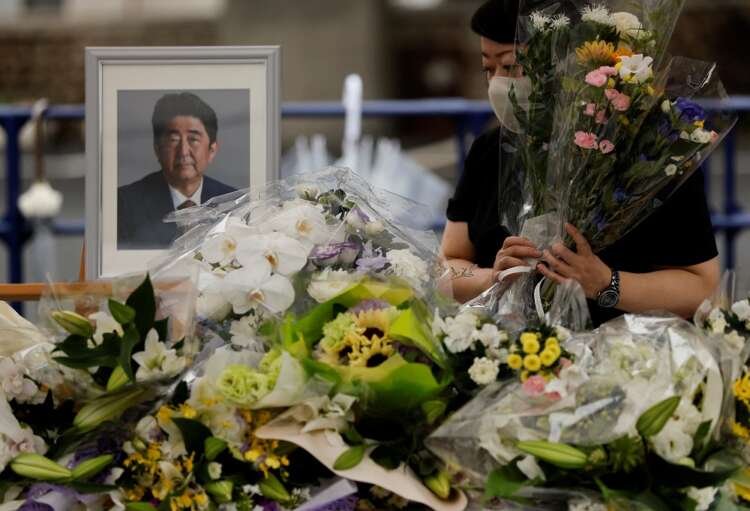
    A somber gathering of mourners at the altar for former Prime Minister Shinzo Abe in Tokyo, reflecting on the security failures that led to his tragic assassination.
    Mourners gather to honor Shinzo Abe after his assassination - Global Banking & Finance Review
    Why waste money on news and opinion when you can access them for free?

    Take advantage of our newsletter subscription and stay informed on the go!

    Subscribe

    Tags:securityfinancial crisisrisk managementinsuranceinvestment

    By Satoshi Sugiyama, Sam Nussey and Ju-min Park

    NARA, Japan (Reuters) -Bodyguards could have saved Shinzo Abe if they shielded him or removed him from the line of fire in the 2.5 seconds between a missed first shot and a second round of gunfire that fatally wounded him, according to eight security experts who reviewed footage of the former Japanese leader’s assassination.

    The failure to protect Abe from the second shot followed what appeared to be a series of security lapses in the lead-up to the assassination of Japan’s longest-serving prime minister on July 8, the Japanese and international experts said.

    Abe’s killing in the western city of Nara by a man using a homemade weapon shocked a nation where gun violence is rare and politicians campaign up close to the public with light security.

    Japanese authorities – including Prime Minister Fumio Kishida – have acknowledged security lapses, and police say they are investigating.

    In addition to the security experts, Reuters spoke to six witnesses at the scene and examined multiple videos available online, taken from different angles, to piece together a detailed account of security measures ahead of his shooting.

    After leaving 67-year-old Abe exposed from behind as he spoke on a traffic island on a public road, his security detail allowed the shooter – identified by police as Tetsuya Yamagami, 41 – to come within metres of Abe unchecked, carrying a weapon, the footage showed.

    “They should have seen the attacker very deliberately walking towards the rear of the prime minister and intervened,” said Kenneth Bombace, head of Global Threat Solutions, which provided security to Joe Biden when he was a presidential candidate.

    Yamagami came within around 7 metres (23 feet) of Abe before firing his first shot, which missed, the Yomiuri newspaper said, citing investigative sources. He fired the second shot, which hit, at around 5 metres away, it said.

    Abe’s bodyguards did not appear to have “concentric rings of security” around him, said John Soltys, a former Navy SEAL and CIA officer now a vice president at security firm Prosegur. “They didn’t have any kind of surveillance in the crowd.”

    Asked about the experts’ analysis, the Nara Prefectural Police, in charge of security for Abe’s campaign stop, told Reuters in a statement the department was “committed to thoroughly identifying the security problems” with Abe’s protection, declining to comment further.

    The video footage showed that, after the first shot, Abe turns and looks over his left shoulder. Two bodyguards scramble to get between him and the shooter, one hoisting a slim black bag. Two others head toward the shooter, who moves closer through the smoke.

    Although Abe’s security tackled the assailant moments later and arrested him, it was the “wrong response” for some of the security to go after the shooter instead of moving to protect Abe, said Mitsuru Fukuda, a Nihon University professor specialising in crisis management and terrorism.

    There was enough security, “but no sense of danger,” said Yasuhiro Sasaki, a retired police officer in Saitama prefecture near Tokyo who handled security for VIPs. “Everyone was startled and no one went to where Abe was.”

    The Tokyo police, in charge of VIP politicians’ bodyguards, referred questions to the Nara police.

    The National Police Agency, which oversees local police forces, said Abe’s killing was the result of the police failing to fulfil their responsibility and said it had set up a team to review security and protection measures and to consider concrete steps to prevent such a serious incident from recurring.

    “We recognise that there were problems not only in the on-site response, such as the security and protection set-up, deployment of personnel and fundamental security procedures, but also in the way the National Police Agency was involved,” it said in response to Reuters questions.

    Reuters could not reach Yamagami, who remains in police custody, for comment and could not determine whether he had a lawyer.

    ‘COULD HAVE BEEN AVOIDED’

    Footage shows four bodyguards inside the guardrails as Abe spoke, according to Koichi Ito, a former sergeant at the Tokyo Metropolitan Police Department’s special assault team, now a security consultant. Their number was corroborated by local politician Masahiro Okuni, who was at the scene.

    When the former prime minister stepped up to speak, Yamagami could be seen in video footage in the background, clapping.

    As Yamagami walked up behind Abe, security did not appear to take action, the footage showed.

    Abe should have had a dedicated close protection bodyguard to get him away, said a member of the U.S. Diplomatic Security Service, which protects senior diplomats and foreign dignitaries.

    “We would grab him by the belt and collar, shield him with our body and move away,” the agent said.

    Katsuhiko Ikeda, former superintendent general of the Tokyo police who ran security for Japan’s Group of Eight summits in 2000 and 2008, said the situation would have developed very differently if Abe’s security detail had been close enough to reach him in a second or two.

    Ito, the former police sergeant, said security could have stopped the first shot had they been vigilant and communicating.

    “Even if they missed that, there was a more than two-second window before the second shot, so they definitely could have prevented that,” he said. “If Abe had been protected properly, it could have been avoided.”

    (Reporting by Satoshi Sugiyama in Nara, Sam Nussey in Tokyo and Ju-min Park in Seoul; Additional reporting by Tim Kelly, Rocky Swift, Kiyoshi Takenaka, Nobuhiro Kubo, David Dolan and Yukiko Toyoda; Writing by Sam Nussey; Editing by David Dolan and William Mallard)

    Frequently Asked Questions about Analysis-The 2.5 seconds of security lapses that sealed Shinzo Abe’s fate

    1What is risk management?

    Risk management is the process of identifying, assessing, and controlling threats to an organization's capital and earnings. It involves analyzing potential risks and implementing strategies to mitigate them.

    2What is security in finance?

    In finance, security refers to a financial instrument that holds some form of monetary value and can be traded. Examples include stocks, bonds, and options.

    3What is investment?

    Investment is the act of allocating resources, usually money, in order to generate income or profit. It can involve purchasing assets like stocks, bonds, or real estate.

    More from Top Stories

    Explore more articles in the Top Stories category

    Image for Lessons From the Ring and the Deal Table: How Boxing Shapes Steven Nigro’s Approach to Banking and Life
    Lessons From the Ring and the Deal Table: How Boxing Shapes Steven Nigro’s Approach to Banking and Life
    Image for Joe Kiani in 2025: Capital, Conviction, and a Focused Return to Innovation
    Joe Kiani in 2025: Capital, Conviction, and a Focused Return to Innovation
    Image for Marco Robinson – CLOSE THE DEAL AND SUDDENLY GROW RICH
    Marco Robinson – CLOSE THE DEAL AND SUDDENLY GROW RICH
    Image for Digital Tracing: Turning a regulatory obligation into a commercial advantage
    Digital Tracing: Turning a regulatory obligation into a commercial advantage
    Image for Exploring the Role of Blockchain and the Bitcoin Price Today in Education
    Exploring the Role of Blockchain and the Bitcoin Price Today in Education
    Image for Inside the World’s First Collection Industry Conglomerate: PCA Global’s Platform Strategy
    Inside the World’s First Collection Industry Conglomerate: PCA Global’s Platform Strategy
    Image for Chase Buchanan Private Wealth Management Highlights Key Autumn 2025 Budget Takeaways for Expats
    Chase Buchanan Private Wealth Management Highlights Key Autumn 2025 Budget Takeaways for Expats
    Image for PayLaju Strengthens Its Position as Malaysia’s Trusted Interest-Free Sharia-Compliant Loan Provider
    PayLaju Strengthens Its Position as Malaysia’s Trusted Interest-Free Sharia-Compliant Loan Provider
    Image for A Notable Update for Employee Health Benefits:
    A Notable Update for Employee Health Benefits:
    Image for Creating Equity Between Walls: How Mohak Chauhan is Using Engineering, Finance, and Community Vision to Reengineer Affordable Housing
    Creating Equity Between Walls: How Mohak Chauhan is Using Engineering, Finance, and Community Vision to Reengineer Affordable Housing
    Image for Upcoming Book on Real Estate Investing: Harvard Grace Capital Founder Stewart Heath’s Puts Lessons in Print
    Upcoming Book on Real Estate Investing: Harvard Grace Capital Founder Stewart Heath’s Puts Lessons in Print
    Image for ELECTIVA MARKS A LANDMARK FIRST YEAR WITH MAJOR SENIOR APPOINTMENTS AND EXPANSION MILESTONES
    ELECTIVA MARKS A LANDMARK FIRST YEAR WITH MAJOR SENIOR APPOINTMENTS AND EXPANSION MILESTONES
    View All Top Stories Posts
    Previous Top Stories PostEasyJet CEO: We’ve stabilised operations but melting runways don’t help
    Next Top Stories PostSri Lanka’s Wickremesinghe to face low-key lawmaker in tight race for president