Search
00
GBAF Logo
trophy
Top StoriesInterviewsBusinessFinanceBankingTechnologyInvestingTradingVideosAwardsMagazinesHeadlinesTrends

Subscribe to our newsletter

Get the latest news and updates from our team.

Global Banking & Finance Review®

Global Banking & Finance Review® - Subscribe to our newsletter

Company

    GBAF Logo
    • About Us
    • Profile
    • Privacy & Cookie Policy
    • Terms of Use
    • Contact Us
    • Advertising
    • Submit Post
    • Latest News
    • Research Reports
    • Press Release
    • Awards▾
      • About the Awards
      • Awards TimeTable
      • Submit Nominations
      • Testimonials
      • Media Room
      • Award Winners
      • FAQ
    • Magazines▾
      • Global Banking & Finance Review Magazine Issue 79
      • Global Banking & Finance Review Magazine Issue 78
      • Global Banking & Finance Review Magazine Issue 77
      • Global Banking & Finance Review Magazine Issue 76
      • Global Banking & Finance Review Magazine Issue 75
      • Global Banking & Finance Review Magazine Issue 73
      • Global Banking & Finance Review Magazine Issue 71
      • Global Banking & Finance Review Magazine Issue 70
      • Global Banking & Finance Review Magazine Issue 69
      • Global Banking & Finance Review Magazine Issue 66
    Top StoriesInterviewsBusinessFinanceBankingTechnologyInvestingTradingVideosAwardsMagazinesHeadlinesTrends

    Global Banking & Finance Review® is a leading financial portal and online magazine offering News, Analysis, Opinion, Reviews, Interviews & Videos from the world of Banking, Finance, Business, Trading, Technology, Investing, Brokerage, Foreign Exchange, Tax & Legal, Islamic Finance, Asset & Wealth Management.
    Copyright © 2010-2026 GBAF Publications Ltd - All Rights Reserved. | Sitemap | Tags | Developed By eCorpIT

    Editorial & Advertiser disclosure

    Global Banking & Finance Review® is an online platform offering news, analysis, and opinion on the latest trends, developments, and innovations in the banking and finance industry worldwide. The platform covers a diverse range of topics, including banking, insurance, investment, wealth management, fintech, and regulatory issues. The website publishes news, press releases, opinion and advertorials on various financial organizations, products and services which are commissioned from various Companies, Organizations, PR agencies, Bloggers etc. These commissioned articles are commercial in nature. This is not to be considered as financial advice and should be considered only for information purposes. It does not reflect the views or opinion of our website and is not to be considered an endorsement or a recommendation. We cannot guarantee the accuracy or applicability of any information provided with respect to your individual or personal circumstances. Please seek Professional advice from a qualified professional before making any financial decisions. We link to various third-party websites, affiliate sales networks, and to our advertising partners websites. When you view or click on certain links available on our articles, our partners may compensate us for displaying the content to you or make a purchase or fill a form. This will not incur any additional charges to you. To make things simpler for you to identity or distinguish advertised or sponsored articles or links, you may consider all articles or links hosted on our site as a commercial article placement. We will not be responsible for any loss you may suffer as a result of any omission or inaccuracy on the website.

    Home > Top Stories > Analysis: Russians feel little economic pain now, long-term outlook darkens
    Top Stories

    Analysis: Russians feel little economic pain now, long-term outlook darkens

    Published by Jessica Weisman-Pitts

    Posted on May 30, 2022

    5 min read

    Last updated: February 6, 2026

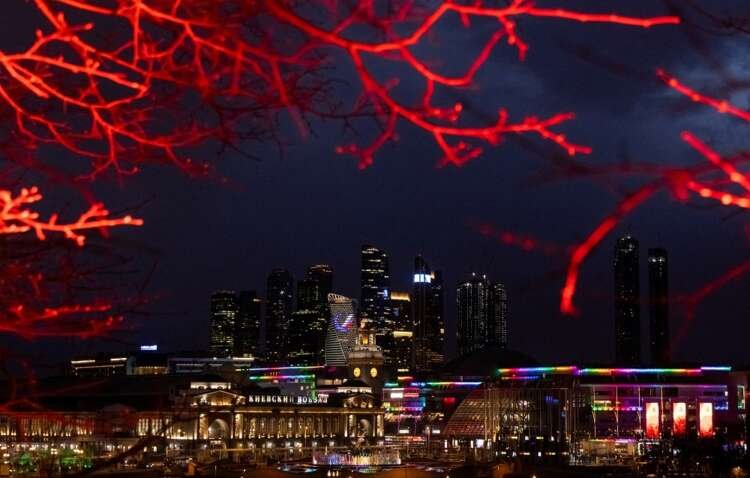
    The image showcases the iconic Moskva-City business center in Moscow, symbolizing the juxtaposition of ongoing confidence and looming economic challenges in Russia amidst the Ukraine crisis.
    View of Moskva-City business center in Moscow, reflecting Russia's economic landscape - Global Banking & Finance Review
    Why waste money on news and opinion when you can access them for free?

    Take advantage of our newsletter subscription and stay informed on the go!

    Subscribe

    Tags:GDPfinancial crisiseconomic growth

    By Jake Cordell

    LONDON (Reuters) – For Oleg Kechin, owner of a chain of barbershops, forecasts that Russia will be plunged into its deepest economic crisis in a generation feel overdone.

    U.S. President Joe Biden may have promised that Western sanctions would wreak economic havoc in Russia, but Kechin’s business is still drawing in customers in the town of Saransk, which lies 510 km (320 miles) southeast of Moscow.

    “There’s no deep crisis. In general, everything’s fine,” he said. “Everyone’s talking about a decrease in purchasing power, but I haven’t noticed it.”

    Yet, such confidence may not be entirely well placed, if some indicators are to be believed. Trade with the outside world has plunged, consumers are reluctant to spend and rising prices on basic items are starting to squeeze household budgets.

    Russian officials insist the economy is holding up. The central bank slashed interest rates by three percentage points to 11% on Thursday and expects to cut its forecast for inflation for this year from the current prediction of 18-23%.

    Under capital controls and orders that exporters sell half their hard currency earnings, the rouble has rallied and, at about 66 to the U.S. dollar, is stronger than before Russia sent its armed forces into Ukraine on Feb. 24. [RU/RUB]

    President Vladimir Putin, who has welcomed the departure of foreign firms which have sold up or just dumped Russian assets, said Russia could not be isolated from global trade.

    But not everyone is convinced the economy will escape unscathed. Roman, a 25-year-old in Moscow, who asked not to be identified by his full name, said middle class life was not “drastically different” than before but he saw worrying signs.

    “One thing that bothers me … is constant price rises for everyday goods and even vegetables. I think that signals the worst is yet to come.” he said. “The situation with the labour market in my sphere doesn’t make me very optimistic either.”

    ‘DEMAND CRISIS’

    Some indicators justify his concerns. VAT receipts, which reflect consumer spending, fell 54% in April year on year, the Kommersant daily said, citing preliminary finance ministry data.

    Economy Minister Maxim Reshetnikov said on Friday there was a “demand crisis” in business and consumer spending.

    Russia has stopped publishing most data on financial flows, but figures compiled by the Bank of Finland based on local customs data show imports have plunged – and not just from the West.

    Chinese exports to Russia were down by a quarter in April and shipments from Vietnam, South Korea, Malaysia and Taiwan more than halved, the bank said.

    The economy minister said manufacturers were re-establishing supply chains broken by sanctions and said 2,000 “backbone companies” could access preferential lending programmes.

    But inflation is still at its highest in two decades at more than 17%. That means a 10% hike in pensions and the minimum wage announced by Putin still leaves many facing a cut in household incomes in real terms.

    Rising prices may not be Russia’s biggest problem. The strong rouble has already brought down weekly inflation sharply, but it won’t fend off a broader threat to economic output from Russia’s increasing isolation.

    Reshetnikov said there were “fears that we could break into a deflationary spiral, when a reduction in money in the economy leads to a reduction in production, lower prices, and so on.”

    Meanwhile, financing a military campaign in Ukraine will put pressure on the budget. Finance Minister Anton Siluanov said on Friday that Moscow required “huge financial resources” for what Moscow calls its “special military operation”.

    STIMULUS

    Russia has already dipped into its National Wealth Fund, which has about $110 billion of liquid assets, to support spending, which is up 22% this year, the economy minister said.

    The finance minister said Moscow had earmarked 8 trillion roubles ($123 billion) of stimulus for “the current circumstances”, although it was not clear how much of that was new money and over what period.

    The full impact on economic output and jobs from the withdrawal of Western firms, ranging from carmakers to banks, has yet to seen.

    Sergei Guriev, economics professor at France’s Sciences Po, expected the impact to be felt more sharply in the next few months.

    “The real pain has not started yet as some exiting companies are still paying wages and some companies continue production using their inventories of imported parts,” said Guriev, who is also a former chief economist at the European Bank for Reconstruction and Development.

    Morgan Stanley economists see a 13% drop in household consumption in 2022 and a 23% fall in investment. The bank’s chief regional economist, Alina Slyusarchuk, said in a note that Russia’s potential long-term growth rate was now just 1%.

    The outlook appears to be dimming for smaller Russian firms, although there is little way to gauge it precisely with so little official data now being published and businesses no longer required to report results.

    “Very few companies want to create a strategy or plan long-term, large-scale contracts right now,” said Anastasia Kiseleva, a partner at a small public relations firm in Moscow.

    “Businesses – especially small ones – will be engaged in pure survival, not developing or creating anything new.”

    Survival-mode, however, is nothing new to many Russians, who have lived through several deep crises since the collapse of the Soviet Union in 1991.

    “The worst is ahead of us,” said Yevgeniy Sheremetov, who runs a tour company near Lake Baikal in Siberia. “But residents of this country are used to difficulties. I have my summer house, with potatoes and cucumbers. After the 1990s, nothing can scare me.”

    (Additional reporting by Marc Jones in London; Editing by Kevin Liffey and Edmund Blair)

    Frequently Asked Questions about Analysis: Russians feel little economic pain now, long-term outlook darkens

    1What is inflation?

    Inflation is the rate at which the general level of prices for goods and services rises, eroding purchasing power. It is typically measured by the Consumer Price Index (CPI).

    2What is GDP?

    Gross Domestic Product (GDP) is the total monetary value of all goods and services produced within a country's borders in a specific time period, indicating the size of its economy.

    3What is consumer spending?

    Consumer spending refers to the total amount of money spent by households on goods and services. It is a key driver of economic growth.

    4What is a financial crisis?

    A financial crisis is a situation in which the value of financial institutions or assets drops significantly, leading to a loss of confidence and potential economic downturn.

    5What is economic growth?

    Economic growth is an increase in the production of goods and services in an economy over a period of time, usually measured as the percentage increase in real GDP.

    More from Top Stories

    Explore more articles in the Top Stories category

    Image for Lessons From the Ring and the Deal Table: How Boxing Shapes Steven Nigro’s Approach to Banking and Life
    Lessons From the Ring and the Deal Table: How Boxing Shapes Steven Nigro’s Approach to Banking and Life
    Image for Joe Kiani in 2025: Capital, Conviction, and a Focused Return to Innovation
    Joe Kiani in 2025: Capital, Conviction, and a Focused Return to Innovation
    Image for Marco Robinson – CLOSE THE DEAL AND SUDDENLY GROW RICH
    Marco Robinson – CLOSE THE DEAL AND SUDDENLY GROW RICH
    Image for Digital Tracing: Turning a regulatory obligation into a commercial advantage
    Digital Tracing: Turning a regulatory obligation into a commercial advantage
    Image for Exploring the Role of Blockchain and the Bitcoin Price Today in Education
    Exploring the Role of Blockchain and the Bitcoin Price Today in Education
    Image for Inside the World’s First Collection Industry Conglomerate: PCA Global’s Platform Strategy
    Inside the World’s First Collection Industry Conglomerate: PCA Global’s Platform Strategy
    Image for Chase Buchanan Private Wealth Management Highlights Key Autumn 2025 Budget Takeaways for Expats
    Chase Buchanan Private Wealth Management Highlights Key Autumn 2025 Budget Takeaways for Expats
    Image for PayLaju Strengthens Its Position as Malaysia’s Trusted Interest-Free Sharia-Compliant Loan Provider
    PayLaju Strengthens Its Position as Malaysia’s Trusted Interest-Free Sharia-Compliant Loan Provider
    Image for A Notable Update for Employee Health Benefits:
    A Notable Update for Employee Health Benefits:
    Image for Creating Equity Between Walls: How Mohak Chauhan is Using Engineering, Finance, and Community Vision to Reengineer Affordable Housing
    Creating Equity Between Walls: How Mohak Chauhan is Using Engineering, Finance, and Community Vision to Reengineer Affordable Housing
    Image for Upcoming Book on Real Estate Investing: Harvard Grace Capital Founder Stewart Heath’s Puts Lessons in Print
    Upcoming Book on Real Estate Investing: Harvard Grace Capital Founder Stewart Heath’s Puts Lessons in Print
    Image for ELECTIVA MARKS A LANDMARK FIRST YEAR WITH MAJOR SENIOR APPOINTMENTS AND EXPANSION MILESTONES
    ELECTIVA MARKS A LANDMARK FIRST YEAR WITH MAJOR SENIOR APPOINTMENTS AND EXPANSION MILESTONES
    View All Top Stories Posts
    Previous Top Stories PostUK to grant visas to graduates from the world’s best universities
    Next Top Stories PostCOVID-hit Shanghai to end two-month lockdown on June 1