Search
00
GBAF Logo
trophy
Top StoriesInterviewsBusinessFinanceBankingTechnologyInvestingTradingVideosAwardsMagazinesHeadlinesTrends

Subscribe to our newsletter

Get the latest news and updates from our team.

Global Banking & Finance Review®

Global Banking & Finance Review® - Subscribe to our newsletter

Company

    GBAF Logo
    • About Us
    • Profile
    • Privacy & Cookie Policy
    • Terms of Use
    • Contact Us
    • Advertising
    • Submit Post
    • Latest News
    • Research Reports
    • Press Release
    • Awards▾
      • About the Awards
      • Awards TimeTable
      • Submit Nominations
      • Testimonials
      • Media Room
      • Award Winners
      • FAQ
    • Magazines▾
      • Global Banking & Finance Review Magazine Issue 79
      • Global Banking & Finance Review Magazine Issue 78
      • Global Banking & Finance Review Magazine Issue 77
      • Global Banking & Finance Review Magazine Issue 76
      • Global Banking & Finance Review Magazine Issue 75
      • Global Banking & Finance Review Magazine Issue 73
      • Global Banking & Finance Review Magazine Issue 71
      • Global Banking & Finance Review Magazine Issue 70
      • Global Banking & Finance Review Magazine Issue 69
      • Global Banking & Finance Review Magazine Issue 66
    Top StoriesInterviewsBusinessFinanceBankingTechnologyInvestingTradingVideosAwardsMagazinesHeadlinesTrends

    Global Banking & Finance Review® is a leading financial portal and online magazine offering News, Analysis, Opinion, Reviews, Interviews & Videos from the world of Banking, Finance, Business, Trading, Technology, Investing, Brokerage, Foreign Exchange, Tax & Legal, Islamic Finance, Asset & Wealth Management.
    Copyright © 2010-2026 GBAF Publications Ltd - All Rights Reserved. | Sitemap | Tags | Developed By eCorpIT

    Editorial & Advertiser disclosure

    Global Banking & Finance Review® is an online platform offering news, analysis, and opinion on the latest trends, developments, and innovations in the banking and finance industry worldwide. The platform covers a diverse range of topics, including banking, insurance, investment, wealth management, fintech, and regulatory issues. The website publishes news, press releases, opinion and advertorials on various financial organizations, products and services which are commissioned from various Companies, Organizations, PR agencies, Bloggers etc. These commissioned articles are commercial in nature. This is not to be considered as financial advice and should be considered only for information purposes. It does not reflect the views or opinion of our website and is not to be considered an endorsement or a recommendation. We cannot guarantee the accuracy or applicability of any information provided with respect to your individual or personal circumstances. Please seek Professional advice from a qualified professional before making any financial decisions. We link to various third-party websites, affiliate sales networks, and to our advertising partners websites. When you view or click on certain links available on our articles, our partners may compensate us for displaying the content to you or make a purchase or fill a form. This will not incur any additional charges to you. To make things simpler for you to identity or distinguish advertised or sponsored articles or links, you may consider all articles or links hosted on our site as a commercial article placement. We will not be responsible for any loss you may suffer as a result of any omission or inaccuracy on the website.

    Home > Top Stories > Analysis-Russian gold removed from some Western funds after Ukraine
    Top Stories

    Analysis-Russian gold removed from some Western funds after Ukraine

    Published by Uma Rajagopal

    Posted on December 21, 2022

    6 min read

    Last updated: February 2, 2026

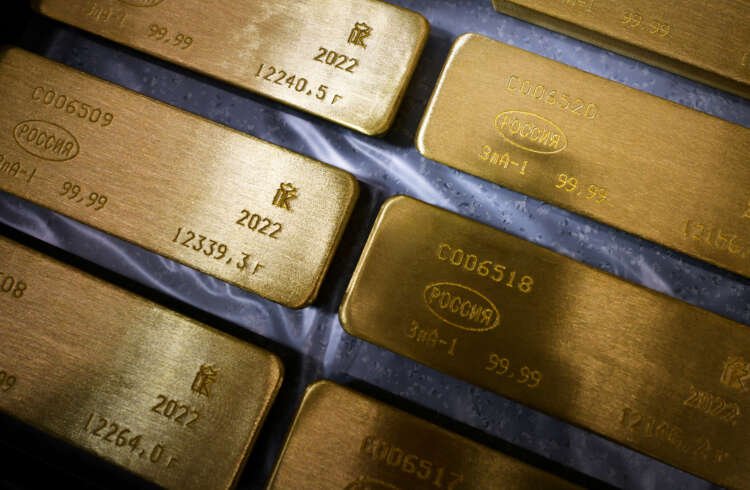
    This image showcases marked gold ingots, illustrating the ongoing divestment of Russian gold from Western funds following the Ukraine conflict. The shift reflects growing concerns over assets linked to Russia in global markets.
    Gold ingots marked for purity, representing Russian gold removal from Western funds - Global Banking & Finance Review
    Why waste money on news and opinion when you can access them for free?

    Take advantage of our newsletter subscription and stay informed on the go!

    Subscribe

    Tags:investmentGold marketfinancial services

    By Peter Hobson

    LONDON (Reuters) – Hidden inside high-security bank vaults in London, Zurich and New York, billions of dollars’ worth of gold of Russian origin has quietly changed hands in recent months in response to Moscow’s invasion of Ukraine.

    Data from 11 Western investment funds show that Russian bullion worth a total of $2.2 billion at current prices was removed from their accounts between July and November.

    Funds storing gold have shrunk in recent months as rising interest rates triggered disinvestment from bullion. But the data, compiled by Reuters, shows Russian gold being removed at a significantly faster pace than that from other countries.

    While a small fraction of the total amount of Russian gold held by wealth managers, this reflects a shift, with some funds saying they no longer want to hold any assets linked to Russia.

    Two sources at exchange traded funds (ETFs) with hundreds of tonnes of gold said they would like to divest from metal originating in Russia. One said he had asked the bank paid to store his fund’s gold to allocate as little Russian metal as possible to it.

    ETFs are among the biggest holders of bullion and many list publicly the bars they own. This means investors can see whether they have Russian gold as each bar is stamped with its origin.

    “Some clients click on the bar list, see a lot of Russia and they are like, ‘Whoa, what’s going on?’,” one source said.

    “Explaining it to them is difficult. We want to make the barriers to entry (to the fund) as low as possible and anything that would make them doubt that this is the right product we try to eliminate,” the source added.

    Click here for a FACTBOX detailing ETF gold holdings.

    ‘BUSINESS AS USUAL’

    In the months after Russia invaded Ukraine, banks resisted requests from funds to remove Russian gold, fearing a sell-off that would disrupt the market.

    “We didn’t want a knee jerk sell-off of all the Russian metal,” said an executive at one of the banks storing gold for ETFs, who spoke to Reuters on condition of anonymity.

    “It’s been phased in a controlled, business as usual manner,” the executive said of the removal of Russian gold.

    Funds do not have to sell their holdings as gold produced in Russia before March 7, shortly Moscow began what it calls a “special military operation” in Ukraine, does not fall under Western sanctions against Moscow, unless it is owned by a sanctioned Russian individual or company.

    But sanctions do bar funds from holding new gold from Russia, which is one of the world’s biggest producers, mining around 330 tonnes a year worth $19 billion at current prices.

    Two people at banks which store gold said some funds that publicly reveal the origin of what they own are worried that investors may not want them to hold Russian metal, while other owners of gold who do not publish such data are less concerned.

    Russian gold removed from such funds was often reassigned to other owners in the same location, the bankers said.

    But some has been shipped to Asia, where demand has been strong in recent months, according to bankers, analysts and customs data.

    The amount of gold stored in vaults in London monitored by the London Bullion Market Association (LBMA) fell by 468 tonnes, or 5%, in the first 11 months of the year. British and Swiss customs data show huge shipments to China, India and other countries in Asia and the Middle East.

    GOLD FLOWS

    Reuters analysed the holdings of eleven of the biggest ETFs.

    These between them held almost 2,300 tonnes of gold in late November worth $130 billion, stored in London, Zurich and New York, around two thirds of all the gold owned by ETFs globally, according to the World Gold Council, which tracks the sector.

    Most of the gold held by ETFs is managed by JP Morgan, HSBC and ICBC Standard.

    ICBC Standard is the smallest, holding around 100 tonnes of gold for the eleven funds tracked by Reuters, and has moved the fastest, reducing Russian gold by 47% in those funds while increasing non-Russian gold by 16% since mid-July.

    HSBC, which stored around 1,100 tonnes of gold for the tracked funds, reduced Russian gold in their accounts by 20% since July and non-Russian gold by 10%.

    JP Morgan, which stored around 1,050 tonnes of gold for the funds, trimmed Russian gold by 13% and non-Russian gold by 9%.

    All three banks declined to comment.

    Of the funds, eight had cut the proportion of Russian gold in their stockpiles since July, while two, run by Amundi and WisdomTree, had shed all of their Russian metal.

    Amundi and WisdomTree did not respond to requests for comment.

    Since July, the total amount of Russian metal in the 11 funds has fallen 19%, while non-Russian gold has decreased 9%.

    However, the two largest funds, BlackRock’s iShares Gold Trust and the World Gold Council’s SPDR Gold Shares, actually increased their proportion of Russian gold.

    The WGC said its funds were guided by rules set by the London Bullion Market Association, under which pre-war Russian gold is eligible to trade. BlackRock declined to comment.

    In late November, 7% of the bullion in the 11 funds was Russian, down from 7.8% in mid-July.

    The shift by some ETFs away from Russian gold further fragments a market where traditionally all bars were equal.

    Some funds are already stocking only newer gold bars which they say are more responsibly sourced than older ones.

    But not many large funds expect to be able to reliably claim to be free of Russian gold anytime soon because ETFs typically draw metal from the wider market and must take eligible gold even if it is Russian, though they can later seek to remove it.

    “In theory they could come to us with 100% Russian bars and we would have to accept them,” the ETF executive said.

    “It’s a long journey. I have no expectation that there will be zero Russian gold anywhere in the near future.”

    (Reporting by Peter Hobson; Editing by Veronica Brown and Alexander Smith)

    Frequently Asked Questions about Analysis-Russian gold removed from some Western funds after Ukraine

    1What is an ETF?

    An ETF, or Exchange-Traded Fund, is a type of investment fund that is traded on stock exchanges, similar to stocks. It holds assets such as stocks, commodities, or bonds and generally operates with an arbitrage mechanism.

    2What is gold bullion?

    Gold bullion refers to gold that is officially recognized as being at least 99.5% pure. It is often in the form of bars or coins and is traded on the commodities market.

    More from Top Stories

    Explore more articles in the Top Stories category

    Image for Lessons From the Ring and the Deal Table: How Boxing Shapes Steven Nigro’s Approach to Banking and Life
    Lessons From the Ring and the Deal Table: How Boxing Shapes Steven Nigro’s Approach to Banking and Life
    Image for Joe Kiani in 2025: Capital, Conviction, and a Focused Return to Innovation
    Joe Kiani in 2025: Capital, Conviction, and a Focused Return to Innovation
    Image for Marco Robinson – CLOSE THE DEAL AND SUDDENLY GROW RICH
    Marco Robinson – CLOSE THE DEAL AND SUDDENLY GROW RICH
    Image for Digital Tracing: Turning a regulatory obligation into a commercial advantage
    Digital Tracing: Turning a regulatory obligation into a commercial advantage
    Image for Exploring the Role of Blockchain and the Bitcoin Price Today in Education
    Exploring the Role of Blockchain and the Bitcoin Price Today in Education
    Image for Inside the World’s First Collection Industry Conglomerate: PCA Global’s Platform Strategy
    Inside the World’s First Collection Industry Conglomerate: PCA Global’s Platform Strategy
    Image for Chase Buchanan Private Wealth Management Highlights Key Autumn 2025 Budget Takeaways for Expats
    Chase Buchanan Private Wealth Management Highlights Key Autumn 2025 Budget Takeaways for Expats
    Image for PayLaju Strengthens Its Position as Malaysia’s Trusted Interest-Free Sharia-Compliant Loan Provider
    PayLaju Strengthens Its Position as Malaysia’s Trusted Interest-Free Sharia-Compliant Loan Provider
    Image for A Notable Update for Employee Health Benefits:
    A Notable Update for Employee Health Benefits:
    Image for Creating Equity Between Walls: How Mohak Chauhan is Using Engineering, Finance, and Community Vision to Reengineer Affordable Housing
    Creating Equity Between Walls: How Mohak Chauhan is Using Engineering, Finance, and Community Vision to Reengineer Affordable Housing
    Image for Upcoming Book on Real Estate Investing: Harvard Grace Capital Founder Stewart Heath’s Puts Lessons in Print
    Upcoming Book on Real Estate Investing: Harvard Grace Capital Founder Stewart Heath’s Puts Lessons in Print
    Image for ELECTIVA MARKS A LANDMARK FIRST YEAR WITH MAJOR SENIOR APPOINTMENTS AND EXPANSION MILESTONES
    ELECTIVA MARKS A LANDMARK FIRST YEAR WITH MAJOR SENIOR APPOINTMENTS AND EXPANSION MILESTONES
    View All Top Stories Posts
    Previous Top Stories PostOil prices rise on U.S. drawdown, Chinese fears weigh
    Next Top Stories PostSpaceX rocket sends first global water survey mission into orbit