Search
00
GBAF Logo
trophy
Top StoriesInterviewsBusinessFinanceBankingTechnologyInvestingTradingVideosAwardsMagazinesHeadlinesTrends

Subscribe to our newsletter

Get the latest news and updates from our team.

Global Banking & Finance Review®

Global Banking & Finance Review® - Subscribe to our newsletter

Company

    GBAF Logo
    • About Us
    • Profile
    • Privacy & Cookie Policy
    • Terms of Use
    • Contact Us
    • Advertising
    • Submit Post
    • Latest News
    • Research Reports
    • Press Release
    • Awards▾
      • About the Awards
      • Awards TimeTable
      • Submit Nominations
      • Testimonials
      • Media Room
      • Award Winners
      • FAQ
    • Magazines▾
      • Global Banking & Finance Review Magazine Issue 79
      • Global Banking & Finance Review Magazine Issue 78
      • Global Banking & Finance Review Magazine Issue 77
      • Global Banking & Finance Review Magazine Issue 76
      • Global Banking & Finance Review Magazine Issue 75
      • Global Banking & Finance Review Magazine Issue 73
      • Global Banking & Finance Review Magazine Issue 71
      • Global Banking & Finance Review Magazine Issue 70
      • Global Banking & Finance Review Magazine Issue 69
      • Global Banking & Finance Review Magazine Issue 66
    Top StoriesInterviewsBusinessFinanceBankingTechnologyInvestingTradingVideosAwardsMagazinesHeadlinesTrends

    Global Banking & Finance Review® is a global financial intelligence and recognition platform delivering authoritative insights, data-driven analysis, and institutional benchmarking across Banking, Capital Markets, Investment, Technology, and Financial Infrastructure. Global Banking & Finance Review® operates a Digital-First Banking Awards Program and framework — an industry-first digital only recognition model built for the modern financial era, delivering continuous, transparent, and data-driven evaluation of institutional performance.
    Copyright © 2010-2026 GBAF Publications Ltd - All Rights Reserved. | Sitemap | Tags | Developed By eCorpIT

    Editorial & Advertiser disclosure

    Global Banking & Finance Review® is an online platform offering news, analysis, and opinion on the latest trends, developments, and innovations in the banking and finance industry worldwide. The platform covers a diverse range of topics, including banking, insurance, investment, wealth management, fintech, and regulatory issues. The website publishes news, press releases, opinion and advertorials on various financial organizations, products and services which are commissioned from various Companies, Organizations, PR agencies, Bloggers etc. These commissioned articles are commercial in nature. This is not to be considered as financial advice and should be considered only for information purposes. It does not reflect the views or opinion of our website and is not to be considered an endorsement or a recommendation. We cannot guarantee the accuracy or applicability of any information provided with respect to your individual or personal circumstances. Please seek Professional advice from a qualified professional before making any financial decisions. We link to various third-party websites, affiliate sales networks, and to our advertising partners websites. When you view or click on certain links available on our articles, our partners may compensate us for displaying the content to you or make a purchase or fill a form. This will not incur any additional charges to you. To make things simpler for you to identity or distinguish advertised or sponsored articles or links, you may consider all articles or links hosted on our site as a commercial article placement. We will not be responsible for any loss you may suffer as a result of any omission or inaccuracy on the website.

    1. Home
    2. >Top Stories
    3. >Analysis-Italy’s “drugged” construction boom hits a wall
    Top Stories

    Analysis-Italy’s “drugged” construction boom hits a wall
    Published by Wanda Rich

    Posted on June 22, 2022

    6 min read

    Last updated: February 6, 2026

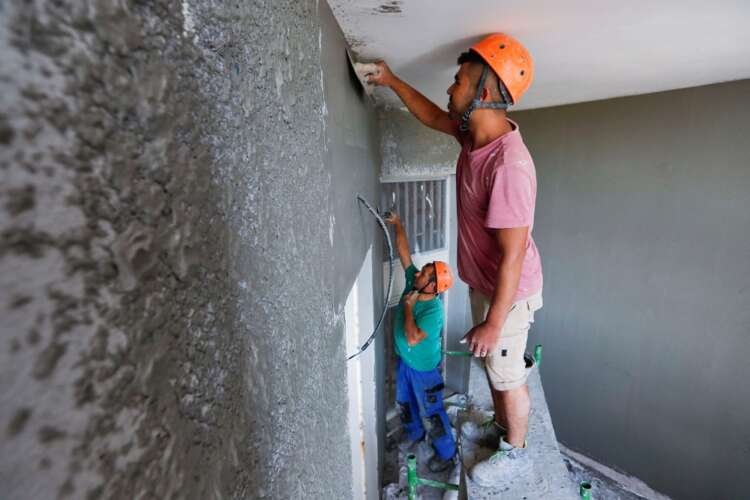
    This image depicts a construction site in Italy, symbolizing the halted projects due to a liquidity crisis in the construction sector. The article discusses Italy's construction boom and the recent challenges faced by builders, highlighting the impact of fraudulent tax credit schemes on the economy.
    Construction site in Italy showcasing halted building projects amid economic crisis - Global Banking & Finance Review
    Why waste money on news and opinion when you can access them for free?

    Take advantage of our newsletter subscription and stay informed on the go!

    Subscribe

    Tags:Construction industryeconomic growthfinancial crisissustainability

    By Gavin Jones

    ROME (Reuters) – Innovative incentives for people to green up their homes revived Italy’s construction sector last year, boosted its economy and drew international praise. A few months on it is close to ending in tears.

    The complex system of tradeable tax credits that supercharged the sector has ground to a halt, as the government clamps down due to suspicions of fraud, leaving builders unpaid for work done.

    They and a business lobby group are warning of tens of thousands of bankruptcies and lay-offs which could tip Italy’s weak economy into recession.

    Companies that have not been paid for about seven months have in turn stopped paying suppliers and consultants in a domino effect involving thousands of firms and workers.

    “We are heading for a disaster, not just for the construction industry but for the whole economy,” says Norbert Toth, whose building firm in the central coastal town of Formia has shed 20 of the 30 workers it had six months ago.

    The crisis is already starting to emerge in official data.

    Construction output fell in April for the first time in nine months, building sector confidence in May was the lowest for six months, and the construction purchasing managers’ index was the lowest since January 2021.

    Also potentially at risk are some of the 200 billion euros ($210 billion) of pandemic recovery funds Rome is due to get from Brussels. One condition for the pay-out is that Italy almost doubles the energy efficiency of its buildings by 2025 — something that could be in jeopardy without the incentives.

    LIQUIDITY CRISIS

    The highly vaunted schemes launched in 2020 have turned into a very Italian story of inventiveness, fraud and bureaucracy.

    Toth, 39, is co-founder of a group called National Construction Class Action, in which hundreds of small building companies like his own exchange messages and lobby politicians to try to keep the incentives alive.

    Some of the firms, desperate for liquidity, are offering to sell tax credits worth tens of thousands of euros at huge discounts of up to 50%.

    Under the most generous scheme, known as the “superbonus”, the state paid an eye-watering 110% of the cost of making buildings more energy-efficient, from insulation to solar panels to replacing old-fashioned boilers and window fittings.

    It allowed homeowners to deduct the cost of the building work from their taxes over a five year period, or sell the tax credit to the builder as a form of payment.

    The builder could then sell it at a discount to another firm or a bank, which could in turn sell it to another, much like any other financial instrument providing liquidity to the system.

    BOOST TO GROWTH

    Despite much red tape and frequent tweaks to the rules, the scheme seemed like a roaring success.

    Italy’s long-stagnant construction sector contributed 0.9 points of last year’s economic growth of 6.6%.

    In November, the European Commission’s Construction Sector Observatory called the superbonus “a very successful measure” and recommended it be extended to a wider range of buildings.

    Other European countries, including Germany, Spain and France offered their own subsidies for green home improvements, though none as generous as Italy’s.

    Then late last year tax police said they had found suspected fraud worth over 2 billion euros linked to green building incentives including, to a small degree, the superbonus.

    That rang alarm bells among policymakers and Prime Minister Mario Draghi began sharply criticising the measure, which was introduced by the previous administration and renewed by Draghi.

    “We don’t agree with the superbonus,” he told the European Parliament last month, in an unusual case of a government criticising one of its own policies.

    Draghi said it had not only spawned swindles but had also driven up costs because clients, knowing they would be reimbursed, had no need to bargain with builders over prices.

    Industry Minister Giancarlo Giorgetti said it was “drugging the sector and contributing to inflation”.

    This is not supported by Eurostat data showing Italian construction cost inflation in the fourth quarter of last year stood at 5.5%, well below the euro zone average of 8.9%.

    TIGHTER RULES

    In an anti-fraud drive, Draghi set limits on the number of times the tax credits could be sold from one bank or firm to another, undermining the mechanism the scheme was based on.

    Regulatory uncertainty and ministers’ hostile comments hit confidence and, one by one, the country’s largest banks stopped buying the tax credits from customers and builders, leaving them out of pocket for work done.

    “More than 33,000 firms risk bankruptcy with a loss of 150,000 jobs,” says Claudio Giovine, head of economic analysis at Italy’s small business lobby CNA.

    A survey of the group’s members this month showed 60,000 firms lack liquidity because they were unable to sell the tax credits they had accepted as payment for work.

    These blocked credits amount to more than 5 billion euros, the CNA estimates. As a result, 50% of the firms are delaying payments to their suppliers, 30% have stopped paying their taxes and 20% are not paying their workers, according to the survey. Almost 50% said they risk having to close their business.

    Whether last year’s boom turns into a full-blown bust depends on what is decided in the coming weeks.

    With the economy already stagnant, Italy’s alarmed parties have presented numerous proposals to parliament aimed at reviving the superbonus.

    These include extending the types of firms to whom banks can sell their tax credits to include small businesses with turnover above 50,000 euros, and allowing banks to use the credits to buy government bonds. It remains to be seen whether such ideas are acceptable to Draghi.

    The construction firm owner Toth said industry data over the summer will be “awful” and the only way to save the scheme is to restore the unlimited tradeability of the tax credits, despite acknowledging some firms may have bent the rules.

    “Last autumn everything was going so well,” he said. “It’s been truncated in such a brutal way.”

    ($1 = 0.9508 euros)

    (Additional reporting by Giuseppe Fonte; Editing by Alison Williams)

    Frequently Asked Questions about Analysis-Italy’s “drugged” construction boom hits a wall

    1What is a liquidity crisis?

    A liquidity crisis occurs when an organization or economy cannot meet its short-term financial obligations due to a lack of cash or easily convertible assets.

    2What are tradeable tax credits?

    Tradeable tax credits are financial instruments that allow taxpayers to transfer their tax credits to other entities, often used to incentivize investments in specific sectors like construction.

    3What is economic growth?

    Economic growth refers to an increase in the production of goods and services in an economy over a period, typically measured by the rise in Gross Domestic Product (GDP).

    4What is sustainability in construction?

    Sustainability in construction involves using resources efficiently to minimize environmental impact, focusing on energy efficiency, waste reduction, and sustainable materials.

    5What is a financial crisis?

    A financial crisis is a situation in which the value of financial institutions or assets drops significantly, leading to a loss of confidence and potential economic downturn.

    More from Top Stories

    Explore more articles in the Top Stories category

    Image for Lessons From the Ring and the Deal Table: How Boxing Shapes Steven Nigro’s Approach to Banking and Life
    Lessons From the Ring and the Deal Table: How Boxing Shapes Steven Nigro’s Approach to Banking and Life
    Image for Joe Kiani in 2025: Capital, Conviction, and a Focused Return to Innovation
    Joe Kiani in 2025: Capital, Conviction, and a Focused Return to Innovation
    Image for Marco Robinson – CLOSE THE DEAL AND SUDDENLY GROW RICH
    Marco Robinson – CLOSE THE DEAL AND SUDDENLY GROW RICH
    Image for Digital Tracing: Turning a regulatory obligation into a commercial advantage
    Digital Tracing: Turning a regulatory obligation into a commercial advantage
    Image for Exploring the Role of Blockchain and the Bitcoin Price Today in Education
    Exploring the Role of Blockchain and the Bitcoin Price Today in Education
    Image for Inside the World’s First Collection Industry Conglomerate: PCA Global’s Platform Strategy
    Inside the World’s First Collection Industry Conglomerate: PCA Global’s Platform Strategy
    Image for Chase Buchanan Private Wealth Management Highlights Key Autumn 2025 Budget Takeaways for Expats
    Chase Buchanan Private Wealth Management Highlights Key Autumn 2025 Budget Takeaways for Expats
    Image for PayLaju Strengthens Its Position as Malaysia’s Trusted Interest-Free Sharia-Compliant Loan Provider
    PayLaju Strengthens Its Position as Malaysia’s Trusted Interest-Free Sharia-Compliant Loan Provider
    Image for A Notable Update for Employee Health Benefits:
    A Notable Update for Employee Health Benefits:
    Image for Creating Equity Between Walls: How Mohak Chauhan is Using Engineering, Finance, and Community Vision to Reengineer Affordable Housing
    Creating Equity Between Walls: How Mohak Chauhan is Using Engineering, Finance, and Community Vision to Reengineer Affordable Housing
    Image for Upcoming Book on Real Estate Investing: Harvard Grace Capital Founder Stewart Heath’s Puts Lessons in Print
    Upcoming Book on Real Estate Investing: Harvard Grace Capital Founder Stewart Heath’s Puts Lessons in Print
    Image for ELECTIVA MARKS A LANDMARK FIRST YEAR WITH MAJOR SENIOR APPOINTMENTS AND EXPANSION MILESTONES
    ELECTIVA MARKS A LANDMARK FIRST YEAR WITH MAJOR SENIOR APPOINTMENTS AND EXPANSION MILESTONES
    View All Top Stories Posts
    Previous Top Stories PostBrexit will cost UK workers 470 pounds a year, study predicts
    Next Top Stories PostExplainer-Why is there a worldwide oil-refining crunch?