Search
00
GBAF Logo
trophy
Top StoriesInterviewsBusinessFinanceBankingTechnologyInvestingTradingVideosAwardsMagazinesHeadlinesTrends

Subscribe to our newsletter

Get the latest news and updates from our team.

Global Banking & Finance Review®

Global Banking & Finance Review® - Subscribe to our newsletter

Company

    GBAF Logo
    • About Us
    • Profile
    • Privacy & Cookie Policy
    • Terms of Use
    • Contact Us
    • Advertising
    • Submit Post
    • Latest News
    • Research Reports
    • Press Release
    • Awards▾
      • About the Awards
      • Awards TimeTable
      • Submit Nominations
      • Testimonials
      • Media Room
      • Award Winners
      • FAQ
    • Magazines▾
      • Global Banking & Finance Review Magazine Issue 79
      • Global Banking & Finance Review Magazine Issue 78
      • Global Banking & Finance Review Magazine Issue 77
      • Global Banking & Finance Review Magazine Issue 76
      • Global Banking & Finance Review Magazine Issue 75
      • Global Banking & Finance Review Magazine Issue 73
      • Global Banking & Finance Review Magazine Issue 71
      • Global Banking & Finance Review Magazine Issue 70
      • Global Banking & Finance Review Magazine Issue 69
      • Global Banking & Finance Review Magazine Issue 66
    Top StoriesInterviewsBusinessFinanceBankingTechnologyInvestingTradingVideosAwardsMagazinesHeadlinesTrends

    Global Banking & Finance Review® is a leading financial portal and online magazine offering News, Analysis, Opinion, Reviews, Interviews & Videos from the world of Banking, Finance, Business, Trading, Technology, Investing, Brokerage, Foreign Exchange, Tax & Legal, Islamic Finance, Asset & Wealth Management.
    Copyright © 2010-2026 GBAF Publications Ltd - All Rights Reserved. | Sitemap | Tags | Developed By eCorpIT

    Editorial & Advertiser disclosure

    Global Banking & Finance Review® is an online platform offering news, analysis, and opinion on the latest trends, developments, and innovations in the banking and finance industry worldwide. The platform covers a diverse range of topics, including banking, insurance, investment, wealth management, fintech, and regulatory issues. The website publishes news, press releases, opinion and advertorials on various financial organizations, products and services which are commissioned from various Companies, Organizations, PR agencies, Bloggers etc. These commissioned articles are commercial in nature. This is not to be considered as financial advice and should be considered only for information purposes. It does not reflect the views or opinion of our website and is not to be considered an endorsement or a recommendation. We cannot guarantee the accuracy or applicability of any information provided with respect to your individual or personal circumstances. Please seek Professional advice from a qualified professional before making any financial decisions. We link to various third-party websites, affiliate sales networks, and to our advertising partners websites. When you view or click on certain links available on our articles, our partners may compensate us for displaying the content to you or make a purchase or fill a form. This will not incur any additional charges to you. To make things simpler for you to identity or distinguish advertised or sponsored articles or links, you may consider all articles or links hosted on our site as a commercial article placement. We will not be responsible for any loss you may suffer as a result of any omission or inaccuracy on the website.

    Home > Top Stories > Analysis-Hungary’s sliding forint pressures PM Orban to reach deal on EU funds
    Top Stories

    Analysis-Hungary’s sliding forint pressures PM Orban to reach deal on EU funds

    Published by Jessica Weisman-Pitts

    Posted on June 27, 2022

    5 min read

    Last updated: February 6, 2026

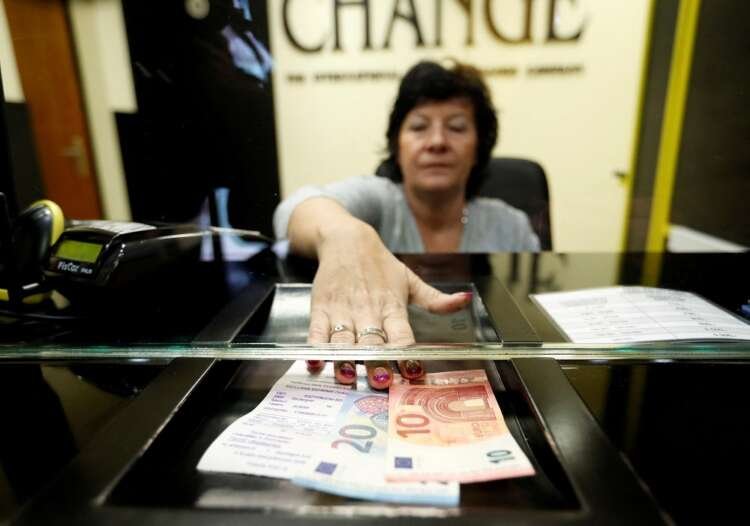
    A woman exchanges Hungarian forints for euros at a currency shop, reflecting the financial pressure on Hungary as the forint falls. This scene is crucial in understanding the implications of EU fund negotiations for Hungary's economy.
    Woman exchanging forints for euros, highlighting Hungary's economic challenges - Global Banking & Finance Review
    Why waste money on news and opinion when you can access them for free?

    Take advantage of our newsletter subscription and stay informed on the go!

    Subscribe

    Tags:European Commissionforeign exchangefinancial stabilityeconomic growth

    By Krisztina Than

    BUDAPEST (Reuters) – The Hungarian forint fell to a record low against the euro on Monday, exposing the economy’s vulnerabilities and putting pressure on Prime Minister Viktor Orban to reach a deal with Brussels on the release of frozen European Union funds.

    Unblocking access to about 15.5 billion euros of EU recovery fund grants and loans, pending approval by the EU’s executive Commission, could boost the forint and trigger a winding down of short positions built up against the currency, while also driving down government bond yields, analysts said.

    In the absence of a deal, the forint will stay on a weakening trajectory, complicating efforts to curb double-digit inflation and exposing Hungarian assets to any negative shift in sentiment amid the war in neighbouring Ukraine and surging energy costs.

    The EU funds are also needed to bolster the Hungarian economy which is expected to slow in the second half of the year as rapidly rising interest rates and inflation bite.

    Like most EU countries, Hungary last year submitted its blueprint on how it would use EU grants to make its economy more environmentally friendly and high-tech after the COVID-19 pandemic.

    But unlike the blueprints of most other countries, Hungary has yet to receive approval because of EU concerns over corruption, judicial independence and the rule of law.

    Hungary’s vulnerabilities have increased this year. Its current account gap has widened mostly due to its high energy imports bill at a time when the government has only just started to rein in a huge budget deficit, after a spending spree which helped Orban win a landslide in April elections.

    “With uncertainty over EU funds and the EM backdrop, we prefer to keep a dislike stance on HUF,” Morgan Stanley said in a note on Friday, referring to the currency.

    “The recent FX underperformance and rise in HUF yields increase pressure on the government to strike a deal,” Citigroup analysts said.

    On Monday, a day before the NBH is expected to hike interest rates again, the forint fell to a record low 404.50. It has weakened 8.6% so far this year, decoupling from its peers in the region.

    The Polish zloty has eased 2.2%, while the Czech crown has gained half a percent, supported by hefty rate hikes and, since May, central bank interventions to prevent weakening.

    The Czech National Bank has ample ammunition, holding 156.1 billion euros in international reserves at the end of May.

    The NBH, which has lifted its base rate by over 500 basis points in the past 12 months, is expected to raise the rate by another 50 bps to 6.4% on Tuesday, but some analysts pencilled in a bigger rise. The bank, which raised its one-week deposit rate to 7.25% on June 16, had 34 billion euros in international reserves at the end of May.

    On June 9, Hungary issued foreign currency bonds worth $3.8 billion, which increased reserves, but those still pale in comparison with Czech levels. The NBH never communicates its moves in currency markets.

    “It is not a coincidence that the forint has decoupled from the region to such an extent. As long as there is no EU deal, this will not change,” said Peter Virovacz at ING in Budapest.

    NO DEAL IN SIGHT YET

    In past weeks, senior Hungarian government officials have flagged that an agreement with Brussels is just around the corner, but nothing has emerged yet.

    Last Thursday, Balazs Orban, political director for the prime minister, told Reuters that Budapest would welcome detailed recommendations from the EU Commission on exactly what it must change in its laws to get the EU funds flowing.

    Orban, who is not related to the prime minister, said Hungary was “open to a compromise” to reach a deal.

    “We are prepared for all scenarios – we can move fast if necessary, but we are also prepared that we will have to survive without the funds,” he said. “It is not a good scenario for us but we are financially prepared.”

    But analysts say this is a scenario Hungary should avoid or risk a sharper market sell-off.

    “We pencil in the EUR/HUF moving to 420 by the end of the year and negative returns against forwards. The risk is toward a sharper/faster sell-off amid thin liquidity and in periods of negative sentiment swings,” Societe Generale said last week. “These may occur in response to negative developments in the rule of law spat.”

    On Monday, the government did not reply to emailed Reuters questions on the state of talks with the EU.

    This month the European Commission approved billions of euros in COVID-19 recovery funds for Poland after withholding approval for a year on the grounds that Warsaw has damaged democracy. But the money will not flow until Warsaw makes reforms to its judiciary.

    ($1 = 381.0100 forints)

    (Additional reporting by Jason Hovet in Prague; Editing by Nick Macfie)

    Frequently Asked Questions about Analysis-Hungary’s sliding forint pressures PM Orban to reach deal on EU funds

    1What is the forint?

    The forint is the official currency of Hungary, abbreviated as HUF. It is used for all transactions within the country and is managed by the National Bank of Hungary.

    2What are EU funds?

    EU funds refer to financial resources provided by the European Union to member states for various purposes, including economic development, infrastructure projects, and recovery efforts.

    3What is inflation?

    Inflation is the rate at which the general level of prices for goods and services rises, eroding purchasing power. It is often measured by the Consumer Price Index (CPI).

    4What is a current account gap?

    A current account gap occurs when a country's total imports of goods, services, and transfers exceed its total exports. This can indicate economic instability.

    More from Top Stories

    Explore more articles in the Top Stories category

    Image for Lessons From the Ring and the Deal Table: How Boxing Shapes Steven Nigro’s Approach to Banking and Life
    Lessons From the Ring and the Deal Table: How Boxing Shapes Steven Nigro’s Approach to Banking and Life
    Image for Joe Kiani in 2025: Capital, Conviction, and a Focused Return to Innovation
    Joe Kiani in 2025: Capital, Conviction, and a Focused Return to Innovation
    Image for Marco Robinson – CLOSE THE DEAL AND SUDDENLY GROW RICH
    Marco Robinson – CLOSE THE DEAL AND SUDDENLY GROW RICH
    Image for Digital Tracing: Turning a regulatory obligation into a commercial advantage
    Digital Tracing: Turning a regulatory obligation into a commercial advantage
    Image for Exploring the Role of Blockchain and the Bitcoin Price Today in Education
    Exploring the Role of Blockchain and the Bitcoin Price Today in Education
    Image for Inside the World’s First Collection Industry Conglomerate: PCA Global’s Platform Strategy
    Inside the World’s First Collection Industry Conglomerate: PCA Global’s Platform Strategy
    Image for Chase Buchanan Private Wealth Management Highlights Key Autumn 2025 Budget Takeaways for Expats
    Chase Buchanan Private Wealth Management Highlights Key Autumn 2025 Budget Takeaways for Expats
    Image for PayLaju Strengthens Its Position as Malaysia’s Trusted Interest-Free Sharia-Compliant Loan Provider
    PayLaju Strengthens Its Position as Malaysia’s Trusted Interest-Free Sharia-Compliant Loan Provider
    Image for A Notable Update for Employee Health Benefits:
    A Notable Update for Employee Health Benefits:
    Image for Creating Equity Between Walls: How Mohak Chauhan is Using Engineering, Finance, and Community Vision to Reengineer Affordable Housing
    Creating Equity Between Walls: How Mohak Chauhan is Using Engineering, Finance, and Community Vision to Reengineer Affordable Housing
    Image for Upcoming Book on Real Estate Investing: Harvard Grace Capital Founder Stewart Heath’s Puts Lessons in Print
    Upcoming Book on Real Estate Investing: Harvard Grace Capital Founder Stewart Heath’s Puts Lessons in Print
    Image for ELECTIVA MARKS A LANDMARK FIRST YEAR WITH MAJOR SENIOR APPOINTMENTS AND EXPANSION MILESTONES
    ELECTIVA MARKS A LANDMARK FIRST YEAR WITH MAJOR SENIOR APPOINTMENTS AND EXPANSION MILESTONES
    View All Top Stories Posts
    Previous Top Stories PostQueen Elizabeth heads to Scotland for ‘Royal Week’
    Next Top Stories PostG7: we will stand with Ukraine ‘for as long as it takes’