Search
00
GBAF Logo
trophy
Top StoriesInterviewsBusinessFinanceBankingTechnologyInvestingTradingVideosAwardsMagazinesHeadlinesTrends

Subscribe to our newsletter

Get the latest news and updates from our team.

Global Banking & Finance Review®

Global Banking & Finance Review® - Subscribe to our newsletter

Company

    GBAF Logo
    • About Us
    • Profile
    • Privacy & Cookie Policy
    • Terms of Use
    • Contact Us
    • Advertising
    • Submit Post
    • Latest News
    • Research Reports
    • Press Release
    • Awards▾
      • About the Awards
      • Awards TimeTable
      • Submit Nominations
      • Testimonials
      • Media Room
      • Award Winners
      • FAQ
    • Magazines▾
      • Global Banking & Finance Review Magazine Issue 79
      • Global Banking & Finance Review Magazine Issue 78
      • Global Banking & Finance Review Magazine Issue 77
      • Global Banking & Finance Review Magazine Issue 76
      • Global Banking & Finance Review Magazine Issue 75
      • Global Banking & Finance Review Magazine Issue 73
      • Global Banking & Finance Review Magazine Issue 71
      • Global Banking & Finance Review Magazine Issue 70
      • Global Banking & Finance Review Magazine Issue 69
      • Global Banking & Finance Review Magazine Issue 66
    Top StoriesInterviewsBusinessFinanceBankingTechnologyInvestingTradingVideosAwardsMagazinesHeadlinesTrends

    Global Banking & Finance Review® is a leading financial portal and online magazine offering News, Analysis, Opinion, Reviews, Interviews & Videos from the world of Banking, Finance, Business, Trading, Technology, Investing, Brokerage, Foreign Exchange, Tax & Legal, Islamic Finance, Asset & Wealth Management.
    Copyright © 2010-2026 GBAF Publications Ltd - All Rights Reserved. | Sitemap | Tags | Developed By eCorpIT

    Editorial & Advertiser disclosure

    Global Banking & Finance Review® is an online platform offering news, analysis, and opinion on the latest trends, developments, and innovations in the banking and finance industry worldwide. The platform covers a diverse range of topics, including banking, insurance, investment, wealth management, fintech, and regulatory issues. The website publishes news, press releases, opinion and advertorials on various financial organizations, products and services which are commissioned from various Companies, Organizations, PR agencies, Bloggers etc. These commissioned articles are commercial in nature. This is not to be considered as financial advice and should be considered only for information purposes. It does not reflect the views or opinion of our website and is not to be considered an endorsement or a recommendation. We cannot guarantee the accuracy or applicability of any information provided with respect to your individual or personal circumstances. Please seek Professional advice from a qualified professional before making any financial decisions. We link to various third-party websites, affiliate sales networks, and to our advertising partners websites. When you view or click on certain links available on our articles, our partners may compensate us for displaying the content to you or make a purchase or fill a form. This will not incur any additional charges to you. To make things simpler for you to identity or distinguish advertised or sponsored articles or links, you may consider all articles or links hosted on our site as a commercial article placement. We will not be responsible for any loss you may suffer as a result of any omission or inaccuracy on the website.

    Home > Top Stories > Analysis-How the Ukraine conflict is reshaping global oil markets
    Top Stories

    Analysis-How the Ukraine conflict is reshaping global oil markets

    Published by Wanda Rich

    Posted on May 30, 2022

    4 min read

    Last updated: February 6, 2026

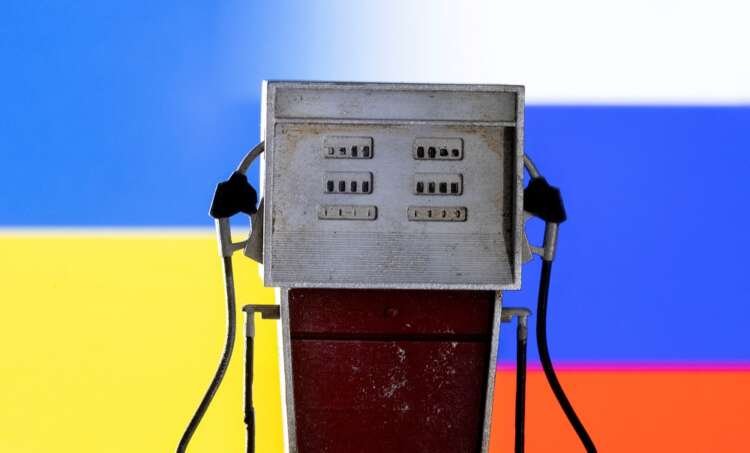
    This image illustrates a petrol pump colored in the flag designs of Ukraine and Russia, representing the ongoing shifts in global oil markets due to the Ukraine conflict. It highlights the implications for European oil supply and Russia's strategy to redirect exports towards Asia.
    Illustration of petrol pump with Ukraine and Russian flags, symbolizing oil market shifts - Global Banking & Finance Review
    Why waste money on news and opinion when you can access them for free?

    Take advantage of our newsletter subscription and stay informed on the go!

    Subscribe

    Tags:oil and gasInternational tradeenergy marketfinancial marketseconomic growth

    By Alex Lawler

    LONDON (Reuters) – Russia’s invasion of Ukraine has reconfigured the global oil market, with African suppliers stepping in to meet European demand and Moscow, stung by Western sanctions, increasingly tapping risky ship-to-ship transfers to get its crude to Asia.

    The reroutings mark the biggest supply-side shakeup of the global oil trade since the U.S. shale revolution altered the shape of the market around a decade ago and suggest Russia will be able to navigate a European Union (EU) oil ban, provided Asia and China continue to buy its crude.

    Sanctions imposed on Moscow after the conflict in Ukraine kicked off in February, including a U.S. ban on its oil imports, have prompted Russia to pivot away from Europe, where its crude is shunned, to customers in India and China who are picking up cargoes at a steep discount, according to industry data and traders.

    Russian exports were back to pre-invasion levels in April, according to data from the Paris-based International Energy Agency and oil prices have stabilised around $110 after hitting a 14-year high above $139 a barrel in March.

    Even if the EU agrees to an oil ban in its next round of Russian sanctions, analysts said the impact could be tempered by demand from Asia.

    “Unless the West puts diplomatic pressure on Asian buyers, we do not see the supply gap widening and oil prices spiking,” said Norbert Rücker of Julius Baer.

    A complex patchwork of U.S., EU and British sanctions have prohibited Russian-owned or flagged ships from calling at ports meaning that some of the increased trade to Asia is being facilitated via ship-to-ship transfer at sea — a costly process where the risk of spills is greater.

    Overall, the flow of Russian oil to Asia via the sea has jumped at least 50% since the start of the year, according to tanker-tracker Petro-Logistics and other data.

    Transfers between vessels, which account for a small fraction of the overall sea trade, have shifted away from the Danish coast to the Mediterranean Sea to avoid sanctions and protests.

    “Ship-to-ship (STS) transfers were common in Danish waters, at the entry point of the Baltic Sea,” Petro-Logistics President Mark Gerber told Reuters. “Those are not happening anymore; hence the STS trend of sanctioned tanker to non-sanctioned tanker increasing in the warmer and friendlier Mediterranean waters.”

    Gerber put the volumes of Russian crude and products being transferred between tankers in the Mediterranean at about 400,000 barrels per day (bpd), of which the majority is going to Asia, adding to the 2.3 million bpd going directly.

    In January, before the invasion, around 1.5 million bpd were being sent directly to Asia.

    Russian oil is loaded on Aframax or Suezmax tankers that carry less than 1 million barrels and it is transferred at sea to larger vessels that can take 2 million barrels, making shipping more cost effective, traders said.

    The seaborne volumes are only part of the total exports from Russia. Including pipeline supplies, total Russian crude and products exports increased to just above 8 million bpd in April, back to the pre-invasion rate.

    WEST AFRICAN CRUDE

    To compensate for the loss of Russian oil, European refiners have been turning to imports of West African crude, which are up 17% in April compared to the 2018-2021 average according to Petro-Logistics.

    Eikon data also shows an increase and indicates 660,000 bpd mostly from Nigeria, Angola and Cameroon is arriving in northwest Europe in May, with three cargoes of Nigerian Amenam coming compared to one in February.

    Volumes of west African crude to India, meanwhile, have nearly halved, according to Gerber, with 280,000 bpd delivered in April from 510,000 bpd in March as Delhi switches to Russian supply.

    With European demand red-hot, the prices of Nigerian light, sweet crude grades in particular are hitting record highs, according to traders, with Forcados crude for example offered at a premium of at least $7 to Brent.

    Supply from North Africa to Europe is up by 30% since March, Petro-Logistics said. Of this, Eikon data indicates arrivals into northwest Europe from Egypt’s Sidi Kerir port, which analysts say is likely Saudi crude, will almost double versus March to above 400,000 bpd in May.

    The United States has also boosted supply to Europe. European crude imports in May from the U.S. on a delivered basis are up over 15% versus March, according to tracking company Kpler, the highest monthly pace in its records. Europe has discharged about 1.45 million bpd of crude from the United States.

    (Additional reporting by Jonathan Saul, editing by Carmel Crimmins)

    Frequently Asked Questions about Analysis-How the Ukraine conflict is reshaping global oil markets

    1What is crude oil?

    Crude oil is a natural, unrefined petroleum product composed of hydrocarbon deposits and other organic materials. It is extracted from the ground and refined into various products, including gasoline, diesel, and other petrochemicals.

    2What are sanctions?

    Sanctions are restrictions imposed by countries or international organizations to influence or punish a nation or group. They can include trade barriers, tariffs, and financial restrictions aimed at altering behavior or policies.

    3What is the significance of oil prices?

    Oil prices are crucial as they impact the global economy, influencing inflation, transportation costs, and energy expenses. Fluctuations in oil prices can affect consumer behavior and economic growth.

    More from Top Stories

    Explore more articles in the Top Stories category

    Image for Lessons From the Ring and the Deal Table: How Boxing Shapes Steven Nigro’s Approach to Banking and Life
    Lessons From the Ring and the Deal Table: How Boxing Shapes Steven Nigro’s Approach to Banking and Life
    Image for Joe Kiani in 2025: Capital, Conviction, and a Focused Return to Innovation
    Joe Kiani in 2025: Capital, Conviction, and a Focused Return to Innovation
    Image for Marco Robinson – CLOSE THE DEAL AND SUDDENLY GROW RICH
    Marco Robinson – CLOSE THE DEAL AND SUDDENLY GROW RICH
    Image for Digital Tracing: Turning a regulatory obligation into a commercial advantage
    Digital Tracing: Turning a regulatory obligation into a commercial advantage
    Image for Exploring the Role of Blockchain and the Bitcoin Price Today in Education
    Exploring the Role of Blockchain and the Bitcoin Price Today in Education
    Image for Inside the World’s First Collection Industry Conglomerate: PCA Global’s Platform Strategy
    Inside the World’s First Collection Industry Conglomerate: PCA Global’s Platform Strategy
    Image for Chase Buchanan Private Wealth Management Highlights Key Autumn 2025 Budget Takeaways for Expats
    Chase Buchanan Private Wealth Management Highlights Key Autumn 2025 Budget Takeaways for Expats
    Image for PayLaju Strengthens Its Position as Malaysia’s Trusted Interest-Free Sharia-Compliant Loan Provider
    PayLaju Strengthens Its Position as Malaysia’s Trusted Interest-Free Sharia-Compliant Loan Provider
    Image for A Notable Update for Employee Health Benefits:
    A Notable Update for Employee Health Benefits:
    Image for Creating Equity Between Walls: How Mohak Chauhan is Using Engineering, Finance, and Community Vision to Reengineer Affordable Housing
    Creating Equity Between Walls: How Mohak Chauhan is Using Engineering, Finance, and Community Vision to Reengineer Affordable Housing
    Image for Upcoming Book on Real Estate Investing: Harvard Grace Capital Founder Stewart Heath’s Puts Lessons in Print
    Upcoming Book on Real Estate Investing: Harvard Grace Capital Founder Stewart Heath’s Puts Lessons in Print
    Image for ELECTIVA MARKS A LANDMARK FIRST YEAR WITH MAJOR SENIOR APPOINTMENTS AND EXPANSION MILESTONES
    ELECTIVA MARKS A LANDMARK FIRST YEAR WITH MAJOR SENIOR APPOINTMENTS AND EXPANSION MILESTONES
    View All Top Stories Posts
    Previous Top Stories PostHow a cheap component could help kill off combustion cars
    Next Top Stories PostEuro zone sentiment barely changed in May, inflation expectations ease