Search
00
GBAF Logo
trophy
Top StoriesInterviewsBusinessFinanceBankingTechnologyInvestingTradingVideosAwardsMagazinesHeadlinesTrends

Subscribe to our newsletter

Get the latest news and updates from our team.

Global Banking & Finance Review®

Global Banking & Finance Review® - Subscribe to our newsletter

Company

    GBAF Logo
    • About Us
    • Profile
    • Privacy & Cookie Policy
    • Terms of Use
    • Contact Us
    • Advertising
    • Submit Post
    • Latest News
    • Research Reports
    • Press Release
    • Awards▾
      • About the Awards
      • Awards TimeTable
      • Submit Nominations
      • Testimonials
      • Media Room
      • Award Winners
      • FAQ
    • Magazines▾
      • Global Banking & Finance Review Magazine Issue 79
      • Global Banking & Finance Review Magazine Issue 78
      • Global Banking & Finance Review Magazine Issue 77
      • Global Banking & Finance Review Magazine Issue 76
      • Global Banking & Finance Review Magazine Issue 75
      • Global Banking & Finance Review Magazine Issue 73
      • Global Banking & Finance Review Magazine Issue 71
      • Global Banking & Finance Review Magazine Issue 70
      • Global Banking & Finance Review Magazine Issue 69
      • Global Banking & Finance Review Magazine Issue 66
    Top StoriesInterviewsBusinessFinanceBankingTechnologyInvestingTradingVideosAwardsMagazinesHeadlinesTrends

    Global Banking & Finance Review® is a leading financial portal and online magazine offering News, Analysis, Opinion, Reviews, Interviews & Videos from the world of Banking, Finance, Business, Trading, Technology, Investing, Brokerage, Foreign Exchange, Tax & Legal, Islamic Finance, Asset & Wealth Management.
    Copyright © 2010-2026 GBAF Publications Ltd - All Rights Reserved. | Sitemap | Tags | Developed By eCorpIT

    Editorial & Advertiser disclosure

    Global Banking & Finance Review® is an online platform offering news, analysis, and opinion on the latest trends, developments, and innovations in the banking and finance industry worldwide. The platform covers a diverse range of topics, including banking, insurance, investment, wealth management, fintech, and regulatory issues. The website publishes news, press releases, opinion and advertorials on various financial organizations, products and services which are commissioned from various Companies, Organizations, PR agencies, Bloggers etc. These commissioned articles are commercial in nature. This is not to be considered as financial advice and should be considered only for information purposes. It does not reflect the views or opinion of our website and is not to be considered an endorsement or a recommendation. We cannot guarantee the accuracy or applicability of any information provided with respect to your individual or personal circumstances. Please seek Professional advice from a qualified professional before making any financial decisions. We link to various third-party websites, affiliate sales networks, and to our advertising partners websites. When you view or click on certain links available on our articles, our partners may compensate us for displaying the content to you or make a purchase or fill a form. This will not incur any additional charges to you. To make things simpler for you to identity or distinguish advertised or sponsored articles or links, you may consider all articles or links hosted on our site as a commercial article placement. We will not be responsible for any loss you may suffer as a result of any omission or inaccuracy on the website.

    Home > Top Stories > Analysis: For central bankers, tighter financial conditions may be an ally
    Top Stories

    Analysis: For central bankers, tighter financial conditions may be an ally

    Published by Wanda Rich

    Posted on June 15, 2022

    4 min read

    Last updated: February 6, 2026

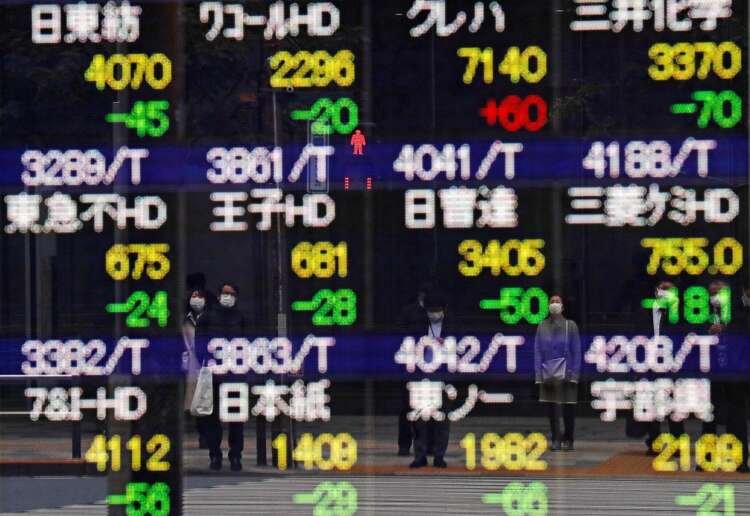
    A quotation board in Tokyo reflects pedestrians, symbolizing the impact of tightening financial conditions on global markets as discussed in the article. The image represents the current turbulence in bond yields and stock markets.
    Quotation board reflecting pedestrians, symbolizing global financial markets - Global Banking & Finance Review
    Why waste money on news and opinion when you can access them for free?

    Take advantage of our newsletter subscription and stay informed on the go!

    Subscribe

    Tags:GDPfinancial marketsmonetary policyeconomic growth

    By Tommy Wilkes and Dhara Ranasinghe

    LONDON (Reuters) – Slumping stocks and surging bond yields are rapidly crimping global financial conditions, yet given their effect on dampening economic growth and eventually inflation, the moves might be welcomed by the Federal Reserve and other central banks.

    Financial conditions is the umbrella phrase for how metrics such as exchange rates, equity swings and borrowing costs affect the availability of funding for households and businesses. Tighter conditions are widely seen as heralding a growth slowdown and vice-versa.

    So the recent sell-off in global markets – driven by signs of faster-than-anticipated interest rate rises in the United States and Europe – is contributing to a sharp contraction in financial conditions.

    The widely used Goldman Sachs U.S. financial conditions index (FCI) shows a 100 basis points (bps) tightening this month alone. The last time the U.S. FCI contracted as sharply was during the February-March 2020 COVID-linked sell-off, Goldman data shows.

    Goldman’s rule of thumb is that a persistent 100 bps FCI tightening slows GDP by about one percentage point after a year, in turn slowing inflation by roughly 0.1 percentage point.

    The contraction picked up speed amid a markets sell-off that took U.S. Treasury yields to the highest in over a decade, confirmed a bear market in U.S. shares and sent yield premia on top-grade U.S. corporate debt to the highest in years..

    Yields have soared too in Europe, where rate expectations have repriced higher and interbank lending rates saw their biggest daily rise in over 10 years on Tuesday.

    But while the FCI tightening appears alarming, it may not be for central banks, which face inflation at multi-decade highs; in fact the latest sell-off was sparked by above-forecast U.S. inflation for May of 8.1%.

    All the more so because, as BlueBay Asset Management CIO Mark Dowding points out, Goldman’s FCI remains in line with its 30-year average of around 99.8. Another FCI compiled by the Chicago Fed shows U.S. conditions well below their 50-year average.

    “Central banks are clearly managing their messaging with one eye on financial conditions and at this point in time they wouldn’t want them to be much easier, that would more likely make them become more hawkish,” Dowding said.

    An inversion in the U.S. Treasury yield curve this week shows fears are growing of a recession triggered by aggressive rate hikes.

    So if tighter conditions force growth to slow, bring down inflation expectations and thus enable fewer rate hikes down the line, markets may be doing central bankers’ job for them.

    “The looser conditions are today, the greater the risk of higher inflation tomorrow,” said Fahad Kamal, CIO at Kleinwort Hambros.

    “The fact they are tightening is a good thing. Conditions are still a long ways off being tight, they have gone from being crazy loose to just loose.”

    HOLD IT

    What is alarming some observers is the rapid cooling of economies outside the United States.

    Data compiled by Robin Brooks, chief economist at the Institute of International Finance, shows government borrowing costs, especially for long 30-year maturities, are rising faster than in the United States.

    That signals a “global recession is coming”, Brooks said.

    The differential between U.S. and foreign bond yields has shrunk to an average 1.09% this month from 1.6% in January, his data shows. The gap was at 0.67% in July 2020 when central banks were forced to slashed rates as the COVID-19 pandemic hit.

    The jump in German yields is particularly notable as the European Central Bank prepares to raise rates for the first time in 11 years.

    Rate-sensitive two-year German yields are up 67 bps in June, the biggest monthly jump since 1989, while since the start of April they have soared 124 bps, outpacing a 104 bps rise in U.S. two-year yields.

    Equivalent yields in Australia are 150 bps higher and in Britain they are up around 75 bps since April.

    Goldman’s global FCI is at the highest since 2009, indicating financial conditions have tightened by around 335 bps since the start of the year.

    (Additional reporting by Sujata Rao and Yoruk Bahceli; Editing by Sujata Rao and Mark Potter)

    Frequently Asked Questions about Analysis: For central bankers, tighter financial conditions may be an ally

    1What is financial conditions?

    Financial conditions refer to the overall state of financial markets, including metrics like exchange rates, equity swings, and borrowing costs, which affect the availability of funding for households and businesses.

    2What is inflation?

    Inflation is the rate at which the general level of prices for goods and services rises, leading to a decrease in purchasing power. Central banks often aim to control inflation through monetary policy.

    3What is a bear market?

    A bear market is a period in which prices in a financial market decline by 20% or more from recent highs, typically associated with widespread pessimism and negative investor sentiment.

    4What is a financial conditions index (FCI)?

    A Financial Conditions Index (FCI) is a statistical measure that summarizes the overall state of financial conditions in an economy, incorporating factors like interest rates, stock prices, and credit spreads.

    More from Top Stories

    Explore more articles in the Top Stories category

    Image for Lessons From the Ring and the Deal Table: How Boxing Shapes Steven Nigro’s Approach to Banking and Life
    Lessons From the Ring and the Deal Table: How Boxing Shapes Steven Nigro’s Approach to Banking and Life
    Image for Joe Kiani in 2025: Capital, Conviction, and a Focused Return to Innovation
    Joe Kiani in 2025: Capital, Conviction, and a Focused Return to Innovation
    Image for Marco Robinson – CLOSE THE DEAL AND SUDDENLY GROW RICH
    Marco Robinson – CLOSE THE DEAL AND SUDDENLY GROW RICH
    Image for Digital Tracing: Turning a regulatory obligation into a commercial advantage
    Digital Tracing: Turning a regulatory obligation into a commercial advantage
    Image for Exploring the Role of Blockchain and the Bitcoin Price Today in Education
    Exploring the Role of Blockchain and the Bitcoin Price Today in Education
    Image for Inside the World’s First Collection Industry Conglomerate: PCA Global’s Platform Strategy
    Inside the World’s First Collection Industry Conglomerate: PCA Global’s Platform Strategy
    Image for Chase Buchanan Private Wealth Management Highlights Key Autumn 2025 Budget Takeaways for Expats
    Chase Buchanan Private Wealth Management Highlights Key Autumn 2025 Budget Takeaways for Expats
    Image for PayLaju Strengthens Its Position as Malaysia’s Trusted Interest-Free Sharia-Compliant Loan Provider
    PayLaju Strengthens Its Position as Malaysia’s Trusted Interest-Free Sharia-Compliant Loan Provider
    Image for A Notable Update for Employee Health Benefits:
    A Notable Update for Employee Health Benefits:
    Image for Creating Equity Between Walls: How Mohak Chauhan is Using Engineering, Finance, and Community Vision to Reengineer Affordable Housing
    Creating Equity Between Walls: How Mohak Chauhan is Using Engineering, Finance, and Community Vision to Reengineer Affordable Housing
    Image for Upcoming Book on Real Estate Investing: Harvard Grace Capital Founder Stewart Heath’s Puts Lessons in Print
    Upcoming Book on Real Estate Investing: Harvard Grace Capital Founder Stewart Heath’s Puts Lessons in Print
    Image for ELECTIVA MARKS A LANDMARK FIRST YEAR WITH MAJOR SENIOR APPOINTMENTS AND EXPANSION MILESTONES
    ELECTIVA MARKS A LANDMARK FIRST YEAR WITH MAJOR SENIOR APPOINTMENTS AND EXPANSION MILESTONES
    View All Top Stories Posts
    Previous Top Stories PostAnalysis-How it came to this: The Fed and White House’s slow inflation awakening
    Next Top Stories PostChina’s factories perk up, but frail consumption points to weak economic recovery