Search
00
GBAF Logo
trophy
Top StoriesInterviewsBusinessFinanceBankingTechnologyInvestingTradingVideosAwardsMagazinesHeadlinesTrends

Subscribe to our newsletter

Get the latest news and updates from our team.

Global Banking and Finance Review

Global Banking & Finance Review

Company

    GBAF Logo
    • About Us
    • Profile
    • Privacy & Cookie Policy
    • Terms of Use
    • Contact Us
    • Advertising
    • Submit Post
    • Latest News
    • Research Reports
    • Press Release
    • Awards▾
      • About the Awards
      • Awards TimeTable
      • Submit Nominations
      • Testimonials
      • Media Room
      • Award Winners
      • FAQ
    • Magazines▾
      • Global Banking & Finance Review Magazine Issue 79
      • Global Banking & Finance Review Magazine Issue 78
      • Global Banking & Finance Review Magazine Issue 77
      • Global Banking & Finance Review Magazine Issue 76
      • Global Banking & Finance Review Magazine Issue 75
      • Global Banking & Finance Review Magazine Issue 73
      • Global Banking & Finance Review Magazine Issue 71
      • Global Banking & Finance Review Magazine Issue 70
      • Global Banking & Finance Review Magazine Issue 69
      • Global Banking & Finance Review Magazine Issue 66
    Top StoriesInterviewsBusinessFinanceBankingTechnologyInvestingTradingVideosAwardsMagazinesHeadlinesTrends

    Global Banking & Finance Review® is a leading financial portal and online magazine offering News, Analysis, Opinion, Reviews, Interviews & Videos from the world of Banking, Finance, Business, Trading, Technology, Investing, Brokerage, Foreign Exchange, Tax & Legal, Islamic Finance, Asset & Wealth Management.
    Copyright © 2010-2025 GBAF Publications Ltd - All Rights Reserved.

    Editorial & Advertiser disclosure

    Global Banking and Finance Review is an online platform offering news, analysis, and opinion on the latest trends, developments, and innovations in the banking and finance industry worldwide. The platform covers a diverse range of topics, including banking, insurance, investment, wealth management, fintech, and regulatory issues. The website publishes news, press releases, opinion and advertorials on various financial organizations, products and services which are commissioned from various Companies, Organizations, PR agencies, Bloggers etc. These commissioned articles are commercial in nature. This is not to be considered as financial advice and should be considered only for information purposes. It does not reflect the views or opinion of our website and is not to be considered an endorsement or a recommendation. We cannot guarantee the accuracy or applicability of any information provided with respect to your individual or personal circumstances. Please seek Professional advice from a qualified professional before making any financial decisions. We link to various third-party websites, affiliate sales networks, and to our advertising partners websites. When you view or click on certain links available on our articles, our partners may compensate us for displaying the content to you or make a purchase or fill a form. This will not incur any additional charges to you. To make things simpler for you to identity or distinguish advertised or sponsored articles or links, you may consider all articles or links hosted on our site as a commercial article placement. We will not be responsible for any loss you may suffer as a result of any omission or inaccuracy on the website.

    Home > Top Stories > Analysis-Even with sanctions, Russia can afford to feed its war machine
    Top Stories

    Analysis-Even with sanctions, Russia can afford to feed its war machine

    Analysis-Even with sanctions, Russia can afford to feed its war machine

    Published by Wanda Rich

    Posted on April 12, 2022

    Featured image for article about Top Stories

    By Mark Trevelyan and Jacob Gronholt-Pedersen

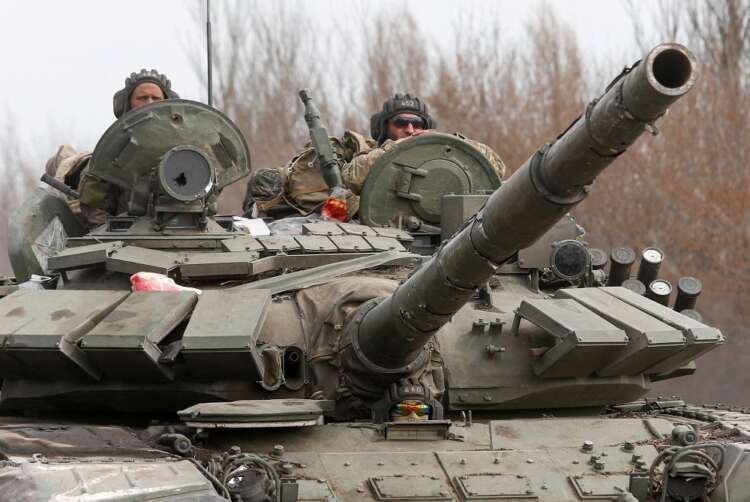
    LONDON (Reuters) – Russia can afford to wage a long war in Ukraine despite being hammered by Western sanctions aimed at crippling its ability to sustain the campaign, defence experts and economists say.

    Russia’s invasion has driven up the price of the oil, gas and grain it exports, providing it with a substantial windfall to fund its “special military operation” – now entering a new phase as Moscow focuses on the eastern Donbas region after failing to break Ukraine’s defence of the capital Kyiv.

    As the war grinds on, rising casualties and the need to rotate fresh troops into battle may prove more pressing challenges than the financial cost.

    “This type of low-tech war can be financed almost entirely in roubles, which means they can continue pouring troops and heavy artillery into Ukraine at least until there’s a more general collapse of the economy,” said Jacob Kirkegaard, economist at the Peterson Institute for International Economics in Washington.

    Johan Norberg, senior analyst at the Swedish Defence Research Agency, said: “The sanctions will not affect this war in the short run, because Russia’s military is fighting with tanks it had already built and soldiers it had already trained.”

    Sanctions are expected to shrink the economy by more than 11% this year, the World Bank says, but revenues from energy exports are actually increasing. The Russian finance ministry said on April 5 that Moscow expects to earn $9.6 billion in additional revenue from energy sales in April alone thanks to high oil prices, which remain around $100 a barrel.

    There is no doubt, however, that Russia’s vaunted military machine has taken a huge and costly hit.

    The United States assesses that Russia has lost about 15-20% of its combat power during its invasion of Ukraine, a senior U.S. defence official said.

    That includes everything from tanks, armoured vehicles, artillery systems, fighter and bomber aircraft and helicopters to surface-to-air and ballistic missiles, the official said, speaking on condition of anonymity.

    LOST TANKS

    According to Oryx, a closely watched military blog which tallies both sides’ losses based on verifiable visual evidence, Russia had lost at least 2,770 items of military equipment as of Tuesday, including at least 476 tanks that had been destroyed, damaged, abandoned or captured.

    That, said Yohann Michel of the International Institute for Strategic Studies (IISS), is more than the combined tank strength of NATO members France (222) and Britain (227).

    Russia, which had around 3,000 tanks before the war, according to IISS figures, is not about to run out. But experts said some of those are likely to be old, in poor condition or held for spare parts, so the effective number available for combat is lower.

    Mathieu Boulegue, a specialist in the Russian military at Chatham House, said Moscow had so far held back its most modern weaponry, which it is reluctant to lose, and relied heavily on an abundance of more expendable Soviet-era hardware.

    He said it could take “a decade or two at least” to rebuild equipment levels to where they were before the war – a task complicated by a host of factors including design and innovation challenges, corruption, the indebted state of defence companies and a lack of access to Western microelectronics because of sanctions.

    DEFENCE BURDEN

    Russian military spending will need to rise both because of the war with Ukraine and the resulting sharp increase in tension with NATO, which has sent thousands more troops to eastern Europe, said Richard Connolly, an associate fellow at RUSI in London and director of the Eastern Advisory Group consultancy.

    He said defence spending as a share of GDP could rise significantly from its current level of around 4%, potentially doubling in the next few years.

    Connolly said ordinary Russians would feel the impact but the state could comfortably pay for the war effort, even if its economy is plunged into recession. If necessary it could commandeer resources like fuel from state-owned companies.

    The more pressing question, he said, was the level of casualties and the difficulty of sustaining a war involving up to 150,000 troops at a time.

    Russia has so far acknowledged only 1,351 troops killed and 3,825 wounded, although Ukraine and Western governments believe the toll is many times higher. Its army and airborne troops have a combined strength of about 325,000.

    Eventually, Connolly said, it may have to take the politically unpopular decision to dip into its reserves, which the IISS estimates to number 2 million men under 50 with military service within the past five years.

    “If you’ve got 150,000 committed to Ukraine, you’ve got half of your effective army currently in combat operations, many of which have experienced significant losses,” Connolly said.

    “So they’re going to need to replace, they’re going to need to rotate them. They’re using their entire army, basically – or they will be if this goes on for very much longer.”

    (Reporting by Mark Trevelyan in London and Jacob Gronholt-Pedersen in Copenhagen; additional reporting by Phil Stewart, Idrees Ali and David Lawder in Washington, Katya Golubkova and Peter Hobson; Editing by Nick Macfie)

    Related Posts
    Inside the World’s First Collection Industry Conglomerate: PCA Global’s Platform Strategy
    Inside the World’s First Collection Industry Conglomerate: PCA Global’s Platform Strategy
    Chase Buchanan Private Wealth Management Highlights Key Autumn 2025 Budget Takeaways for Expats
    Chase Buchanan Private Wealth Management Highlights Key Autumn 2025 Budget Takeaways for Expats
    PayLaju Strengthens Its Position as Malaysia’s Trusted Interest-Free Sharia-Compliant Loan Provider
    PayLaju Strengthens Its Position as Malaysia’s Trusted Interest-Free Sharia-Compliant Loan Provider
    A Notable Update for Employee Health Benefits:
    A Notable Update for Employee Health Benefits:
    Creating Equity Between Walls: How Mohak Chauhan is Using Engineering, Finance, and Community Vision to Reengineer Affordable Housing
    Creating Equity Between Walls: How Mohak Chauhan is Using Engineering, Finance, and Community Vision to Reengineer Affordable Housing
    Upcoming Book on Real Estate Investing: Harvard Grace Capital Founder Stewart Heath’s Puts Lessons in Print
    Upcoming Book on Real Estate Investing: Harvard Grace Capital Founder Stewart Heath’s Puts Lessons in Print
    ELECTIVA MARKS A LANDMARK FIRST YEAR WITH MAJOR SENIOR APPOINTMENTS AND EXPANSION MILESTONES
    ELECTIVA MARKS A LANDMARK FIRST YEAR WITH MAJOR SENIOR APPOINTMENTS AND EXPANSION MILESTONES
    Hebbia Processes One Billion Pages as Financial Institutions Deploy AI Infrastructure at Unprecedented Scale
    Hebbia Processes One Billion Pages as Financial Institutions Deploy AI Infrastructure at Unprecedented Scale
    Beyond Governance Fatigue: Making ESG Integration Work in Financial Markets
    Beyond Governance Fatigue: Making ESG Integration Work in Financial Markets
    Why I-9 Verification Matters for Financial Institutions: Building a Culture of Compliance and Trust
    Why I-9 Verification Matters for Financial Institutions: Building a Culture of Compliance and Trust
    Curvestone AI partners with The White Rose Finance Group to enhance compliance file reviews
    Curvestone AI partners with The White Rose Finance Group to enhance compliance file reviews
    LinkedIn Influence in 2025: Insights from Stevo Jokic on Building Authority and Trust
    LinkedIn Influence in 2025: Insights from Stevo Jokic on Building Authority and Trust

    Why waste money on news and opinions when you can access them for free?

    Take advantage of our newsletter subscription and stay informed on the go!

    Subscribe

    More from Top Stories

    Explore more articles in the Top Stories category

    Should You Take the Dealer’s Bike Insurance or Buy Online Yourself? Here’s the Real Difference

    Should You Take the Dealer’s Bike Insurance or Buy Online Yourself? Here’s the Real Difference

    ID-Pal Unveils ID-Detect Enhancements to Counter Surge in Digital Manipulation and Deepfakes

    ID-Pal Unveils ID-Detect Enhancements to Counter Surge in Digital Manipulation and Deepfakes

    TRUST TAKES THE LEAD: HALF OF UK SHOPPERS HAVE ABANDONED ONLINE PURCHASES OVER SECURITY CONCERNS

    TRUST TAKES THE LEAD: HALF OF UK SHOPPERS HAVE ABANDONED ONLINE PURCHASES OVER SECURITY CONCERNS

    Why Choose Premium Driver Service in Miami Over Rideshare Apps for Business Travel and Special Events?

    Why Choose Premium Driver Service in Miami Over Rideshare Apps for Business Travel and Special Events?

    Over 30 Million Users Benefit From Ant International’s Bettr Credit Tech Solutions

    Over 30 Million Users Benefit From Ant International’s Bettr Credit Tech Solutions

    Side-Hustle Economics: How Part-Time Service Work Can Strengthen Your Financial Plan

    Side-Hustle Economics: How Part-Time Service Work Can Strengthen Your Financial Plan

    London to Host Major Summit on “New Horizons” for Islamic Economy in the UK

    London to Host Major Summit on “New Horizons” for Islamic Economy in the UK

    BLOXX Launches World’s First Home Equity Subscription, Creating a New Residential Asset Class

    BLOXX Launches World’s First Home Equity Subscription, Creating a New Residential Asset Class

    LiaFi Addresses Gap Between Business Transaction and Savings Accounts

    LiaFi Addresses Gap Between Business Transaction and Savings Accounts

    Ant Group Chairman Eric Jing Outlines Strategy for Inclusive AI, Collaboration on Tokenised Settlement

    Ant Group Chairman Eric Jing Outlines Strategy for Inclusive AI, Collaboration on Tokenised Settlement

    Deeply Cultivating the Syndicated Loan and Cross-Border Financing Fields: Empowering Chinese Banks’ Global Expansion with Professional Excellence

    Deeply Cultivating the Syndicated Loan and Cross-Border Financing Fields: Empowering Chinese Banks’ Global Expansion with Professional Excellence

    Ant International’s Antom Launches AI‑Powered MSME App for Finance and Business Operations

    Ant International’s Antom Launches AI‑Powered MSME App for Finance and Business Operations

    View All Top Stories Posts
    Previous Top Stories PostFEATURE-Nigeria’s women shopkeepers forced to scale back as prices soar
    Next Top Stories PostUK jobless rate lowest since 2019, but inflation eats into pay