Search
00
GBAF Logo
trophy
Top StoriesInterviewsBusinessFinanceBankingTechnologyInvestingTradingVideosAwardsMagazinesHeadlinesTrends

Subscribe to our newsletter

Get the latest news and updates from our team.

Global Banking & Finance Review®

Global Banking & Finance Review® - Subscribe to our newsletter

Company

    GBAF Logo
    • About Us
    • Profile
    • Privacy & Cookie Policy
    • Terms of Use
    • Contact Us
    • Advertising
    • Submit Post
    • Latest News
    • Research Reports
    • Press Release
    • Awards▾
      • About the Awards
      • Awards TimeTable
      • Submit Nominations
      • Testimonials
      • Media Room
      • Award Winners
      • FAQ
    • Magazines▾
      • Global Banking & Finance Review Magazine Issue 79
      • Global Banking & Finance Review Magazine Issue 78
      • Global Banking & Finance Review Magazine Issue 77
      • Global Banking & Finance Review Magazine Issue 76
      • Global Banking & Finance Review Magazine Issue 75
      • Global Banking & Finance Review Magazine Issue 73
      • Global Banking & Finance Review Magazine Issue 71
      • Global Banking & Finance Review Magazine Issue 70
      • Global Banking & Finance Review Magazine Issue 69
      • Global Banking & Finance Review Magazine Issue 66
    Top StoriesInterviewsBusinessFinanceBankingTechnologyInvestingTradingVideosAwardsMagazinesHeadlinesTrends

    Global Banking & Finance Review® is a leading financial portal and online magazine offering News, Analysis, Opinion, Reviews, Interviews & Videos from the world of Banking, Finance, Business, Trading, Technology, Investing, Brokerage, Foreign Exchange, Tax & Legal, Islamic Finance, Asset & Wealth Management.
    Copyright © 2010-2026 GBAF Publications Ltd - All Rights Reserved. | Sitemap | Tags | Developed By eCorpIT

    Editorial & Advertiser disclosure

    Global Banking & Finance Review® is an online platform offering news, analysis, and opinion on the latest trends, developments, and innovations in the banking and finance industry worldwide. The platform covers a diverse range of topics, including banking, insurance, investment, wealth management, fintech, and regulatory issues. The website publishes news, press releases, opinion and advertorials on various financial organizations, products and services which are commissioned from various Companies, Organizations, PR agencies, Bloggers etc. These commissioned articles are commercial in nature. This is not to be considered as financial advice and should be considered only for information purposes. It does not reflect the views or opinion of our website and is not to be considered an endorsement or a recommendation. We cannot guarantee the accuracy or applicability of any information provided with respect to your individual or personal circumstances. Please seek Professional advice from a qualified professional before making any financial decisions. We link to various third-party websites, affiliate sales networks, and to our advertising partners websites. When you view or click on certain links available on our articles, our partners may compensate us for displaying the content to you or make a purchase or fill a form. This will not incur any additional charges to you. To make things simpler for you to identity or distinguish advertised or sponsored articles or links, you may consider all articles or links hosted on our site as a commercial article placement. We will not be responsible for any loss you may suffer as a result of any omission or inaccuracy on the website.

    Home > Top Stories > Analysis-Europe’s banks dim lights as they brace for winter blackout
    Top Stories

    Analysis-Europe’s banks dim lights as they brace for winter blackout

    Published by Jessica Weisman-Pitts

    Posted on September 7, 2022

    5 min read

    Last updated: February 4, 2026

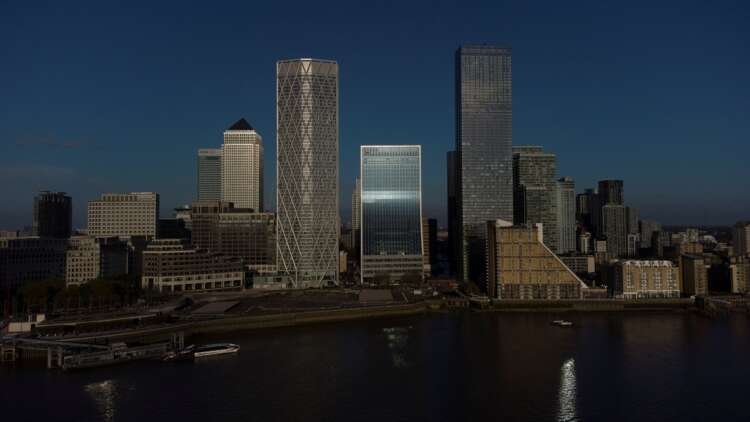
    A view of London's Canary Wharf, a key financial hub, as Europe's banks prepare for potential winter blackouts and energy rationing amid ongoing geopolitical tensions. This image highlights the urgency of operational resilience in the banking sector.
    Canary Wharf financial district in London during energy crisis - Global Banking & Finance Review
    Why waste money on news and opinion when you can access them for free?

    Take advantage of our newsletter subscription and stay informed on the go!

    Subscribe

    Tags:sustainabilityfinancial stabilityrisk management

    By Sinead Cruise and Iain Withers

    LONDON (Reuters) – Some of Europe’s biggest banks are preparing back-up generators and to dim the lights as they brace for potential power cuts and energy rationing that threaten the money system underpinning the region’s economy.

    As Russia throttles gas supplies to the continent, banks are stress-testing how they can cope with power shortages and lining up alternative sources of energy, such as generators, so that ATMs and online banking don’t go dark.

    There is a special urgency for financial firms to act because of the importance of payments and transactions to Europe’s economy, already fragile due to the fallout of war.

    While the sector adapted to COVID-19 lockdowns and remote working, power blackouts or rationing present a very different challenge. “The banking system is part of other systems,” said Gianluca Pescaroli, professor in operational continuity and disaster resilience at University College London, who has advised authorities in London on power outages. “My main concern is the cascading effects on society of failures to ATMs or cashless transactions. Similarly, the dependencies banks have on other services such as the internet.” JPMorgan, which employs thousands across European hubs in London and Frankfurt, has conducted power outage simulations, a source familiar with the matter told Reuters. Depending on the severity, the bank could switch to diesel generators that could keep key office locations up and running for several days, the person said.

    The biggest U.S. bank lends money to companies in Europe and trades stocks and bonds in addition to running a British consumer bank. Italy’s second-biggest bank UniCredit has tested its operational resilience this summer, a source familiar with the plans said. Its latest disaster recovery test focused on the resilience of data processing, the source said, adding the bank’s two core data centres had power supply from two independent power stations. It’s unclear how long its power would last. Euronext, which runs the French and Italian stock exchanges, said it had reassessed its energy use since Russia’s invasion of Ukraine, adding it had back-up generators, without elaborating.

    HOT WATER

    Banks are also taking visible steps to acknowledge the energy crisis, such as paring office space and consolidating staff in fewer buildings.Deutsche Bank said it was rolling out a slew of energy saving measures across its 1,400 buildings in Germany, to save 4.9 million kWh of electricity each year – enough to power roughly 49,000 light bulbs for an hour. The lender is shutting off hot running water in washrooms, adjusting workplace temperatures, switching off all interior branch lighting and illuminated outdoor advertising overnight. The fountain in front of its head office in Frankfurt will also be turned off. Regulators are on high alert. The supervisory arm of the European Central Bank and its equivalent UK peer, the Prudential Regulation Authority (PRA), both require lenders to have plans to cope with disruption.

    Firms in Britain are required to identify their “Important Business Services” and the methods of resolving vulnerabilities should threats materialise.

    Nonetheless, experts fear that few companies are prepared for lengthy blackouts of more than a few days. “This represents a serious gap in resilience planning,” said Avi Schnurr, CEO of the Electric Infrastructure Security Council, a think-tank that advises on preparing for such hazards.

    Banks should already be making arrangements to ensure that they can cope even in a prolonged power outage, with agreements for transactions to be logged retroactively once systems are back online, he said. BNP Paribas, France’s biggest bank, is addressing power consumption across the approximate 2,750 branches, offices and data centres it operates across France, Belgium and Italy, a source close to the French lender said.

    The possibility of electricity supply cuts was being “closely monitored” and covered by the Business Continuity Plan in place at the bank.

    European gas prices have surged after Russia’s state-controlled Gazprom said it would indefinitely extend a shutdown to the major Nord Stream 1 gas pipeline.

    Europe has accused Russia of weaponising energy supplies in retaliation for Western sanctions imposed on Moscow since the outbreak of hostilities with Ukraine. Russia blames those sanctions for causing the gas supply problems, which it puts down to pipeline faults.

    In Britain, rising energy costs are squeezing businesses and consumers, who are facing runaway inflation.

    State-backed NatWest said it had partially mitigated the financial hit by hedging future costs of its energy.

    Major insurers also said they were cutting their energy use. Switzerland’s Zurich said it would darken offices at night and mothball “decorative power consumers” like fountains.

    Should the crisis worsen, the sources said companies will take more drastic steps. And while staff may notice, the firms are hoping that customers won’t.

    “Additional measures that can be taken should the energy situation worsen include using only certain floors of the buildings, and the shutdown of certain services such as the employee gym,” the insurer said.

    (Additional reporting by Julien Ponthus in Paris and Carolyn Cohn in London; editing by Elisa Martinuzzi, John O’Donnell and David Evans)

    Frequently Asked Questions about Analysis-Europe’s banks dim lights as they brace for winter blackout

    1What is energy rationing?

    Energy rationing is the controlled distribution of energy resources to manage shortages, ensuring that essential services and operations can continue during periods of limited supply.

    2What is operational resilience?

    Operational resilience refers to an organization's ability to prepare for, respond to, and recover from disruptions, ensuring that critical functions can continue during crises.

    3What is business continuity planning?

    Business continuity planning involves creating strategies and procedures to ensure that essential business functions can continue during and after a disaster or disruption.

    4What is a back-up generator?

    A back-up generator is a secondary power source that provides electricity during outages, ensuring that critical systems and operations remain functional.

    5What is risk management?

    Risk management is the process of identifying, assessing, and mitigating potential risks that could negatively impact an organization’s operations or objectives.

    More from Top Stories

    Explore more articles in the Top Stories category

    Image for Lessons From the Ring and the Deal Table: How Boxing Shapes Steven Nigro’s Approach to Banking and Life
    Lessons From the Ring and the Deal Table: How Boxing Shapes Steven Nigro’s Approach to Banking and Life
    Image for Joe Kiani in 2025: Capital, Conviction, and a Focused Return to Innovation
    Joe Kiani in 2025: Capital, Conviction, and a Focused Return to Innovation
    Image for Marco Robinson – CLOSE THE DEAL AND SUDDENLY GROW RICH
    Marco Robinson – CLOSE THE DEAL AND SUDDENLY GROW RICH
    Image for Digital Tracing: Turning a regulatory obligation into a commercial advantage
    Digital Tracing: Turning a regulatory obligation into a commercial advantage
    Image for Exploring the Role of Blockchain and the Bitcoin Price Today in Education
    Exploring the Role of Blockchain and the Bitcoin Price Today in Education
    Image for Inside the World’s First Collection Industry Conglomerate: PCA Global’s Platform Strategy
    Inside the World’s First Collection Industry Conglomerate: PCA Global’s Platform Strategy
    Image for Chase Buchanan Private Wealth Management Highlights Key Autumn 2025 Budget Takeaways for Expats
    Chase Buchanan Private Wealth Management Highlights Key Autumn 2025 Budget Takeaways for Expats
    Image for PayLaju Strengthens Its Position as Malaysia’s Trusted Interest-Free Sharia-Compliant Loan Provider
    PayLaju Strengthens Its Position as Malaysia’s Trusted Interest-Free Sharia-Compliant Loan Provider
    Image for A Notable Update for Employee Health Benefits:
    A Notable Update for Employee Health Benefits:
    Image for Creating Equity Between Walls: How Mohak Chauhan is Using Engineering, Finance, and Community Vision to Reengineer Affordable Housing
    Creating Equity Between Walls: How Mohak Chauhan is Using Engineering, Finance, and Community Vision to Reengineer Affordable Housing
    Image for Upcoming Book on Real Estate Investing: Harvard Grace Capital Founder Stewart Heath’s Puts Lessons in Print
    Upcoming Book on Real Estate Investing: Harvard Grace Capital Founder Stewart Heath’s Puts Lessons in Print
    Image for ELECTIVA MARKS A LANDMARK FIRST YEAR WITH MAJOR SENIOR APPOINTMENTS AND EXPANSION MILESTONES
    ELECTIVA MARKS A LANDMARK FIRST YEAR WITH MAJOR SENIOR APPOINTMENTS AND EXPANSION MILESTONES
    View All Top Stories Posts
    Previous Top Stories PostEU, U.S. step up Russian aluminium, nickel imports since Ukraine war
    Next Top Stories PostRussia’s largest lender Sberbank on track to profitability, says CEO