Search
00
GBAF Logo
trophy
Top StoriesInterviewsBusinessFinanceBankingTechnologyInvestingTradingVideosAwardsMagazinesHeadlinesTrends

Subscribe to our newsletter

Get the latest news and updates from our team.

Global Banking & Finance Review®

Global Banking & Finance Review® - Subscribe to our newsletter

Company

    GBAF Logo
    • About Us
    • Profile
    • Privacy & Cookie Policy
    • Terms of Use
    • Contact Us
    • Advertising
    • Submit Post
    • Latest News
    • Research Reports
    • Press Release
    • Awards▾
      • About the Awards
      • Awards TimeTable
      • Submit Nominations
      • Testimonials
      • Media Room
      • Award Winners
      • FAQ
    • Magazines▾
      • Global Banking & Finance Review Magazine Issue 79
      • Global Banking & Finance Review Magazine Issue 78
      • Global Banking & Finance Review Magazine Issue 77
      • Global Banking & Finance Review Magazine Issue 76
      • Global Banking & Finance Review Magazine Issue 75
      • Global Banking & Finance Review Magazine Issue 73
      • Global Banking & Finance Review Magazine Issue 71
      • Global Banking & Finance Review Magazine Issue 70
      • Global Banking & Finance Review Magazine Issue 69
      • Global Banking & Finance Review Magazine Issue 66
    Top StoriesInterviewsBusinessFinanceBankingTechnologyInvestingTradingVideosAwardsMagazinesHeadlinesTrends

    Global Banking & Finance Review® is a leading financial portal and online magazine offering News, Analysis, Opinion, Reviews, Interviews & Videos from the world of Banking, Finance, Business, Trading, Technology, Investing, Brokerage, Foreign Exchange, Tax & Legal, Islamic Finance, Asset & Wealth Management.
    Copyright © 2010-2026 GBAF Publications Ltd - All Rights Reserved. | Sitemap | Tags | Developed By eCorpIT

    Editorial & Advertiser disclosure

    Global Banking & Finance Review® is an online platform offering news, analysis, and opinion on the latest trends, developments, and innovations in the banking and finance industry worldwide. The platform covers a diverse range of topics, including banking, insurance, investment, wealth management, fintech, and regulatory issues. The website publishes news, press releases, opinion and advertorials on various financial organizations, products and services which are commissioned from various Companies, Organizations, PR agencies, Bloggers etc. These commissioned articles are commercial in nature. This is not to be considered as financial advice and should be considered only for information purposes. It does not reflect the views or opinion of our website and is not to be considered an endorsement or a recommendation. We cannot guarantee the accuracy or applicability of any information provided with respect to your individual or personal circumstances. Please seek Professional advice from a qualified professional before making any financial decisions. We link to various third-party websites, affiliate sales networks, and to our advertising partners websites. When you view or click on certain links available on our articles, our partners may compensate us for displaying the content to you or make a purchase or fill a form. This will not incur any additional charges to you. To make things simpler for you to identity or distinguish advertised or sponsored articles or links, you may consider all articles or links hosted on our site as a commercial article placement. We will not be responsible for any loss you may suffer as a result of any omission or inaccuracy on the website.

    Home > Top Stories > Analysis-Euro-dollar parity leaves ECB facing costly choices
    Top Stories

    Analysis-Euro-dollar parity leaves ECB facing costly choices

    Published by Jessica Weisman-Pitts

    Posted on July 13, 2022

    4 min read

    Last updated: February 5, 2026

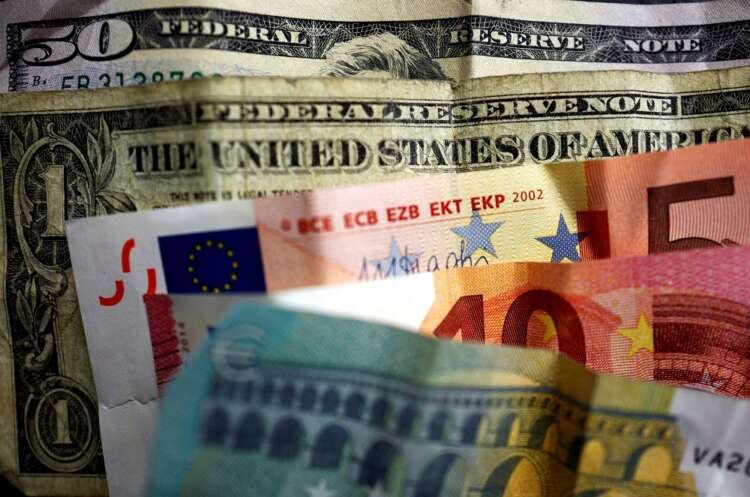
    This image showcases U.S. dollar and Euro bank notes, symbolizing the current euro-dollar parity crisis. It illustrates the challenges faced by the European Central Bank in managing inflation and economic stability amid the currency's decline.
    Illustration of U.S. dollar and Euro bank notes highlighting euro-dollar parity - Global Banking & Finance Review
    Why waste money on news and opinion when you can access them for free?

    Take advantage of our newsletter subscription and stay informed on the go!

    Subscribe

    Tags:monetary policyEuropean Central Bankforeign exchangecurrency hedgingfinancial markets

    By Balazs Koranyi and Francesco Canepa

    FRANKFURT (Reuters) – The euro’s tumble to parity against the dollar has pushed the European Central Bank back against a wall, leaving its policymakers with only painful and economically costly choices.

    Letting the currency fall further would push up already record high inflation, raising the risk of price growth becoming entrenched at a rate well above the ECB’s target of 2%.

    But fighting back against 20-year lows for the euro would require more rapid interest rate hikes, which could add to the misery for an economy already facing a possible recession, looming gas shortages and sky-high energy costs that are depleting purchasing power.

    The bank has so far played down the issue, arguing that it has no exchange rate target, even if the currency does matter. Even the accounts of its June policy meeting published on Thursday indicated no particular concern. But the market moves are now too big to play down.

    “The euro’s weakness reinforces the notion that the ECB is behind the curve,” Dirk Schumacher, head of European macro research at Natixis CIB, said. “Given how high inflation is, a stronger euro would be quite helpful because it lowers inflation.”

    The euro is now down around 10% against the dollar this year, even if the trade-weighted currency has only dropped 3.3% so far.

    This raises the cost of imports, especially for energy and other dollar-denominated commodities, making everything more expensive. Studies frequently cited by the ECB suggest that a 1% depreciation of the exchange rate raises inflation by 0.1% over one year and by up to 0.25% over three years.

    MORE WEAKNESS?

    The problem is that economic fundamentals point to even more euro weakness.

    Firstly, the ECB and the U.S. Federal Reserve are moving at vastly different speeds.

    While Fed Chair Jerome Powell has made clear he was willing to risk a recession with oversized rate hikes to bring down inflation, the ECB continues to take baby steps in unwinding the exceptionally easy policy of the past decade, when inflation was too low.

    It will raise rates for the first time this month but expects to lift the deposit rate out of negative territory only in September, with any further move clouded by recession risks.

    The euro zone’s outlook has soured so much since mid-June that one rate hike has been priced out and markets now see just 135 basis points of tightening from the ECB.

    The Fed, which has already raised rates several times, including by 75 basis points last month, is expected to increase them by another 180 basis points.

    That gives investors higher profits on the other side of the Atlantic, so they are moving cash out of Europe and weakening the euro in the process.

    Secondly, the euro zone’s huge energy dependence, primarily on Russian gas, also makes the economy more vulnerable to the fallout of the war in Ukraine, a natural drag on the currency.

    “Faced with the looming risk of recession – and the euro being a pro-cyclical currency – the ECB’s hands may be tied in its ability to threaten more aggressive rate hikes in defence of the euro,” ING said in a note to clients.

    Finally, the bloc’s energy bill has pushed up import costs, leaving it with a rare current account deficit. Such outflows also weaken the currency over time.

    Since each of 19 euro zone countries are impacted differently, consensus on any push back is also likely to be difficult to achieve.

    To prop up the euro, the ECB could signal more aggressive policy tightening, including a 50 basis-point hike in September, and further moves in October and December.

    But since markets already expect these steps, the ECB must also at least in part match the Fed’s message that getting inflation down trumps all other priorities, even if that means reinforcing a recession.

    Such a message, even if euro-positive, would likely fuel a selloff on the currency bloc’s periphery, setting off debt sustainability concerns.

    So the ECB must also roll out its already flagged bond-buying scheme aimed at limiting the rise in borrowing costs for Italy, Spain, Portugal and Greece.

    (Reporting by Balazs Koranyi and Francesco Canepa; Editing by Hugh Lawson, Mark John and Bradley Perrett)

    Frequently Asked Questions about Analysis-Euro-dollar parity leaves ECB facing costly choices

    1What is monetary policy?

    Monetary policy refers to the actions taken by a central bank to manage the money supply and interest rates in order to achieve macroeconomic objectives such as controlling inflation and stabilizing the currency.

    2What is inflation?

    Inflation is the rate at which the general level of prices for goods and services rises, eroding purchasing power. Central banks attempt to limit inflation to maintain economic stability.

    3What is the European Central Bank?

    The European Central Bank (ECB) is the central bank for the euro and is responsible for monetary policy within the Eurozone, aiming to maintain price stability and support economic growth.

    4What is foreign exchange?

    Foreign exchange, or forex, is the global market for trading national currencies against one another. It is the largest financial market in the world, influencing international trade and investment.

    5What is currency hedging?

    Currency hedging is a financial strategy used to protect against the risk of currency fluctuations. It involves using financial instruments to offset potential losses in foreign exchange transactions.

    More from Top Stories

    Explore more articles in the Top Stories category

    Image for Lessons From the Ring and the Deal Table: How Boxing Shapes Steven Nigro’s Approach to Banking and Life
    Lessons From the Ring and the Deal Table: How Boxing Shapes Steven Nigro’s Approach to Banking and Life
    Image for Joe Kiani in 2025: Capital, Conviction, and a Focused Return to Innovation
    Joe Kiani in 2025: Capital, Conviction, and a Focused Return to Innovation
    Image for Marco Robinson – CLOSE THE DEAL AND SUDDENLY GROW RICH
    Marco Robinson – CLOSE THE DEAL AND SUDDENLY GROW RICH
    Image for Digital Tracing: Turning a regulatory obligation into a commercial advantage
    Digital Tracing: Turning a regulatory obligation into a commercial advantage
    Image for Exploring the Role of Blockchain and the Bitcoin Price Today in Education
    Exploring the Role of Blockchain and the Bitcoin Price Today in Education
    Image for Inside the World’s First Collection Industry Conglomerate: PCA Global’s Platform Strategy
    Inside the World’s First Collection Industry Conglomerate: PCA Global’s Platform Strategy
    Image for Chase Buchanan Private Wealth Management Highlights Key Autumn 2025 Budget Takeaways for Expats
    Chase Buchanan Private Wealth Management Highlights Key Autumn 2025 Budget Takeaways for Expats
    Image for PayLaju Strengthens Its Position as Malaysia’s Trusted Interest-Free Sharia-Compliant Loan Provider
    PayLaju Strengthens Its Position as Malaysia’s Trusted Interest-Free Sharia-Compliant Loan Provider
    Image for A Notable Update for Employee Health Benefits:
    A Notable Update for Employee Health Benefits:
    Image for Creating Equity Between Walls: How Mohak Chauhan is Using Engineering, Finance, and Community Vision to Reengineer Affordable Housing
    Creating Equity Between Walls: How Mohak Chauhan is Using Engineering, Finance, and Community Vision to Reengineer Affordable Housing
    Image for Upcoming Book on Real Estate Investing: Harvard Grace Capital Founder Stewart Heath’s Puts Lessons in Print
    Upcoming Book on Real Estate Investing: Harvard Grace Capital Founder Stewart Heath’s Puts Lessons in Print
    Image for ELECTIVA MARKS A LANDMARK FIRST YEAR WITH MAJOR SENIOR APPOINTMENTS AND EXPANSION MILESTONES
    ELECTIVA MARKS A LANDMARK FIRST YEAR WITH MAJOR SENIOR APPOINTMENTS AND EXPANSION MILESTONES
    View All Top Stories Posts
    Previous Top Stories PostThe most coveted endorsement in race to be next British prime minister? Margaret Thatcher
    Next Top Stories PostVeteran Hong Kong activist jailed for unlawful assembly