Search
00
GBAF Logo
trophy
Top StoriesInterviewsBusinessFinanceBankingTechnologyInvestingTradingVideosAwardsMagazinesHeadlinesTrends

Subscribe to our newsletter

Get the latest news and updates from our team.

Global Banking & Finance Review®

Global Banking & Finance Review® - Subscribe to our newsletter

Company

    GBAF Logo
    • About Us
    • Profile
    • Privacy & Cookie Policy
    • Terms of Use
    • Contact Us
    • Advertising
    • Submit Post
    • Latest News
    • Research Reports
    • Press Release
    • Awards▾
      • About the Awards
      • Awards TimeTable
      • Submit Nominations
      • Testimonials
      • Media Room
      • Award Winners
      • FAQ
    • Magazines▾
      • Global Banking & Finance Review Magazine Issue 79
      • Global Banking & Finance Review Magazine Issue 78
      • Global Banking & Finance Review Magazine Issue 77
      • Global Banking & Finance Review Magazine Issue 76
      • Global Banking & Finance Review Magazine Issue 75
      • Global Banking & Finance Review Magazine Issue 73
      • Global Banking & Finance Review Magazine Issue 71
      • Global Banking & Finance Review Magazine Issue 70
      • Global Banking & Finance Review Magazine Issue 69
      • Global Banking & Finance Review Magazine Issue 66
    Top StoriesInterviewsBusinessFinanceBankingTechnologyInvestingTradingVideosAwardsMagazinesHeadlinesTrends

    Global Banking & Finance Review® is a leading financial portal and online magazine offering News, Analysis, Opinion, Reviews, Interviews & Videos from the world of Banking, Finance, Business, Trading, Technology, Investing, Brokerage, Foreign Exchange, Tax & Legal, Islamic Finance, Asset & Wealth Management.
    Copyright © 2010-2026 GBAF Publications Ltd - All Rights Reserved. | Sitemap | Tags | Developed By eCorpIT

    Editorial & Advertiser disclosure

    Global Banking & Finance Review® is an online platform offering news, analysis, and opinion on the latest trends, developments, and innovations in the banking and finance industry worldwide. The platform covers a diverse range of topics, including banking, insurance, investment, wealth management, fintech, and regulatory issues. The website publishes news, press releases, opinion and advertorials on various financial organizations, products and services which are commissioned from various Companies, Organizations, PR agencies, Bloggers etc. These commissioned articles are commercial in nature. This is not to be considered as financial advice and should be considered only for information purposes. It does not reflect the views or opinion of our website and is not to be considered an endorsement or a recommendation. We cannot guarantee the accuracy or applicability of any information provided with respect to your individual or personal circumstances. Please seek Professional advice from a qualified professional before making any financial decisions. We link to various third-party websites, affiliate sales networks, and to our advertising partners websites. When you view or click on certain links available on our articles, our partners may compensate us for displaying the content to you or make a purchase or fill a form. This will not incur any additional charges to you. To make things simpler for you to identity or distinguish advertised or sponsored articles or links, you may consider all articles or links hosted on our site as a commercial article placement. We will not be responsible for any loss you may suffer as a result of any omission or inaccuracy on the website.

    Home > Top Stories > Analysis-EU gas solidarity complicated by lack of fuel sharing deals
    Top Stories

    Analysis-EU gas solidarity complicated by lack of fuel sharing deals

    Published by Wanda Rich

    Posted on July 29, 2022

    5 min read

    Last updated: February 5, 2026

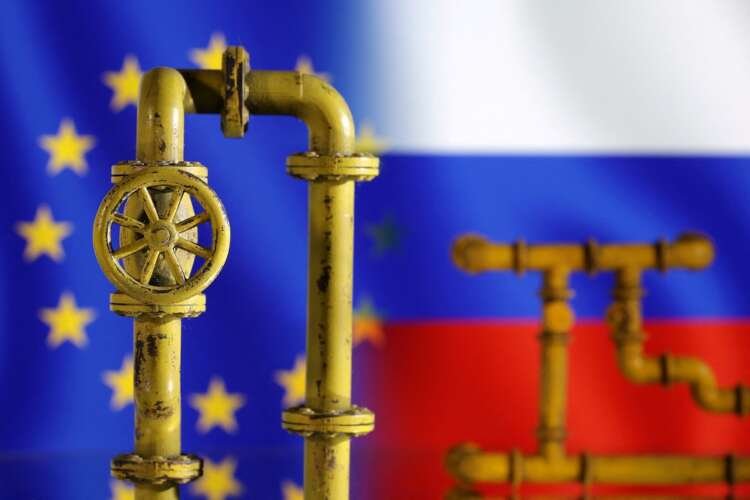
    An illustration showing a natural gas pipeline alongside the flags of the EU and Russia, symbolizing the complexities of gas sharing agreements amid the ongoing supply crisis in Europe. This image relates to the challenges EU member states face in establishing bilateral gas pacts as discussed in the article.
    Illustration depicting natural gas pipeline with EU and Russia flags, highlighting gas solidarity issues - Global Banking & Finance Review
    Why waste money on news and opinion when you can access them for free?

    Take advantage of our newsletter subscription and stay informed on the go!

    Subscribe

    Tags:CompensationEuropean economiesfinancial stability

    By Kate Abnett

    BRUSSELS (Reuters) -The European Union clinched a deal this week to cope with a gas supply crisis, but to make it work member states need to establish bilateral pacts to share gas and, right now, most have no such agreement in place.

    Only six such deals have been secured, leaving most of the EU’s 27 countries without firm terms on how and when they would share gas in a supply crunch, or the financial compensation they would give or get for doing so.

    “(Bilateral deals) are really … the only thing that will hold at the end of the day if there is a real supply crisis,” Christian Egenhofer, associate senior research fellow at the Centre for European Policy Studies, said.

    “They organise the legal stuff, the compensation, the financial but also the infrastructure constraints,” he said.

    Fearing Russia may completely halt gas flows, EU countries agreed on Tuesday to curb their gas use by 15% over winter, to fill storage and free up fuel to share around in a supply crisis.

    But it is up to individual countries to sort out how that sharing of fuel will happen in practice.

    EU laws oblige member states to send gas to a neighbouring state whose households or essential services like hospitals face a severe shortage. To make that happen, governments arrange bilateral deals. However, just eight countries are covered by the six agreements so far – including between Germany and Austria, Estonia and Latvia, and Italy and Slovenia.

    “This is not sufficient,” EU energy policy chief Kadri Simson said last month, urging countries to arrange more.

    A handful of countries are negotiating new two-way agreements, government officials said. A German-Czech deal is due to be signed by winter, and Germany is working on further agreements with Poland and Italy, its economy ministry said.

    But some countries heavily reliant on Russian gas – such as landlocked Hungary, which opposed this week’s deal – have none. Italy and France are the EU’s biggest gas users after economic powerhouse Germany. Italy has just one bilateral deal on emergency gas sharing and France has none.

    A senior Italian official said the country was negotiating a deal with Greece on gas storage. The French energy ministry said “at this stage” France did not have any bilateral agreements in place.

    The solidarity deals aim to avoid a panicked response if a supply crisis did strike, and reduce the risk that countries would hoard fuel and refuse to help their neighbours.

    GUARANTEEING GAS SHARING

    Simone Tagliapietra, senior fellow at the Bruegel think tank, suggested the EU should implement a wider compensation scheme where countries pay other member states to save and share gas.

    “Without such a compensation mechanism it will be difficult to ensure solidarity,” he said, adding that Europe’s biggest economy Germany, which is heavily reliant on Russian gas, should be first to contribute.

    Without firmer terms on gas sharing, “we might not see all the solidarity we currently see on paper turn into molecules moving around Europe,” Tagliapietra added.

    The idea of compensation may appeal to states like Greece and Spain, which initially balked at being asked by Brussels to use less gas to help countries that for years cultivated closer energy ties with Moscow.

    Spain does not rely on Russian gas, and EU diplomats said Brussels’ call for solidarity rankled in some capitals that still resent Germany’s sharp criticisms of southern states’ economic policies during past financial crises.

    After EU countries approved the gas curbs on Tuesday, however, Spanish Energy Minister Teresa Ribera struck a more conciliatory tone, expressing willingness to reinforce Spain’s liquefied natural gas import capacity “for the benefit of all”.

    German Economy Minister Robert Habeck also pledged, “as part of European solidarity” to keep gas flowing to its neighbours including Austria and the Czech Republic.

    Germany has so far been the most active country in seeking solidarity arrangements with neighbours. As well as being Europe’s biggest gas consumer, Germany’s pipelines are the veins through which gas reaches many central and eastern states.

    Some appear unwilling to cooperate, however. Hungary this month said it would stop exporting fuels to other countries. Poland has also struck a sceptical tone on sharing supplies.

    The EU-wide deal on Tuesday was approved by all 27 members except Hungary, which also initially opposed EU oil sanctions on Russia. The agreement set voluntary curbs on gas use that can be made binding in a supply crisis. But it included a raft of exemptions and derogations for countries and industries that some analysts said meant, if Russia did shut off flows, more severe curbs and sharing between states would be needed to guarantee supply.

    One EU diplomat said it was ultimately in countries’ own interests to help one another, since an economic crisis or a gas shortage in one – particularly in Germany – would ripple around the bloc.

    “If Germany falls, every one of us will fall with Germany,” the diplomat said.

    (Reporting by Kate Abnett; additional reporting by Philip Blenkinsop, Giuseppe Fonte, Riham Alkousaa, Benjamin Mallet; Editing by John Chalmers and Susan Fenton)

    Frequently Asked Questions about Analysis-EU gas solidarity complicated by lack of fuel sharing deals

    1What is the significance of gas solidarity in the EU?

    Gas solidarity in the EU refers to the commitment of member states to assist each other during gas supply crises, ensuring that countries with shortages receive necessary support.

    2What is a compensation mechanism in energy sharing?

    A compensation mechanism in energy sharing is a system that provides financial reimbursement to countries that supply gas to others during shortages, incentivizing cooperation among member states.

    3What is the impact of a gas supply crisis?

    A gas supply crisis can lead to severe shortages affecting households and essential services, prompting countries to implement emergency measures and share resources to mitigate the impact.

    4What are the EU's energy policies?

    The EU's energy policies aim to ensure energy security, promote sustainable energy use, and enhance cooperation among member states to manage energy resources effectively.

    More from Top Stories

    Explore more articles in the Top Stories category

    Image for Lessons From the Ring and the Deal Table: How Boxing Shapes Steven Nigro’s Approach to Banking and Life
    Lessons From the Ring and the Deal Table: How Boxing Shapes Steven Nigro’s Approach to Banking and Life
    Image for Joe Kiani in 2025: Capital, Conviction, and a Focused Return to Innovation
    Joe Kiani in 2025: Capital, Conviction, and a Focused Return to Innovation
    Image for Marco Robinson – CLOSE THE DEAL AND SUDDENLY GROW RICH
    Marco Robinson – CLOSE THE DEAL AND SUDDENLY GROW RICH
    Image for Digital Tracing: Turning a regulatory obligation into a commercial advantage
    Digital Tracing: Turning a regulatory obligation into a commercial advantage
    Image for Exploring the Role of Blockchain and the Bitcoin Price Today in Education
    Exploring the Role of Blockchain and the Bitcoin Price Today in Education
    Image for Inside the World’s First Collection Industry Conglomerate: PCA Global’s Platform Strategy
    Inside the World’s First Collection Industry Conglomerate: PCA Global’s Platform Strategy
    Image for Chase Buchanan Private Wealth Management Highlights Key Autumn 2025 Budget Takeaways for Expats
    Chase Buchanan Private Wealth Management Highlights Key Autumn 2025 Budget Takeaways for Expats
    Image for PayLaju Strengthens Its Position as Malaysia’s Trusted Interest-Free Sharia-Compliant Loan Provider
    PayLaju Strengthens Its Position as Malaysia’s Trusted Interest-Free Sharia-Compliant Loan Provider
    Image for A Notable Update for Employee Health Benefits:
    A Notable Update for Employee Health Benefits:
    Image for Creating Equity Between Walls: How Mohak Chauhan is Using Engineering, Finance, and Community Vision to Reengineer Affordable Housing
    Creating Equity Between Walls: How Mohak Chauhan is Using Engineering, Finance, and Community Vision to Reengineer Affordable Housing
    Image for Upcoming Book on Real Estate Investing: Harvard Grace Capital Founder Stewart Heath’s Puts Lessons in Print
    Upcoming Book on Real Estate Investing: Harvard Grace Capital Founder Stewart Heath’s Puts Lessons in Print
    Image for ELECTIVA MARKS A LANDMARK FIRST YEAR WITH MAJOR SENIOR APPOINTMENTS AND EXPANSION MILESTONES
    ELECTIVA MARKS A LANDMARK FIRST YEAR WITH MAJOR SENIOR APPOINTMENTS AND EXPANSION MILESTONES
    View All Top Stories Posts
    Previous Top Stories PostSwiss National Bank posts record H1 loss, says no policy impact
    Next Top Stories PostAir France-KLM lowers capacity forecast citing ‘operational challenges’