Search
00
GBAF Logo
trophy
Top StoriesInterviewsBusinessFinanceBankingTechnologyInvestingTradingVideosAwardsMagazinesHeadlinesTrends

Subscribe to our newsletter

Get the latest news and updates from our team.

Global Banking & Finance Review®

Global Banking & Finance Review® - Subscribe to our newsletter

Company

    GBAF Logo
    • About Us
    • Profile
    • Privacy & Cookie Policy
    • Terms of Use
    • Contact Us
    • Advertising
    • Submit Post
    • Latest News
    • Research Reports
    • Press Release
    • Awards▾
      • About the Awards
      • Awards TimeTable
      • Submit Nominations
      • Testimonials
      • Media Room
      • Award Winners
      • FAQ
    • Magazines▾
      • Global Banking & Finance Review Magazine Issue 79
      • Global Banking & Finance Review Magazine Issue 78
      • Global Banking & Finance Review Magazine Issue 77
      • Global Banking & Finance Review Magazine Issue 76
      • Global Banking & Finance Review Magazine Issue 75
      • Global Banking & Finance Review Magazine Issue 73
      • Global Banking & Finance Review Magazine Issue 71
      • Global Banking & Finance Review Magazine Issue 70
      • Global Banking & Finance Review Magazine Issue 69
      • Global Banking & Finance Review Magazine Issue 66
    Top StoriesInterviewsBusinessFinanceBankingTechnologyInvestingTradingVideosAwardsMagazinesHeadlinesTrends

    Global Banking & Finance Review® is a leading financial portal and online magazine offering News, Analysis, Opinion, Reviews, Interviews & Videos from the world of Banking, Finance, Business, Trading, Technology, Investing, Brokerage, Foreign Exchange, Tax & Legal, Islamic Finance, Asset & Wealth Management.
    Copyright © 2010-2026 GBAF Publications Ltd - All Rights Reserved. | Sitemap | Tags | Developed By eCorpIT

    Editorial & Advertiser disclosure

    Global Banking & Finance Review® is an online platform offering news, analysis, and opinion on the latest trends, developments, and innovations in the banking and finance industry worldwide. The platform covers a diverse range of topics, including banking, insurance, investment, wealth management, fintech, and regulatory issues. The website publishes news, press releases, opinion and advertorials on various financial organizations, products and services which are commissioned from various Companies, Organizations, PR agencies, Bloggers etc. These commissioned articles are commercial in nature. This is not to be considered as financial advice and should be considered only for information purposes. It does not reflect the views or opinion of our website and is not to be considered an endorsement or a recommendation. We cannot guarantee the accuracy or applicability of any information provided with respect to your individual or personal circumstances. Please seek Professional advice from a qualified professional before making any financial decisions. We link to various third-party websites, affiliate sales networks, and to our advertising partners websites. When you view or click on certain links available on our articles, our partners may compensate us for displaying the content to you or make a purchase or fill a form. This will not incur any additional charges to you. To make things simpler for you to identity or distinguish advertised or sponsored articles or links, you may consider all articles or links hosted on our site as a commercial article placement. We will not be responsible for any loss you may suffer as a result of any omission or inaccuracy on the website.

    Home > Top Stories > Analysis-Adani allegations shine spotlight on India’s clean energy conundrum
    Top Stories

    Analysis-Adani allegations shine spotlight on India’s clean energy conundrum

    Published by Uma Rajagopal

    Posted on November 28, 2024

    4 min read

    Last updated: January 28, 2026

    Gautam Adani's image highlights the scrutiny over bribery allegations impacting India's renewable energy sector. This reflects the ongoing challenges faced by developers in securing power purchase agreements amidst a shift to clean energy.
    Gautam Adani amidst concerns over renewable energy deals in India - Global Banking & Finance Review
    Why waste money on news and opinion when you can access them for free?

    Take advantage of our newsletter subscription and stay informed on the go!

    Subscribe

    Tags:renewable energysolar powerinvestmentsustainabilityenergy market

    By Sudarshan Varadhan and Sethuraman N R

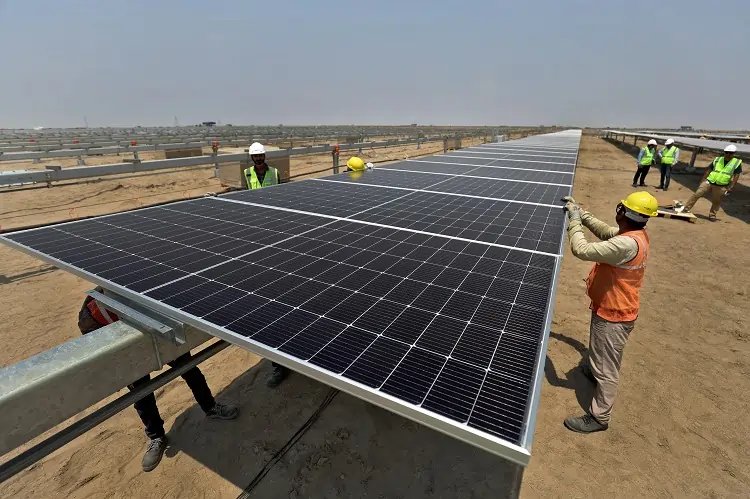
    NEW DELHI (Reuters) – Bribery allegations against Adani Group founder Gautam Adani have highlighted the growing problem India’s renewable energy developers face in finding buyers for the power they generate.

    While India’s central government wants to shift away from polluting coal-fired generation towards solar and wind, officials say state government-owned power distribution companies responsible for keeping the lights on have dragged their heels over striking renewable purchase deals.

    U.S. authorities allege that Indian billionaire Adani conspired to devise a $265 million scheme to bribe Indian state government officials to secure solar power supply deals, after one of his companies was unable to secure buyers for a $6 billion project for several years.

    The Adani Group has denied the charges.

    The conglomerate is not alone in facing increasingly long delays in signing up buyers for the renewable electricity capacity which is now being developed in coal-dependent India – the world’s third-largest emitter of greenhouse gases.

    Coal accounted for 75% of India’s power generation during the year to the end of March, with renewables such as solar and wind, but not including hydro-electricity, making up about 12%.

    India is still more than 10% short of its much-publicised pledge to add 175 gigawatts (GW) of renewable power by 2022.

    That has led the federal government to ramp up bidding for renewable projects to meet an ambitious 2030 target of increasing its non-fossil fuel capacity to 500 gigawatts (GW).

    In the five years to March 2028 it plans to tender for more than four-times the capacity of renewable energy projects it commissioned in the preceding five.

    To push states to help meet India’s overall goal, New Delhi in 2022 introduced so-called renewable purchase obligations (RPOs), which mandate that states increase clean energy adoption so that the national share doubles to 43.3% in March 2030.

    Honouring these RPOs would require 20 of the 30 provinces monitored to more than double the share of green power in their electricity mix, a February report by government think-tank NITI Aayog showed.

    The problem is that India’s states are unprepared for the rapid rise in renewable generating capacity, lack adequate transmission infrastructure and storage and would rather rely on fossil fuel for supply than risk “intermittent” renewables.

    The challenges were stark in the case of Adani Green, India’s largest renewable energy company, which took nearly 3-1/2 years to strike supply deals with buyers for the entire 8 gigawatts (GW) of solar power capacity it won in a tender widely publicised as the country’s biggest.

    DEMAND POOL

    Yet setting targets for tenders and issuing contracts is “meaningless” so long as interest from power distribution companies is so low, said R. Srikanth, energy industry adviser and dean at India’s National Institute of Advanced Studies.

    And the allegations against Adani are likely to result in a further renewables slowdown, as low-cost finance from foreign investors may become more difficult to secure, Srikanth said.

    A change in the way some tenders are run has exacerbated delays in the time it takes to complete renewables projects.

    The tender won by Adani Green was the first major contract issued by state-run Solar Energy Corp of India (SECI) without a state-guaranteed Power Purchase Agreement (PPA).

    When announced in June 2019, SECI said buyers were guaranteed, but it withdrew the provision from the deal signed a year later.

    SECI’s chairman told Reuters last month that a three-fold increase in tendering of renewable projects has left 30 GW of projects for which bidding is complete, but without buyers.

    “You can’t expect the states to respond and start signing three times the power supply agreements,” R P Gupta told Reuters in an interview, adding that a “demand pool has to be created” and states had to be “sensitised” to renewables.

    Brokerage JM Financial said that it now takes 8 to 10 months to sign power supply deals after a contract is awarded.

    By comparison, companies that were awarded contracts between July 2018 and December 2020 needed around three months to strike supply deals, SECI data showed.

    “The sudden surge in bids, large pipeline of projects under construction, mismatch in power demand and bid-pipeline … and constraints in timely execution of projects are leading to delays in signing,” JM Financial said.

    Renewable energy projects have also seen cancellations, with about 4%-5% of all tendered projects annulled, and backlogs in transmission infrastructure development, Gupta said.

    One solution, said Rakesh Nath, former chairman of India’s Central Electricity Authority, would be knowing how much power buyers want before projects are bid for.

    “Taking buyers into confidence before inviting bids may minimise delays in signing power supply agreements,” he said.

    (Additional reporting by Shubham Batra; Editing by Alexander Smith)

    Frequently Asked Questions about Analysis-Adani allegations shine spotlight on India’s clean energy conundrum

    1What is renewable energy?

    Renewable energy is energy generated from natural resources that are replenished constantly, such as sunlight, wind, and water. It is considered more sustainable than fossil fuels.

    2What is solar power?

    Solar power is energy harnessed from sunlight using solar panels or other technologies to generate electricity or heat.

    3What is the significance of gigawatts (GW) in energy production?

    Gigawatts (GW) is a unit of power measurement used to quantify the output of large power plants or the amount of electricity generated. One gigawatt equals one billion watts.

    More from Top Stories

    Explore more articles in the Top Stories category

    Image for Lessons From the Ring and the Deal Table: How Boxing Shapes Steven Nigro’s Approach to Banking and Life
    Lessons From the Ring and the Deal Table: How Boxing Shapes Steven Nigro’s Approach to Banking and Life
    Image for Joe Kiani in 2025: Capital, Conviction, and a Focused Return to Innovation
    Joe Kiani in 2025: Capital, Conviction, and a Focused Return to Innovation
    Image for Marco Robinson – CLOSE THE DEAL AND SUDDENLY GROW RICH
    Marco Robinson – CLOSE THE DEAL AND SUDDENLY GROW RICH
    Image for Digital Tracing: Turning a regulatory obligation into a commercial advantage
    Digital Tracing: Turning a regulatory obligation into a commercial advantage
    Image for Exploring the Role of Blockchain and the Bitcoin Price Today in Education
    Exploring the Role of Blockchain and the Bitcoin Price Today in Education
    Image for Inside the World’s First Collection Industry Conglomerate: PCA Global’s Platform Strategy
    Inside the World’s First Collection Industry Conglomerate: PCA Global’s Platform Strategy
    Image for Chase Buchanan Private Wealth Management Highlights Key Autumn 2025 Budget Takeaways for Expats
    Chase Buchanan Private Wealth Management Highlights Key Autumn 2025 Budget Takeaways for Expats
    Image for PayLaju Strengthens Its Position as Malaysia’s Trusted Interest-Free Sharia-Compliant Loan Provider
    PayLaju Strengthens Its Position as Malaysia’s Trusted Interest-Free Sharia-Compliant Loan Provider
    Image for A Notable Update for Employee Health Benefits:
    A Notable Update for Employee Health Benefits:
    Image for Creating Equity Between Walls: How Mohak Chauhan is Using Engineering, Finance, and Community Vision to Reengineer Affordable Housing
    Creating Equity Between Walls: How Mohak Chauhan is Using Engineering, Finance, and Community Vision to Reengineer Affordable Housing
    Image for Upcoming Book on Real Estate Investing: Harvard Grace Capital Founder Stewart Heath’s Puts Lessons in Print
    Upcoming Book on Real Estate Investing: Harvard Grace Capital Founder Stewart Heath’s Puts Lessons in Print
    Image for ELECTIVA MARKS A LANDMARK FIRST YEAR WITH MAJOR SENIOR APPOINTMENTS AND EXPANSION MILESTONES
    ELECTIVA MARKS A LANDMARK FIRST YEAR WITH MAJOR SENIOR APPOINTMENTS AND EXPANSION MILESTONES
    View All Top Stories Posts
    Previous Top Stories PostRussia’s plane shortage holds air travel back as wartime wages drive demand
    Next Top Stories PostCFM juggles engine supply in boost to Airbus, sources say