Search
00
GBAF Logo
trophy
Top StoriesInterviewsBusinessFinanceBankingTechnologyInvestingTradingVideosAwardsMagazinesHeadlinesTrends

Subscribe to our newsletter

Get the latest news and updates from our team.

Global Banking & Finance Review®

Global Banking & Finance Review® - Subscribe to our newsletter

Company

    GBAF Logo
    • About Us
    • Profile
    • Privacy & Cookie Policy
    • Terms of Use
    • Contact Us
    • Advertising
    • Submit Post
    • Latest News
    • Research Reports
    • Press Release
    • Awards▾
      • About the Awards
      • Awards TimeTable
      • Submit Nominations
      • Testimonials
      • Media Room
      • Award Winners
      • FAQ
    • Magazines▾
      • Global Banking & Finance Review Magazine Issue 79
      • Global Banking & Finance Review Magazine Issue 78
      • Global Banking & Finance Review Magazine Issue 77
      • Global Banking & Finance Review Magazine Issue 76
      • Global Banking & Finance Review Magazine Issue 75
      • Global Banking & Finance Review Magazine Issue 73
      • Global Banking & Finance Review Magazine Issue 71
      • Global Banking & Finance Review Magazine Issue 70
      • Global Banking & Finance Review Magazine Issue 69
      • Global Banking & Finance Review Magazine Issue 66
    Top StoriesInterviewsBusinessFinanceBankingTechnologyInvestingTradingVideosAwardsMagazinesHeadlinesTrends

    Global Banking & Finance Review® is a leading financial portal and online magazine offering News, Analysis, Opinion, Reviews, Interviews & Videos from the world of Banking, Finance, Business, Trading, Technology, Investing, Brokerage, Foreign Exchange, Tax & Legal, Islamic Finance, Asset & Wealth Management.
    Copyright © 2010-2026 GBAF Publications Ltd - All Rights Reserved. | Sitemap | Tags | Developed By eCorpIT

    Editorial & Advertiser disclosure

    Global Banking & Finance Review® is an online platform offering news, analysis, and opinion on the latest trends, developments, and innovations in the banking and finance industry worldwide. The platform covers a diverse range of topics, including banking, insurance, investment, wealth management, fintech, and regulatory issues. The website publishes news, press releases, opinion and advertorials on various financial organizations, products and services which are commissioned from various Companies, Organizations, PR agencies, Bloggers etc. These commissioned articles are commercial in nature. This is not to be considered as financial advice and should be considered only for information purposes. It does not reflect the views or opinion of our website and is not to be considered an endorsement or a recommendation. We cannot guarantee the accuracy or applicability of any information provided with respect to your individual or personal circumstances. Please seek Professional advice from a qualified professional before making any financial decisions. We link to various third-party websites, affiliate sales networks, and to our advertising partners websites. When you view or click on certain links available on our articles, our partners may compensate us for displaying the content to you or make a purchase or fill a form. This will not incur any additional charges to you. To make things simpler for you to identity or distinguish advertised or sponsored articles or links, you may consider all articles or links hosted on our site as a commercial article placement. We will not be responsible for any loss you may suffer as a result of any omission or inaccuracy on the website.

    Home > Top Stories > Amazon’s net loss prompts query: Has it built too many warehouses?
    Top Stories

    Amazon’s net loss prompts query: Has it built too many warehouses?

    Published by Wanda Rich

    Posted on April 29, 2022

    3 min read

    Last updated: February 7, 2026

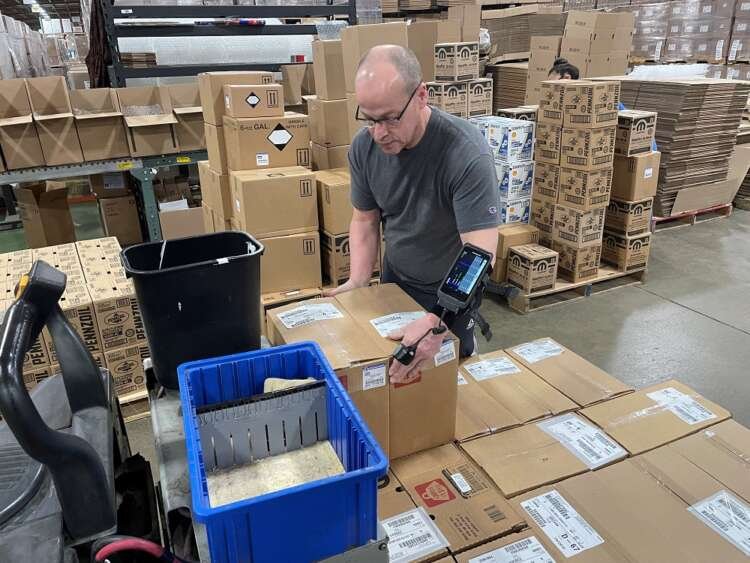
    A warehouse worker efficiently packs orders using an arm-mounted scanner, illustrating Amazon's fulfillment operations. This image highlights the company's struggle with overcapacity and the financial implications discussed in the article about Amazon's recent net loss.
    Warehouse worker using an arm-mounted scanner to fulfill orders - Global Banking & Finance Review
    Why waste money on news and opinion when you can access them for free?

    Take advantage of our newsletter subscription and stay informed on the go!

    Subscribe

    Tags:retail tradee-commercefinancial managementConsumer demandlogistics

    By Jeffrey Dastin

    (Reuters) – In recent years, Amazon.com Inc has spent billions of dollars on new warehouses that cut into profits, explaining to investors that it had no choice but to meet ever-rising consumer demand.

    It turns out, Amazon may have built too much, too soon, analysts say.

    The world’s largest online retailer on Thursday reported $2 billion in incremental costs from having excess fulfillment and transportation capacity, a dramatic shift from just two years ago when Amazon had to turn away merchants’ goods because it had room only for vital supplies.

    The company is lowering its capital expenditure plans for 2022, its Chief Financial Officer Brian Olsavsky said. Amazon will spend less on fulfillment projects this year than last, while transportation investments will be flat to slightly down.

    The new reality began to emerge halfway through 2021. Amazon was on track to double its warehouse and delivery network, a feat necessitated by consumers’ embrace of at-home shopping to avoid COVID-19 infections in stores. For the first time, space was not the retailer’s main constraint; it was labor to staff facilities fully. At Amazon’s scale, that meant hiring 270,000 workers in six months.

    After the Christmas holiday, consumer demand dwindled, as always. Online sales dipped from a year ago, Amazon’s results showed. Brick-and-mortar stores beckoned shoppers once the Omicron wave subsided, and still others faced a choice between buying goods and filling their cars with high-priced gas. Amazon says order patterns have remained the same.

    Nevertheless, Olsavsky told reporters the company appeared to be “overbuilt for current demand.” He said Amazon had no regrets, later telling analysts: “Many of the build decisions were made 18 to 24 months ago, so there are limitations on what we can adjust mid-year.”

    David Glick, a former Amazon vice president who is now chief technology officer of the on-demand fulfillment company Flexe, said extra space was no major challenge.

    “Amazon may have gotten a little ahead on fulfillment capacity, but they will grow into that excess capacity over the next year,” he said. A new program for Amazon to store and ship goods that independent merchants directly sell to consumers, known as Buy with Prime, may help, too.

    Amazon will eventually need these warehouses, agreed Michael Pachter, an analyst at Wedbush Securities. But Amazon’s disclosure provided little solace.

    “Didn’t they see this coming when they built all these fulfillment centers?” Pachter asked, noting how Amazon doubled over two decades of capacity in just 24 months. “Why not do it in 48?”

    Operating income fell 59% to $3.7 billion in the first quarter, while a decline in Amazon’s shares in electric vehicle maker Rivian resulted in the company’s first net loss since 2015.

    (Reporting By Jeffrey Dastin in Palo Alto, Calif.; Editing by Anna Driver and Stephen Coates)

    Frequently Asked Questions about Amazon’s net loss prompts query: Has it built too many warehouses?

    1What is e-commerce?

    E-commerce refers to buying and selling goods or services using the internet. It includes online shopping, electronic payments, and online auctions.

    2What is consumer demand?

    Consumer demand is the desire of consumers to purchase goods and services at given prices. It reflects how much of a product or service is wanted by buyers.

    3What is logistics?

    Logistics involves the planning, execution, and management of the flow of goods and services from origin to consumption. It includes transportation, warehousing, and inventory management.

    4What is retail trade?

    Retail trade is the sale of goods and services to consumers for personal use. It encompasses various formats, including stores, online platforms, and direct sales.

    More from Top Stories

    Explore more articles in the Top Stories category

    Image for Lessons From the Ring and the Deal Table: How Boxing Shapes Steven Nigro’s Approach to Banking and Life
    Lessons From the Ring and the Deal Table: How Boxing Shapes Steven Nigro’s Approach to Banking and Life
    Image for Joe Kiani in 2025: Capital, Conviction, and a Focused Return to Innovation
    Joe Kiani in 2025: Capital, Conviction, and a Focused Return to Innovation
    Image for Marco Robinson – CLOSE THE DEAL AND SUDDENLY GROW RICH
    Marco Robinson – CLOSE THE DEAL AND SUDDENLY GROW RICH
    Image for Digital Tracing: Turning a regulatory obligation into a commercial advantage
    Digital Tracing: Turning a regulatory obligation into a commercial advantage
    Image for Exploring the Role of Blockchain and the Bitcoin Price Today in Education
    Exploring the Role of Blockchain and the Bitcoin Price Today in Education
    Image for Inside the World’s First Collection Industry Conglomerate: PCA Global’s Platform Strategy
    Inside the World’s First Collection Industry Conglomerate: PCA Global’s Platform Strategy
    Image for Chase Buchanan Private Wealth Management Highlights Key Autumn 2025 Budget Takeaways for Expats
    Chase Buchanan Private Wealth Management Highlights Key Autumn 2025 Budget Takeaways for Expats
    Image for PayLaju Strengthens Its Position as Malaysia’s Trusted Interest-Free Sharia-Compliant Loan Provider
    PayLaju Strengthens Its Position as Malaysia’s Trusted Interest-Free Sharia-Compliant Loan Provider
    Image for A Notable Update for Employee Health Benefits:
    A Notable Update for Employee Health Benefits:
    Image for Creating Equity Between Walls: How Mohak Chauhan is Using Engineering, Finance, and Community Vision to Reengineer Affordable Housing
    Creating Equity Between Walls: How Mohak Chauhan is Using Engineering, Finance, and Community Vision to Reengineer Affordable Housing
    Image for Upcoming Book on Real Estate Investing: Harvard Grace Capital Founder Stewart Heath’s Puts Lessons in Print
    Upcoming Book on Real Estate Investing: Harvard Grace Capital Founder Stewart Heath’s Puts Lessons in Print
    Image for ELECTIVA MARKS A LANDMARK FIRST YEAR WITH MAJOR SENIOR APPOINTMENTS AND EXPANSION MILESTONES
    ELECTIVA MARKS A LANDMARK FIRST YEAR WITH MAJOR SENIOR APPOINTMENTS AND EXPANSION MILESTONES
    View All Top Stories Posts
    Previous Top Stories PostRussia makes last-gasp dollar bond payments in bid to avoid default
    Next Top Stories PostBank of England sketches out lighter regime for small banks