Search
00
GBAF Logo
trophy
Top StoriesInterviewsBusinessFinanceBankingTechnologyInvestingTradingVideosAwardsMagazinesHeadlinesTrends

Subscribe to our newsletter

Get the latest news and updates from our team.

Global Banking & Finance Review®

Global Banking & Finance Review® - Subscribe to our newsletter

Company

    GBAF Logo
    • About Us
    • Profile
    • Privacy & Cookie Policy
    • Terms of Use
    • Contact Us
    • Advertising
    • Submit Post
    • Latest News
    • Research Reports
    • Press Release
    • Awards▾
      • About the Awards
      • Awards TimeTable
      • Submit Nominations
      • Testimonials
      • Media Room
      • Award Winners
      • FAQ
    • Magazines▾
      • Global Banking & Finance Review Magazine Issue 79
      • Global Banking & Finance Review Magazine Issue 78
      • Global Banking & Finance Review Magazine Issue 77
      • Global Banking & Finance Review Magazine Issue 76
      • Global Banking & Finance Review Magazine Issue 75
      • Global Banking & Finance Review Magazine Issue 73
      • Global Banking & Finance Review Magazine Issue 71
      • Global Banking & Finance Review Magazine Issue 70
      • Global Banking & Finance Review Magazine Issue 69
      • Global Banking & Finance Review Magazine Issue 66
    Top StoriesInterviewsBusinessFinanceBankingTechnologyInvestingTradingVideosAwardsMagazinesHeadlinesTrends

    Global Banking & Finance Review® is a leading financial portal and online magazine offering News, Analysis, Opinion, Reviews, Interviews & Videos from the world of Banking, Finance, Business, Trading, Technology, Investing, Brokerage, Foreign Exchange, Tax & Legal, Islamic Finance, Asset & Wealth Management.
    Copyright © 2010-2026 GBAF Publications Ltd - All Rights Reserved. | Sitemap | Tags | Developed By eCorpIT

    Editorial & Advertiser disclosure

    Global Banking & Finance Review® is an online platform offering news, analysis, and opinion on the latest trends, developments, and innovations in the banking and finance industry worldwide. The platform covers a diverse range of topics, including banking, insurance, investment, wealth management, fintech, and regulatory issues. The website publishes news, press releases, opinion and advertorials on various financial organizations, products and services which are commissioned from various Companies, Organizations, PR agencies, Bloggers etc. These commissioned articles are commercial in nature. This is not to be considered as financial advice and should be considered only for information purposes. It does not reflect the views or opinion of our website and is not to be considered an endorsement or a recommendation. We cannot guarantee the accuracy or applicability of any information provided with respect to your individual or personal circumstances. Please seek Professional advice from a qualified professional before making any financial decisions. We link to various third-party websites, affiliate sales networks, and to our advertising partners websites. When you view or click on certain links available on our articles, our partners may compensate us for displaying the content to you or make a purchase or fill a form. This will not incur any additional charges to you. To make things simpler for you to identity or distinguish advertised or sponsored articles or links, you may consider all articles or links hosted on our site as a commercial article placement. We will not be responsible for any loss you may suffer as a result of any omission or inaccuracy on the website.

    Home > Banking > Afghanistan remittance payouts limited to local currency -sources
    Banking

    Afghanistan remittance payouts limited to local currency -sources

    Published by maria gbaf

    Posted on September 13, 2021

    4 min read

    Last updated: January 21, 2026

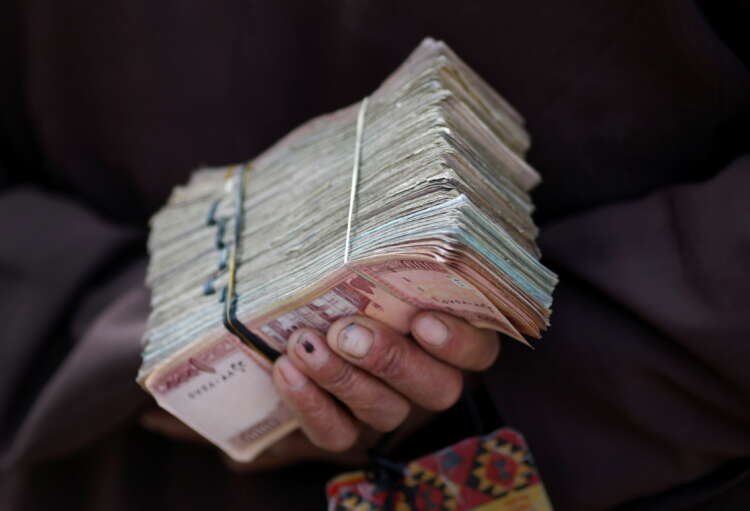
    Image illustrating the directive from Afghanistan's central bank to restrict remittance payouts to local currency amid dwindling U.S. dollars, highlighting the impact on the banking sector.
    Afghanistan's central bank restricts remittance payouts to local currency amid dollar scarcity - Global Banking & Finance Review
    Why waste money on news and opinion when you can access them for free?

    Take advantage of our newsletter subscription and stay informed on the go!

    Subscribe

    By Tom Arnold

    LONDON (Reuters) – Afghanistan’s central bank has ordered banks to pay out remittances in local currency only, the latest move to preserve scarce U.S. dollars, say sources familiar with the matter.

    Hard currency remittances have formed an important source of external finance for Afghanistan over the years but dollar availability has dried up in the aftermath of the Taliban’s conquest of the country.

    Western Union Co’s agent banking partners in Afghanistan received a directive from the country’s central bank in the last few days to pay out remittances in afghani only, said a source close to a money exchange provider.

    Remittances sent before the directive and selected by the sender for dollar payout can continue to be paid in dollars, the source said.

    MoneyGram International Inc said it was paying out in afghani only, without elaborating further.

    Both resumed money-transfer services to Afghanistan last week https://www.reuters.com/world/asia-pacific/exclusive-western-union-resuming-services-afghanistan-senior-exec-2021-09-02, having suspended services in August after the Islamist militia captured Kabul.

    No comment was immediately available from the central bank.

    Under the leadership of acting central bank governor, Haji Mohammad Idris, a Taliban loyalist who has no formal financial training, the central bank has been moving to restrict dollar outflows amid a pause in foreign aid and a scramble by some Afghanis to get savings out of the country.

    Further controls are expected to hasten the afghani’s depreciation against the dollar, exacerbating inflation in a country where more than a third of the population lives on less than $2 a day.

    “It’s a matter of concern that the remaining physical cash of U.S. dollars is going to reduce further,” said an Afghani banker. “With the restrictions we are predicting the dollar will reach more than 100 afghanis to the dollar.”

    The afghani was trading at around 80 to the dollar just before the fall of Kabul on Aug. 15.

    Banks were told by the central bank last week to restrict withdrawals by corporate customers to local currency only, capped at around 20% of each customer’s weekly operating costs, said the banker.

    With around 80% of banking deposits in dollars, bankers say controls should minimise the risk of insolvency.

    Since re-opening in the second half of August, banks have been operating with limited services, including $200 weekly limits on withdrawals and few wire transfers.

    (Additional reporting by James Mackenzie; Editing by Christina Fincher)

    By Tom Arnold

    LONDON (Reuters) – Afghanistan’s central bank has ordered banks to pay out remittances in local currency only, the latest move to preserve scarce U.S. dollars, say sources familiar with the matter.

    Hard currency remittances have formed an important source of external finance for Afghanistan over the years but dollar availability has dried up in the aftermath of the Taliban’s conquest of the country.

    Western Union Co’s agent banking partners in Afghanistan received a directive from the country’s central bank in the last few days to pay out remittances in afghani only, said a source close to a money exchange provider.

    Remittances sent before the directive and selected by the sender for dollar payout can continue to be paid in dollars, the source said.

    MoneyGram International Inc said it was paying out in afghani only, without elaborating further.

    Both resumed money-transfer services to Afghanistan last week https://www.reuters.com/world/asia-pacific/exclusive-western-union-resuming-services-afghanistan-senior-exec-2021-09-02, having suspended services in August after the Islamist militia captured Kabul.

    No comment was immediately available from the central bank.

    Under the leadership of acting central bank governor, Haji Mohammad Idris, a Taliban loyalist who has no formal financial training, the central bank has been moving to restrict dollar outflows amid a pause in foreign aid and a scramble by some Afghanis to get savings out of the country.

    Further controls are expected to hasten the afghani’s depreciation against the dollar, exacerbating inflation in a country where more than a third of the population lives on less than $2 a day.

    “It’s a matter of concern that the remaining physical cash of U.S. dollars is going to reduce further,” said an Afghani banker. “With the restrictions we are predicting the dollar will reach more than 100 afghanis to the dollar.”

    The afghani was trading at around 80 to the dollar just before the fall of Kabul on Aug. 15.

    Banks were told by the central bank last week to restrict withdrawals by corporate customers to local currency only, capped at around 20% of each customer’s weekly operating costs, said the banker.

    With around 80% of banking deposits in dollars, bankers say controls should minimise the risk of insolvency.

    Since re-opening in the second half of August, banks have been operating with limited services, including $200 weekly limits on withdrawals and few wire transfers.

    (Additional reporting by James Mackenzie; Editing by Christina Fincher)

    More from Banking

    Explore more articles in the Banking category

    Image for Latin Securities Named Winner of Two Prestigious 2026 Global Banking & Finance Awards
    Latin Securities Named Winner of Two Prestigious 2026 Global Banking & Finance Awards
    Image for Pix at five years: how Brazil built one of the world’s most advanced public payments infrastructures - and why other countries are paying attention
    Pix at five years: how Brazil built one of the world’s most advanced public payments infrastructures - and why other countries are paying attention
    Image for Idle Stablecoins Are Becoming a Systemic Efficiency Problem — and Banks Should Pay Attention
    Idle Stablecoins Are Becoming a Systemic Efficiency Problem — and Banks Should Pay Attention
    Image for Banking Without Boundaries: A More Practical Approach to Global Banking
    Banking Without Boundaries: A More Practical Approach to Global Banking
    Image for Lessons From the Ring and the Deal Table: How Boxing Shapes Steven Nigro’s Approach to Banking and Life
    Lessons From the Ring and the Deal Table: How Boxing Shapes Steven Nigro’s Approach to Banking and Life
    Image for The Key to Unlocking ROI from GenAI
    The Key to Unlocking ROI from GenAI
    Image for The Changing Landscape of Small Business Lending: What Traditional Finance Models Miss
    The Changing Landscape of Small Business Lending: What Traditional Finance Models Miss
    Image for VestoFX.net Expands Education-Oriented Content as Focus on Risk Awareness Grows in CFD Trading
    VestoFX.net Expands Education-Oriented Content as Focus on Risk Awareness Grows in CFD Trading
    Image for The Hybrid Banking Model That Digital-Only Providers Cannot Match
    The Hybrid Banking Model That Digital-Only Providers Cannot Match
    Image for INTERPOLITAN MONEY ANNOUNCES RECORD GROWTH ACROSS 2025
    INTERPOLITAN MONEY ANNOUNCES RECORD GROWTH ACROSS 2025
    Image for Alter Bank Wins Two Prestigious Awards in the 2025 Global Banking & Finance Awards®
    Alter Bank Wins Two Prestigious Awards in the 2025 Global Banking & Finance Awards®
    Image for CIBC wins two Global Banking and Finance Awards for student banking
    CIBC wins two Global Banking and Finance Awards for student banking
    View All Banking Posts
    Previous Banking PostExclusive-U.S. Treasury, financial industry discuss cryptocurrency ‘stablecoins’
    Next Banking PostBanks expect London to remain a top financial centre, says survey