Search
00
GBAF Logo
trophy
Top StoriesInterviewsBusinessFinanceBankingTechnologyInvestingTradingVideosAwardsMagazinesHeadlinesTrends

Subscribe to our newsletter

Get the latest news and updates from our team.

Global Banking and Finance Review

Global Banking & Finance Review

Company

    GBAF Logo
    • About Us
    • Profile
    • Privacy & Cookie Policy
    • Terms of Use
    • Contact Us
    • Advertising
    • Submit Post
    • Latest News
    • Research Reports
    • Press Release
    • Awards▾
      • About the Awards
      • Awards TimeTable
      • Submit Nominations
      • Testimonials
      • Media Room
      • Award Winners
      • FAQ
    • Magazines▾
      • Global Banking & Finance Review Magazine Issue 79
      • Global Banking & Finance Review Magazine Issue 78
      • Global Banking & Finance Review Magazine Issue 77
      • Global Banking & Finance Review Magazine Issue 76
      • Global Banking & Finance Review Magazine Issue 75
      • Global Banking & Finance Review Magazine Issue 73
      • Global Banking & Finance Review Magazine Issue 71
      • Global Banking & Finance Review Magazine Issue 70
      • Global Banking & Finance Review Magazine Issue 69
      • Global Banking & Finance Review Magazine Issue 66
    Top StoriesInterviewsBusinessFinanceBankingTechnologyInvestingTradingVideosAwardsMagazinesHeadlinesTrends

    Global Banking & Finance Review® is a leading financial portal and online magazine offering News, Analysis, Opinion, Reviews, Interviews & Videos from the world of Banking, Finance, Business, Trading, Technology, Investing, Brokerage, Foreign Exchange, Tax & Legal, Islamic Finance, Asset & Wealth Management.
    Copyright © 2010-2025 GBAF Publications Ltd - All Rights Reserved.

    Editorial & Advertiser disclosure

    Global Banking and Finance Review is an online platform offering news, analysis, and opinion on the latest trends, developments, and innovations in the banking and finance industry worldwide. The platform covers a diverse range of topics, including banking, insurance, investment, wealth management, fintech, and regulatory issues. The website publishes news, press releases, opinion and advertorials on various financial organizations, products and services which are commissioned from various Companies, Organizations, PR agencies, Bloggers etc. These commissioned articles are commercial in nature. This is not to be considered as financial advice and should be considered only for information purposes. It does not reflect the views or opinion of our website and is not to be considered an endorsement or a recommendation. We cannot guarantee the accuracy or applicability of any information provided with respect to your individual or personal circumstances. Please seek Professional advice from a qualified professional before making any financial decisions. We link to various third-party websites, affiliate sales networks, and to our advertising partners websites. When you view or click on certain links available on our articles, our partners may compensate us for displaying the content to you or make a purchase or fill a form. This will not incur any additional charges to you. To make things simpler for you to identity or distinguish advertised or sponsored articles or links, you may consider all articles or links hosted on our site as a commercial article placement. We will not be responsible for any loss you may suffer as a result of any omission or inaccuracy on the website.

    Home > Investing > UK TO LOSE TOP SPOTS FOR VENTURE CAPITAL & PRIVATE EQUITY WORLD INVESTMENT DUE TO BREXIT
    Investing

    UK TO LOSE TOP SPOTS FOR VENTURE CAPITAL & PRIVATE EQUITY WORLD INVESTMENT DUE TO BREXIT

    UK TO LOSE TOP SPOTS FOR VENTURE CAPITAL & PRIVATE EQUITY WORLD INVESTMENT DUE TO BREXIT

    Published by Gbaf News

    Posted on February 11, 2018

    Featured image for article about Investing
    • Historically ranked 2nd in the IESE Venture Capital and Private Equity Country Attractiveness Index, the UK is projected to see a fall of at least four positions two years after leaving the EU
    • The 2018 edition of the index sees the US take the world’s number 1, followed by the UK (2), Canada (3), Hong Kong (4) and Japan (5)
    • In its 9th edition, this year’s report also includes a five-year heat map pointing out rising stars such as Ireland, China, India, and several CEE countries; as well as flagging countries not offering the best investment opportunities including several Latin American countries, Ukraine, Croatia, Cyprus or Slovakia

    Launched in 2009, the Venture Capital and Private Equity Country Attractiveness Index has shown practically no changes in the top three positions of the table in the past nine years: the US has taken the top spot in every edition, followed by the UK and Canada, for almost a decade. However, the authors anticipate a huge shake-up in the following two – three years, mainly driven by Brexit and its impact on the UK. The most direct and palpable effect will be a drop for the UK from 2nd to 6th position in the index.

    “A future loss of several positions is almost inevitable; additional regulatory burdens and increasing costs for UK GPs to gain access to the single market, as well as a slowing economy and an inevitable brain drain, will make the UK less attractive to venture capital and private equity investors,” says one of the indexes authors, IESE Finance Prof. Heinrich Liechtenstein.

    The Index analyses 125 countries according to six key drivers: economic activity, depth of capital markets; taxation; investor protections and corporate governance; human and social environment; and entrepreneurial culture and deal opportunities.

    Historically and including 2018, the UK has always scored very high on many of these drivers: entrepreneurial opportunities, investor protection, social environment and depth of capital markets. The country has also been very strong in regards to its economic activity which, for the first time, appears to start showing the effects of Brexit with a slower GDP growth.

    However, the authors of the study foresee huge and negative changes to these factors. For example, they anticipate a substantial haircut in the indicators measuring the UK’s depth of the capital market. The post-Brexit analysis included in this year’s edition of the VC/PE Country Attractiveness Index, also factors-in a slower GDP growth (1% below predictions in a non-Brexit scenario) and an increase in the UK’s unemployment rate. Incorporating these expectations into the index, results in the UK dropping to 6th position in the world ranking for VC/PE attractiveness (see Figure 1).
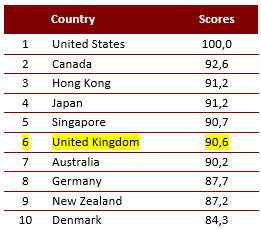
    Figure 1: Post Brexit Scenario

    Figure 1: Post Brexit Scenario

    Explaining these figures, Alexander Groh Professor of Finance at EMLYON Business School stresses: “Brexit will have severe consequences on the UK’s economic growth, her trading with the EU and on the dominance of London as a financial hub for Europe. The shift of qualified staff improves the deal making capacity of cities like Amsterdam, Frankfurt, Dublin or Paris who increase their attractiveness in the global competition for institutional capital.”

    Some potential positives

    Despite their sombre predictions, the authors do point out some drivers of the VC/PE country attractiveness index which UK politicians could move in positive directions in an attempt to offset the financial sector’s loss of market share. For example, lowering taxes and deregulation could improve investment conditions for institutional capital. Despite the political difficulties of making such changes and their negative side-effects, the authors encourage the VC/PE industry in the UK to fight to “ensure as smooth a Brexit as possible.”

    World Heat Map

    In order to demonstrate shifts in the VC and PE country attractiveness, the authors also performed a comparison of the 2014 and 2018 rankings. This analysis reveals strong increases of VC and PE attractiveness for certain countries, as well as highlighting the impact of financial and economic crises on others.

    For instance, Ireland, Denmark, Malaysia, China, India, and several CEE countries have a very positive outlook which the authors translated into “highly attractive countries where investors should increase their exposure”. On the other side of the spectrum, several Latin American countries, Ukraine, Croatia, Cyprus or Slovakia are “unattractive and should rather be avoided,” according to the authors.

    The full interactive heat map is available here: http://blog.iese.edu/vcpeindex/heat-map/

    • Historically ranked 2nd in the IESE Venture Capital and Private Equity Country Attractiveness Index, the UK is projected to see a fall of at least four positions two years after leaving the EU
    • The 2018 edition of the index sees the US take the world’s number 1, followed by the UK (2), Canada (3), Hong Kong (4) and Japan (5)
    • In its 9th edition, this year’s report also includes a five-year heat map pointing out rising stars such as Ireland, China, India, and several CEE countries; as well as flagging countries not offering the best investment opportunities including several Latin American countries, Ukraine, Croatia, Cyprus or Slovakia

    Launched in 2009, the Venture Capital and Private Equity Country Attractiveness Index has shown practically no changes in the top three positions of the table in the past nine years: the US has taken the top spot in every edition, followed by the UK and Canada, for almost a decade. However, the authors anticipate a huge shake-up in the following two – three years, mainly driven by Brexit and its impact on the UK. The most direct and palpable effect will be a drop for the UK from 2nd to 6th position in the index.

    “A future loss of several positions is almost inevitable; additional regulatory burdens and increasing costs for UK GPs to gain access to the single market, as well as a slowing economy and an inevitable brain drain, will make the UK less attractive to venture capital and private equity investors,” says one of the indexes authors, IESE Finance Prof. Heinrich Liechtenstein.

    The Index analyses 125 countries according to six key drivers: economic activity, depth of capital markets; taxation; investor protections and corporate governance; human and social environment; and entrepreneurial culture and deal opportunities.

    Historically and including 2018, the UK has always scored very high on many of these drivers: entrepreneurial opportunities, investor protection, social environment and depth of capital markets. The country has also been very strong in regards to its economic activity which, for the first time, appears to start showing the effects of Brexit with a slower GDP growth.

    However, the authors of the study foresee huge and negative changes to these factors. For example, they anticipate a substantial haircut in the indicators measuring the UK’s depth of the capital market. The post-Brexit analysis included in this year’s edition of the VC/PE Country Attractiveness Index, also factors-in a slower GDP growth (1% below predictions in a non-Brexit scenario) and an increase in the UK’s unemployment rate. Incorporating these expectations into the index, results in the UK dropping to 6th position in the world ranking for VC/PE attractiveness (see Figure 1).

    Figure 1: Post Brexit Scenario

    Figure 1: Post Brexit Scenario

    Explaining these figures, Alexander Groh Professor of Finance at EMLYON Business School stresses: “Brexit will have severe consequences on the UK’s economic growth, her trading with the EU and on the dominance of London as a financial hub for Europe. The shift of qualified staff improves the deal making capacity of cities like Amsterdam, Frankfurt, Dublin or Paris who increase their attractiveness in the global competition for institutional capital.”

    Some potential positives

    Despite their sombre predictions, the authors do point out some drivers of the VC/PE country attractiveness index which UK politicians could move in positive directions in an attempt to offset the financial sector’s loss of market share. For example, lowering taxes and deregulation could improve investment conditions for institutional capital. Despite the political difficulties of making such changes and their negative side-effects, the authors encourage the VC/PE industry in the UK to fight to “ensure as smooth a Brexit as possible.”

    World Heat Map

    In order to demonstrate shifts in the VC and PE country attractiveness, the authors also performed a comparison of the 2014 and 2018 rankings. This analysis reveals strong increases of VC and PE attractiveness for certain countries, as well as highlighting the impact of financial and economic crises on others.

    For instance, Ireland, Denmark, Malaysia, China, India, and several CEE countries have a very positive outlook which the authors translated into “highly attractive countries where investors should increase their exposure”. On the other side of the spectrum, several Latin American countries, Ukraine, Croatia, Cyprus or Slovakia are “unattractive and should rather be avoided,” according to the authors.

    The full interactive heat map is available here: http://blog.iese.edu/vcpeindex/heat-map/

    Related Posts
     Millennials Aren’t Ignoring Retirement. They’re Rebuilding It.
    Millennials Aren’t Ignoring Retirement. They’re Rebuilding It.
    BridgeWise Launches FixedWise, the First AI Solution Bringing Granular Bond Intelligence to the European Market
    BridgeWise Launches FixedWise, the First AI Solution Bringing Granular Bond Intelligence to the European Market
    Why Financial Advisors Are Rethinking Gold Allocations
    Why Financial Advisors Are Rethinking Gold Allocations
    From Opaque to Investable: Yaniv Bertele's Blueprint for Transparent Alternatives
    From Opaque to Investable: Yaniv Bertele's Blueprint for Transparent Alternatives
    Private Equity Needs AI Advocates
    Private Equity Needs AI Advocates
    Understanding the Global Impact of Rising Medical Insurance Premiums on the Middle Class
    Understanding the Global Impact of Rising Medical Insurance Premiums on the Middle Class
    The New Model Driving Creative Investment in University Innovation
    The New Model Driving Creative Investment in University Innovation
    The return of tangible assets in modern portfolios
    The return of tangible assets in modern portfolios
    Retro Bikes And Insurance: What You Should Know?
    Retro Bikes And Insurance: What You Should Know?
    Top Stocks Powering the AI Boom in 2025
    Top Stocks Powering the AI Boom in 2025
    How often should you update your estate plan? The events that demand a refresh
    How often should you update your estate plan? The events that demand a refresh
    Top 5 Mutual Funds in the UAE: Performance, Features, and How to Invest
    Top 5 Mutual Funds in the UAE: Performance, Features, and How to Invest

    Why waste money on news and opinions when you can access them for free?

    Take advantage of our newsletter subscription and stay informed on the go!

    Subscribe

    Previous Investing PostDIESEL COULD BE CHEAPER AND MORE EFFICIENT FOR TWICE AS MANY DRIVERS AS PETROL
    Next Investing PostMITON’S ANTHONY RAYNER: MARKET SHAKE OUT

    More from Investing

    Explore more articles in the Investing category

    How One Investor Learned to Find Value Through a Wider Lens

    How One Investor Learned to Find Value Through a Wider Lens

    Freedom Holding Corp’s Global Rise: Why Institutional Investors Are Betting Big

    Freedom Holding Corp’s Global Rise: Why Institutional Investors Are Betting Big

    Pro Visionary Helps Australians Strengthen Their Financial Resilience Through Licensed Wealth Strategies

    Pro Visionary Helps Australians Strengthen Their Financial Resilience Through Licensed Wealth Strategies

    How ZenInvestor Is Breaking Down Barriers to Financial Literacy and Empowering Everyday Investors Nationwide

    How ZenInvestor Is Breaking Down Barriers to Financial Literacy and Empowering Everyday Investors Nationwide

    Edward L. Shugrue III on Returning to the Office: A Cultural Shift and Investment Opportunity

    Edward L. Shugrue III on Returning to the Office: A Cultural Shift and Investment Opportunity

    How Private Capital Can Build Public Good

    How Private Capital Can Build Public Good

    Private Equity Has a Major Speed and Capacity Problem

    Private Equity Has a Major Speed and Capacity Problem

    Navigating AI Investing Tools: Wealth Management Disruption Ahead

    Navigating AI Investing Tools: Wealth Management Disruption Ahead

    MTF Trading Explained: What It Is, How It Works, and Key Benefits

    MTF Trading Explained: What It Is, How It Works, and Key Benefits

    Private Equity Has Trust Issues With AI

    Private Equity Has Trust Issues With AI

    Merifund Capital Management on FTSE 100 Gains

    Merifund Capital Management on FTSE 100 Gains

    Sycamine Capital Management sets outlook on Japan equities

    Sycamine Capital Management sets outlook on Japan equities

    View All Investing Posts