Search
00
GBAF Logo
trophy
Top StoriesInterviewsBusinessFinanceBankingTechnologyInvestingTradingVideosAwardsMagazinesHeadlinesTrends

Subscribe to our newsletter

Get the latest news and updates from our team.

Global Banking & Finance Review®

Global Banking & Finance Review® - Subscribe to our newsletter

Company

    GBAF Logo
    • About Us
    • Profile
    • Privacy & Cookie Policy
    • Terms of Use
    • Contact Us
    • Advertising
    • Submit Post
    • Latest News
    • Research Reports
    • Press Release
    • Awards▾
      • About the Awards
      • Awards TimeTable
      • Submit Nominations
      • Testimonials
      • Media Room
      • Award Winners
      • FAQ
    • Magazines▾
      • Global Banking & Finance Review Magazine Issue 79
      • Global Banking & Finance Review Magazine Issue 78
      • Global Banking & Finance Review Magazine Issue 77
      • Global Banking & Finance Review Magazine Issue 76
      • Global Banking & Finance Review Magazine Issue 75
      • Global Banking & Finance Review Magazine Issue 73
      • Global Banking & Finance Review Magazine Issue 71
      • Global Banking & Finance Review Magazine Issue 70
      • Global Banking & Finance Review Magazine Issue 69
      • Global Banking & Finance Review Magazine Issue 66
    Top StoriesInterviewsBusinessFinanceBankingTechnologyInvestingTradingVideosAwardsMagazinesHeadlinesTrends

    Global Banking & Finance Review® is a leading financial portal and online magazine offering News, Analysis, Opinion, Reviews, Interviews & Videos from the world of Banking, Finance, Business, Trading, Technology, Investing, Brokerage, Foreign Exchange, Tax & Legal, Islamic Finance, Asset & Wealth Management.
    Copyright © 2010-2026 GBAF Publications Ltd - All Rights Reserved. | Sitemap | Tags | Developed By eCorpIT

    Editorial & Advertiser disclosure

    Global Banking & Finance Review® is an online platform offering news, analysis, and opinion on the latest trends, developments, and innovations in the banking and finance industry worldwide. The platform covers a diverse range of topics, including banking, insurance, investment, wealth management, fintech, and regulatory issues. The website publishes news, press releases, opinion and advertorials on various financial organizations, products and services which are commissioned from various Companies, Organizations, PR agencies, Bloggers etc. These commissioned articles are commercial in nature. This is not to be considered as financial advice and should be considered only for information purposes. It does not reflect the views or opinion of our website and is not to be considered an endorsement or a recommendation. We cannot guarantee the accuracy or applicability of any information provided with respect to your individual or personal circumstances. Please seek Professional advice from a qualified professional before making any financial decisions. We link to various third-party websites, affiliate sales networks, and to our advertising partners websites. When you view or click on certain links available on our articles, our partners may compensate us for displaying the content to you or make a purchase or fill a form. This will not incur any additional charges to you. To make things simpler for you to identity or distinguish advertised or sponsored articles or links, you may consider all articles or links hosted on our site as a commercial article placement. We will not be responsible for any loss you may suffer as a result of any omission or inaccuracy on the website.

    Home > Finance > UK inflation jumps to 2.3%, underscoring BoE’s stance for gradual rate cuts
    Finance

    UK inflation jumps to 2.3%, underscoring BoE’s stance for gradual rate cuts

    Published by Jessica Weisman-Pitts

    Posted on November 20, 2024

    4 min read

    Last updated: January 28, 2026

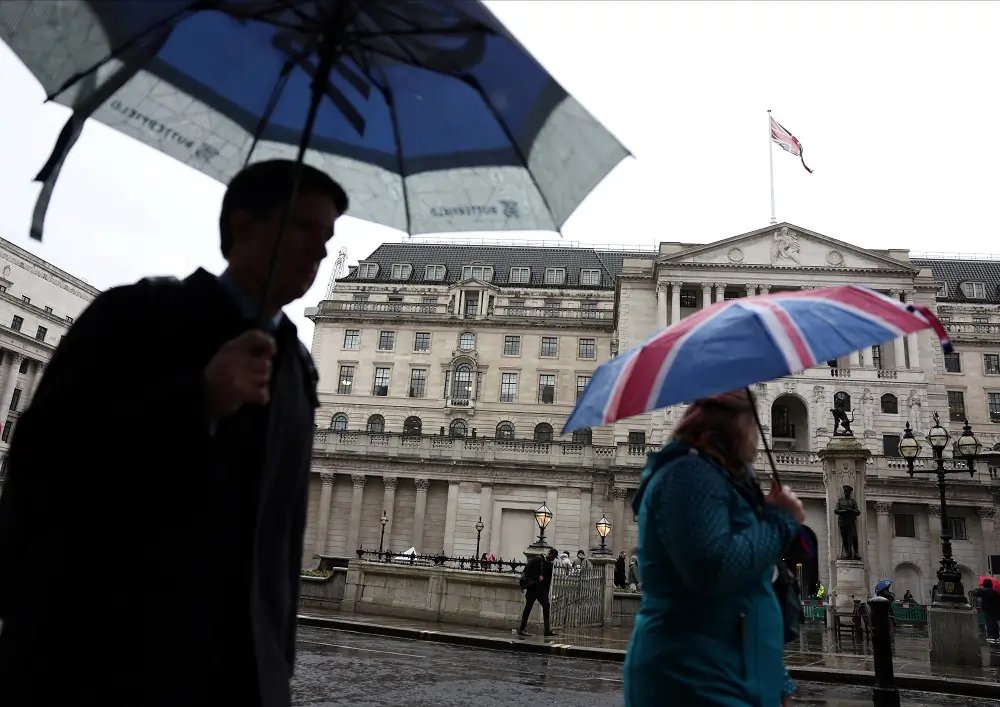
    This image displays a graph showing the increase in UK inflation to 2.3% in October 2024, emphasizing the Bank of England's cautious approach to interest rate cuts amidst rising consumer prices.
    Graph illustrating UK's inflation rate rise to 2.3% in October 2024 - Global Banking & Finance Review
    Why waste money on news and opinion when you can access them for free?

    Take advantage of our newsletter subscription and stay informed on the go!

    Subscribe

    Tags:UK economyinterest ratesfinancial marketsmonetary policy

    By William Schomberg and David Milliken

    LONDON (Reuters) -British inflation jumped by more than expected last month to rise back above the Bank of England’s 2% target and underlying price growth gathered speed too, showing why the BoE is moving cautiously on interest rate cuts.

    Consumer prices rose by an annual 2.3% in October, pushed up almost entirely by an increase in regulated domestic energy tariffs, after a 1.7% rise in September which was the first time the inflation rate had fallen below the BoE’s target since 2021.

    Sterling strengthened by almost a third of a cent against the U.S. dollar after the data was published before giving back most of that rise. Interest rate futures priced in a slightly slower pace of rate cuts and bond prices fell.

    The BoE’s most recent forecast and a Reuters poll of economists had both pointed to a weaker CPI reading of 2.2%.

    James Smith, research director at the Resolution Foundation think tank, said a rise had been expected as last year’s energy price falls dropped out of the annual calculation and the price cap increased in October.

    “But the clean sweep of higher headline, core and services inflation has delivered a triple dose of bad news for families and policymakers alike,” he said.

    The increase took inflation to a six-month high and represented the biggest month-to-month rise in the annual CPI rate since inflation peaked in October 2022.

    Services inflation – which the BoE views as a key measure of domestically generated price pressure – rose to 5.0% in October from 4.9% in September, the Office for National Statistics said, in line with BoE and market expectations.

    But core inflation, which excludes energy, food, alcohol and tobacco prices, picked up to 3.3% from September’s 3.2%, bucking market expectations for a fall.

    The BoE said this month it expected headline inflation to tick up to 2.4% and 2.5% in November and December. Price growth is likely to approach 3% in the second half of next year, it says. Some private-sector economists think inflation will rise close to 3% in early 2025.

    GLOBAL UNCERTAINTY

    The BoE has said the first budget of Britain’s new government will probably add to inflation next year and U.S. President-elect Donald Trump’s threat to impose sweeping import tariffs adds to uncertainty about the outlook.

    Monica George Michail, an associate economist at Britain’s National Institute of Economic and Social Research think tank, said interest rates might stay elevated for longer.

    “This outlook reflects forecasted inflationary pressures stemming from the recently announced budget, in addition to heightened global uncertainty, particularly surrounding the Trump presidency,” she said.

    The new government of Prime Minister Keir Starmer has promised to speed up Britain’s economic growth but has come under fire from employers for the higher employment taxes that they will have to pay from April next year.

    The BoE has said that could lead to higher prices as well as job losses.

    Chief Secretary to the Treasury Darren Jones said the government was trying to reduce the impact of the higher cost of living, including with a latest increase in the minimum wage, “but we know there is more to do.”

    Mel Stride, the Conservative opposition’s would-be finance minister, said the government’s fiscal watchdog had already been predicting higher inflation as a result of the budget.

    “What is worrying about today’s announcement is that inflation is running ahead of expectations and official forecasts state these figures are not expected to improve,” he said.

    There is also upward pressure on prices from the jobs market where many employers face a shortage of candidates.

    Data last week showed British pay grew at its slowest pace in more than two years in the three months to the end of September. But BoE Chief Economist Huw Pill said wage growth was stuck at levels that were too high for the central bank.

    Investors on Wednesday were pricing around 60 basis points of BoE rate reductions by the end of 2025, equivalent to between two and three cuts, down from about 65 basis points of cuts expected by investors before the inflation data.

    Two-year British government bond yields, which are sensitive to interest rate speculation, rose by around 4 basis points.

    Governor Andrew Bailey on Tuesday stressed the BoE’s message that borrowing costs are likely to come down only gradually.

    There were signs of some weaker inflation pressures in the pipeline. Prices charged by factories for their goods fell by 0.8% in the 12 months to October, the biggest drop since October 2020 during the COVID pandemic.

    (Reporting by William Schomberg; editing by David Milliken, Sarah Young and Toby Chopra)

    Frequently Asked Questions about UK inflation jumps to 2.3%, underscoring BoE’s stance for gradual rate cuts

    1What is inflation?

    Inflation is the rate at which the general level of prices for goods and services rises, eroding purchasing power. It is typically measured by the Consumer Price Index (CPI).

    2What is the Bank of England?

    The Bank of England is the central bank of the United Kingdom, responsible for issuing currency, maintaining monetary stability, and overseeing the financial system.

    3What are interest rates?

    Interest rates are the cost of borrowing money or the return on savings, expressed as a percentage. They are influenced by central bank policies and economic conditions.

    4What is core inflation?

    Core inflation measures the long-term trend in prices by excluding volatile items such as food and energy. It provides a clearer view of underlying inflation trends.

    5What is monetary policy?

    Monetary policy refers to the actions taken by a central bank to manage the money supply and interest rates to achieve macroeconomic objectives like controlling inflation.

    More from Finance

    Explore more articles in the Finance category

    Image for French miner Eramet's finance chief steps aside temporarily, days after CEO ouster
    French miner Eramet's finance chief steps aside temporarily, days after CEO ouster
    Image for Ukraine's Zelenskiy calls for faster action on air defence, repairs to grid
    Ukraine's Zelenskiy calls for faster action on air defence, repairs to grid
    Image for Goldman Sachs teams up with Anthropic to automate banking tasks with AI agents, CNBC reports
    Goldman Sachs teams up with Anthropic to automate banking tasks with AI agents, CNBC reports
    Image for Analysis-Hims' $49 weight-loss pill rattles investor case for cash-pay obesity market
    Analysis-Hims' $49 weight-loss pill rattles investor case for cash-pay obesity market
    Image for Analysis-Glencore to focus on short-term disposals as Rio deal remains elusive
    Analysis-Glencore to focus on short-term disposals as Rio deal remains elusive
    Image for Belgium's Agomab Therapeutics valued at $716 million as shares fall in Nasdaq debut
    Belgium's Agomab Therapeutics valued at $716 million as shares fall in Nasdaq debut
    Image for Big Tech's quarter in four charts: AI splurge and cloud growth
    Big Tech's quarter in four charts: AI splurge and cloud growth
    Image for EU hikes tariffs on Chinese ceramics to 79% to counter dumping 
    EU hikes tariffs on Chinese ceramics to 79% to counter dumping 
    Image for AI trade splinters as investors get more selective
    AI trade splinters as investors get more selective
    Image for EU extends tariff suspension on $109.8 billion of US imports for six months
    EU extends tariff suspension on $109.8 billion of US imports for six months
    Image for Dog food maker Ollie acquired by Spain’s Agrolimen
    Dog food maker Ollie acquired by Spain’s Agrolimen
    Image for Salzgitter to take over HKM steel joint venture, end clash with Thyssenkrupp
    Salzgitter to take over HKM steel joint venture, end clash with Thyssenkrupp
    View All Finance Posts
    Previous Finance PostFirst Digital’s FDUSD Stablecoin is Officially Live on Sui
    Next Finance PostUK inflation could undershoot forecasts, requiring faster rate cuts, BoE’s Ramsden says