Search
00
GBAF Logo
trophy
Top StoriesInterviewsBusinessFinanceBankingTechnologyInvestingTradingVideosAwardsMagazinesHeadlinesTrends

Subscribe to our newsletter

Get the latest news and updates from our team.

Global Banking & Finance Review®

Global Banking & Finance Review® - Subscribe to our newsletter

Company

    GBAF Logo
    • About Us
    • Profile
    • Privacy & Cookie Policy
    • Terms of Use
    • Contact Us
    • Advertising
    • Submit Post
    • Latest News
    • Research Reports
    • Press Release
    • Awards▾
      • About the Awards
      • Awards TimeTable
      • Submit Nominations
      • Testimonials
      • Media Room
      • Award Winners
      • FAQ
    • Magazines▾
      • Global Banking & Finance Review Magazine Issue 79
      • Global Banking & Finance Review Magazine Issue 78
      • Global Banking & Finance Review Magazine Issue 77
      • Global Banking & Finance Review Magazine Issue 76
      • Global Banking & Finance Review Magazine Issue 75
      • Global Banking & Finance Review Magazine Issue 73
      • Global Banking & Finance Review Magazine Issue 71
      • Global Banking & Finance Review Magazine Issue 70
      • Global Banking & Finance Review Magazine Issue 69
      • Global Banking & Finance Review Magazine Issue 66
    Top StoriesInterviewsBusinessFinanceBankingTechnologyInvestingTradingVideosAwardsMagazinesHeadlinesTrends

    Global Banking & Finance Review® is a leading financial portal and online magazine offering News, Analysis, Opinion, Reviews, Interviews & Videos from the world of Banking, Finance, Business, Trading, Technology, Investing, Brokerage, Foreign Exchange, Tax & Legal, Islamic Finance, Asset & Wealth Management.
    Copyright © 2010-2026 GBAF Publications Ltd - All Rights Reserved. | Sitemap | Tags | Developed By eCorpIT

    Editorial & Advertiser disclosure

    Global Banking & Finance Review® is an online platform offering news, analysis, and opinion on the latest trends, developments, and innovations in the banking and finance industry worldwide. The platform covers a diverse range of topics, including banking, insurance, investment, wealth management, fintech, and regulatory issues. The website publishes news, press releases, opinion and advertorials on various financial organizations, products and services which are commissioned from various Companies, Organizations, PR agencies, Bloggers etc. These commissioned articles are commercial in nature. This is not to be considered as financial advice and should be considered only for information purposes. It does not reflect the views or opinion of our website and is not to be considered an endorsement or a recommendation. We cannot guarantee the accuracy or applicability of any information provided with respect to your individual or personal circumstances. Please seek Professional advice from a qualified professional before making any financial decisions. We link to various third-party websites, affiliate sales networks, and to our advertising partners websites. When you view or click on certain links available on our articles, our partners may compensate us for displaying the content to you or make a purchase or fill a form. This will not incur any additional charges to you. To make things simpler for you to identity or distinguish advertised or sponsored articles or links, you may consider all articles or links hosted on our site as a commercial article placement. We will not be responsible for any loss you may suffer as a result of any omission or inaccuracy on the website.

    Home > Top Stories > Tunisian president plans to change political system, suspend constitution – adviser
    Top Stories

    Tunisian president plans to change political system, suspend constitution – adviser

    Published by maria gbaf

    Posted on September 10, 2021

    6 min read

    Last updated: January 21, 2026

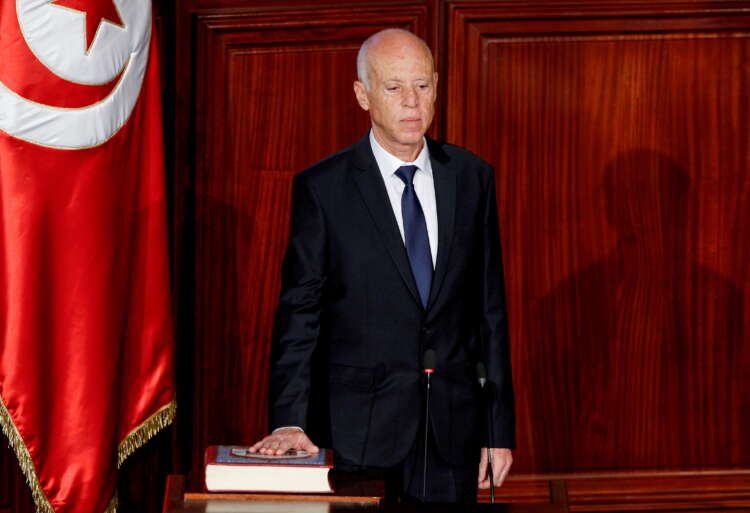
    Image depicting Tunisian President Kais Saied as he discusses plans to suspend the constitution and alter the political system, reflecting the ongoing constitutional crisis in Tunisia.
    Tunisian President Kais Saied discussing political changes amidst constitutional crisis - Global Banking & Finance Review
    Why waste money on news and opinion when you can access them for free?

    Take advantage of our newsletter subscription and stay informed on the go!

    Subscribe

    By Tarek Amara and Angus McDowall

    TUNIS (Reuters) – Tunisian President Kais Saied plans to suspend the constitution and may amend the political system via a referendum, one of his advisers told Reuters on Thursday in the first clear indication of his plans after moves his critics have called a coup.

    More than six weeks after Saied seized governing powers, dismissed the prime minister and suspended parliament on July 25, he has still not appointed a new government or made any broader declaration of his long-term intentions.

    “This system cannot continue … changing the system means changing the constitution through a referendum, perhaps … the referendum requires logistical preparation,” said Walid Hajjem, an adviser to Saied.

    He added that this was the president’s plan, which was at the final stage and was expected to be formally unveiled soon, but he did not expand on what changes Saied was contemplating.

    Saied’s intervention has thrust Tunisia into a constitutional crisis, raising concerns over the future of the democratic system it adopted after the 2011 revolution that led to the Arab Spring.

    Saied has been widely expected to move to a presidential system of government that would reduce the role of the parliament, something that has been frequently discussed during years of gridlock since the 2014 constitution was agreed.

    He has defended his moves as necessary and said they were in line with the constitution, promised to respect Tunisians’ rights and said he will not become a dictator.

    However, arrests of parliament members after Saied lifted their immunity and numerous travel bans against prominent people have alarmed some rights advocates.

    NEW GOVERNMENT

    Both domestic and international forces have pushed for Saied to appoint a government and show how he means to exit the constitutional crisis caused by his intervention.

    The head of Tunisia’s human rights league was quoted in a Tunisian newspaper on Thursday as saying that Saied had informed him that a new government would be appointed this week.

    Tunisia faces grave economic problems and a looming threat to public finances, and had just started talks with the International Monetary Fund for a new loan programme when Saied ousted the prime minister.

    Any further IMF talks could not take place until a new government was installed that could credibly discuss fiscal reforms wanted by foreign lenders.

    Years of economic stagnation and declining public services, worsened by political paralysis, have soured many Tunisians on the form of democracy they adopted after the revolution, and Saied’s intervention appeared to have widespread support.

    This week ambassadors from the G7 group of rich democracies urged Saied to appoint a government and return Tunisia to a constitutional order in which an elected parliament played a significant role.

    Tunisia’s powerful labour union, the UGTT, has also urged him to appoint a government and start dialogue to change the political system. UGTT officials were not immediately available for comment.

    Officials from the largest party in parliament, the moderate Islamist Ennahda, which has been the most vocal opponent of Saied’s moves, were also not immediately available for comment.

    (Reporting By Tarek Amara, writing by Angus McDowall; Editing by Chizu Nomiyama and Grant McCool)

    By Tarek Amara and Angus McDowall

    TUNIS (Reuters) – Tunisian President Kais Saied plans to suspend the constitution and may amend the political system via a referendum, one of his advisers told Reuters on Thursday in the first clear indication of his plans after moves his critics have called a coup.

    More than six weeks after Saied seized governing powers, dismissed the prime minister and suspended parliament on July 25, he has still not appointed a new government or made any broader declaration of his long-term intentions.

    “This system cannot continue … changing the system means changing the constitution through a referendum, perhaps … the referendum requires logistical preparation,” said Walid Hajjem, an adviser to Saied.

    He added that this was the president’s plan, which was at the final stage and was expected to be formally unveiled soon, but he did not expand on what changes Saied was contemplating.

    Saied’s intervention has thrust Tunisia into a constitutional crisis, raising concerns over the future of the democratic system it adopted after the 2011 revolution that led to the Arab Spring.

    Saied has been widely expected to move to a presidential system of government that would reduce the role of the parliament, something that has been frequently discussed during years of gridlock since the 2014 constitution was agreed.

    He has defended his moves as necessary and said they were in line with the constitution, promised to respect Tunisians’ rights and said he will not become a dictator.

    However, arrests of parliament members after Saied lifted their immunity and numerous travel bans against prominent people have alarmed some rights advocates.

    NEW GOVERNMENT

    Both domestic and international forces have pushed for Saied to appoint a government and show how he means to exit the constitutional crisis caused by his intervention.

    The head of Tunisia’s human rights league was quoted in a Tunisian newspaper on Thursday as saying that Saied had informed him that a new government would be appointed this week.

    Tunisia faces grave economic problems and a looming threat to public finances, and had just started talks with the International Monetary Fund for a new loan programme when Saied ousted the prime minister.

    Any further IMF talks could not take place until a new government was installed that could credibly discuss fiscal reforms wanted by foreign lenders.

    Years of economic stagnation and declining public services, worsened by political paralysis, have soured many Tunisians on the form of democracy they adopted after the revolution, and Saied’s intervention appeared to have widespread support.

    This week ambassadors from the G7 group of rich democracies urged Saied to appoint a government and return Tunisia to a constitutional order in which an elected parliament played a significant role.

    Tunisia’s powerful labour union, the UGTT, has also urged him to appoint a government and start dialogue to change the political system. UGTT officials were not immediately available for comment.

    Officials from the largest party in parliament, the moderate Islamist Ennahda, which has been the most vocal opponent of Saied’s moves, were also not immediately available for comment.

    (Reporting By Tarek Amara, writing by Angus McDowall; Editing by Chizu Nomiyama and Grant McCool)

    More from Top Stories

    Explore more articles in the Top Stories category

    Image for Lessons From the Ring and the Deal Table: How Boxing Shapes Steven Nigro’s Approach to Banking and Life
    Lessons From the Ring and the Deal Table: How Boxing Shapes Steven Nigro’s Approach to Banking and Life
    Image for Joe Kiani in 2025: Capital, Conviction, and a Focused Return to Innovation
    Joe Kiani in 2025: Capital, Conviction, and a Focused Return to Innovation
    Image for Marco Robinson – CLOSE THE DEAL AND SUDDENLY GROW RICH
    Marco Robinson – CLOSE THE DEAL AND SUDDENLY GROW RICH
    Image for Digital Tracing: Turning a regulatory obligation into a commercial advantage
    Digital Tracing: Turning a regulatory obligation into a commercial advantage
    Image for Exploring the Role of Blockchain and the Bitcoin Price Today in Education
    Exploring the Role of Blockchain and the Bitcoin Price Today in Education
    Image for Inside the World’s First Collection Industry Conglomerate: PCA Global’s Platform Strategy
    Inside the World’s First Collection Industry Conglomerate: PCA Global’s Platform Strategy
    Image for Chase Buchanan Private Wealth Management Highlights Key Autumn 2025 Budget Takeaways for Expats
    Chase Buchanan Private Wealth Management Highlights Key Autumn 2025 Budget Takeaways for Expats
    Image for PayLaju Strengthens Its Position as Malaysia’s Trusted Interest-Free Sharia-Compliant Loan Provider
    PayLaju Strengthens Its Position as Malaysia’s Trusted Interest-Free Sharia-Compliant Loan Provider
    Image for A Notable Update for Employee Health Benefits:
    A Notable Update for Employee Health Benefits:
    Image for Creating Equity Between Walls: How Mohak Chauhan is Using Engineering, Finance, and Community Vision to Reengineer Affordable Housing
    Creating Equity Between Walls: How Mohak Chauhan is Using Engineering, Finance, and Community Vision to Reengineer Affordable Housing
    Image for Upcoming Book on Real Estate Investing: Harvard Grace Capital Founder Stewart Heath’s Puts Lessons in Print
    Upcoming Book on Real Estate Investing: Harvard Grace Capital Founder Stewart Heath’s Puts Lessons in Print
    Image for ELECTIVA MARKS A LANDMARK FIRST YEAR WITH MAJOR SENIOR APPOINTMENTS AND EXPANSION MILESTONES
    ELECTIVA MARKS A LANDMARK FIRST YEAR WITH MAJOR SENIOR APPOINTMENTS AND EXPANSION MILESTONES
    View All Top Stories Posts
    Previous Top Stories PostG7 seeks more progress on global corporate tax reform
    Next Top Stories PostTesla’s Musk asks staff to ‘go super hardcore’ to ensure decent Q3 delivery number