
Technology
The Role of Cobots on the Future of Manufacturing
Published by Jessica Weisman-Pitts
Posted on May 25, 2022
6 min readLast updated: February 6, 2026
Add as preferred source on Google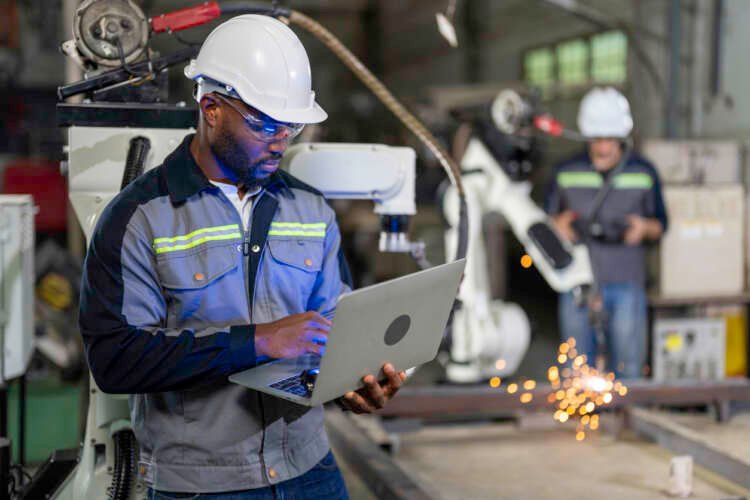
Published by Jessica Weisman-Pitts
Posted on May 25, 2022
6 min readLast updated: February 6, 2026
Add as preferred source on GoogleIn recent years, the word cobot has become a familiar term on the web space. Human labor has been the traditional way of accomplishing tasks in industries, even though reliability and efficiency have been scrutinized.
In recent years, the word cobot has become a familiar term on the web space. Human labor has been the traditional way of accomplishing tasks in industries, even though reliability and efficiency have been scrutinized.
In this regard, robots have been introduced in work-intensive manufacturing departments to increase productivity and reliability. Robots were introduced under heavy supervision because developers believed they lacked human intelligence. This can lead to unpredictable consequences like accidents and damage to property and goods.
The shortcomings of traditional robots triggered the need to introduce collaborative robots with minimal spatial and environmental risks making them ideal for working alongside humans. Cobots have a more human-friendly interaction and can be easily programmed. This enables them to share the same workstation with humans without fear of danger.
The main goal of cobot is to help workers meet their production goals. They can be likened to power saws invented to help rather than replace the carpenter. collaborative robotsassist human workers, unlike industrial robots that used to work independently. They are primarily deployed in areas deemed too strenuous or dangerous for employees. These guarantee safety and efficiency in the workplace.
Cobots are portable due to their lightweight and can therefore be transferred from one station to another. Their design is mainly tiny and compact to assist humans with ease of operation. Their workflow has a small footprint and can be installed quickly without significant adjustments or redesign.
Moving machines and production lines is unnecessary in this case because cobots are created to integrate with workers easily. Factory layouts need not be adjusted because these robotics can be moved around with minimal effort.
A universal robot is a brighter version of the traditional industrial robot. They are equipped with intelligent technologies and sensors. They are fitted with mechanical compliance sensors that halt their movement whenever they contact an object or a person.
Manufacturers of cobots prioritized simplicity as one of its core features. They can be used by anyone who can operate a smartphone. The “savvy bots” are adaptable and can learn on the job. They use hand guiding technology to provide workspace and safety of employees. It remembers new moves and can repeat it to make operations quicker.
Since the launch of cobot in 2008, these robotics have become popular by the day, especially among manufacturers. Their ability to improve efficiency and boost productivity by simplifying tasks in a basic setup is an essential feature.
The market growth for collaborative robots has been astounding. The Federation of Robotics estimates an annual growth rate of 40% and a revenue of $1.94 billion by 2028.
Cobots are mainly used in environments where humans and robots need to collaborate. In this case, humans act as the guide to robots, supervise the process, or learn from them. The manufacturing sector is the primary beneficiary of the introduction of collaborative robots. Some manufacturers are investing in collaborative robots, anticipating a quick return on investment, which is not always the case.
It is recommended to carefully evaluate areas where cobots can have the most significant effect and choose them only. collaborative robots have mechanical arms programmed to take on various factory tasks such as assembly, material building, packaging, process tasks, and assembly. This allows human coworkers to concentrate on tasks that need cognitive abilities for collaborative robots to perform repetitive tasks.
Developers of cobot have conducted a lot of research to determine how robots can mimic human decisions and movements. The artificial intelligence associated with these robotics has found superior solutions that humans could not crack. The integration of collaborative robots and 5G system has led to a better quality of service, such as smart manufacturing. For the system to be controlled and react promptly, reliable communication is required. This is especially in a cobot facility that does not require much human assistance.
Once a technology has proven to be trustworthy, it spreads like wildfire. For a short period, they have been in operation, cobots have greatly assisted modernized industries. They are capable of making numerous decisions simultaneously.
They can traverse large knowledge graphs with high processing power and complex software architecture. Their execution has become robust thanks to recent technological advancements such as parallel processing, linked data, and edge computing.
Service providers must brace themselves to provide differentiated and reliable service. They should also meet predictability and safety measures on all infrastructure to guarantee quality services.
Technology vendors are responsible for the security and safety of the systems. Compliance to set standards and adherence to regulations should be prioritized to ensure the trustworthiness of the systems.
Enterprises should develop use cases and frameworks that ensure human-robot collaboration yields the desired results as this invention matures. Cobot will be efficient if human effort and machine output go side by side. Enterprises must ensure that the cobots integrate with their modes of operation to avoid the paralysis of service provision or human-robot conflict.
In short, a robot, as described by the standard, is incapable of doing anything other than moving around. Cobots are secure in this disguise since they are force-limited, have curved edges, and covered non-pinching joints, and hence are unable to injure humans.
As the notion goes, it’s not the strongest or most intelligent species that survives; it is the one that adapts quickly to change. Evolution has shown us we ought to adapt to survive in the long run. Human-robot collaboration is heading to its peak, and everyone, especially in the manufacturing industry, has to explore this market.
Improved efficiency, reduced human risks, versatile operations, and improved efficiency show that this technology will be increasingly put into use. Collaborative robots will dominate the next industrial revolution. New training and adaptability to new positions will be inevitable to avoid significant loss of jobs.
This is a Sponsored Post
A collaborative robot, or cobot, is designed to work alongside humans in a shared workspace, enhancing productivity and safety without replacing human workers.
The main goal of collaborative robots is to assist human workers in achieving production targets while ensuring safety and efficiency in the workplace.
Cobots provide benefits such as improved efficiency, reduced risk for human workers, and the ability to perform repetitive tasks, allowing humans to focus on more complex activities.
User-friendly operation means that cobots can be easily programmed and operated by individuals without extensive technical training, making them accessible to a wider range of workers.
Explore more articles in the Technology category









