Search
00
GBAF Logo
trophy
Top StoriesInterviewsBusinessFinanceBankingTechnologyInvestingTradingVideosAwardsMagazinesHeadlinesTrends

Subscribe to our newsletter

Get the latest news and updates from our team.

Global Banking and Finance Review

Global Banking & Finance Review

Company

    GBAF Logo
    • About Us
    • Profile
    • Privacy & Cookie Policy
    • Terms of Use
    • Contact Us
    • Advertising
    • Submit Post
    • Latest News
    • Research Reports
    • Press Release
    • Awards▾
      • About the Awards
      • Awards TimeTable
      • Submit Nominations
      • Testimonials
      • Media Room
      • Award Winners
      • FAQ
    • Magazines▾
      • Global Banking & Finance Review Magazine Issue 79
      • Global Banking & Finance Review Magazine Issue 78
      • Global Banking & Finance Review Magazine Issue 77
      • Global Banking & Finance Review Magazine Issue 76
      • Global Banking & Finance Review Magazine Issue 75
      • Global Banking & Finance Review Magazine Issue 73
      • Global Banking & Finance Review Magazine Issue 71
      • Global Banking & Finance Review Magazine Issue 70
      • Global Banking & Finance Review Magazine Issue 69
      • Global Banking & Finance Review Magazine Issue 66
    Top StoriesInterviewsBusinessFinanceBankingTechnologyInvestingTradingVideosAwardsMagazinesHeadlinesTrends

    Global Banking & Finance Review® is a leading financial portal and online magazine offering News, Analysis, Opinion, Reviews, Interviews & Videos from the world of Banking, Finance, Business, Trading, Technology, Investing, Brokerage, Foreign Exchange, Tax & Legal, Islamic Finance, Asset & Wealth Management.
    Copyright © 2010-2025 GBAF Publications Ltd - All Rights Reserved.

    Editorial & Advertiser disclosure

    Global Banking and Finance Review is an online platform offering news, analysis, and opinion on the latest trends, developments, and innovations in the banking and finance industry worldwide. The platform covers a diverse range of topics, including banking, insurance, investment, wealth management, fintech, and regulatory issues. The website publishes news, press releases, opinion and advertorials on various financial organizations, products and services which are commissioned from various Companies, Organizations, PR agencies, Bloggers etc. These commissioned articles are commercial in nature. This is not to be considered as financial advice and should be considered only for information purposes. It does not reflect the views or opinion of our website and is not to be considered an endorsement or a recommendation. We cannot guarantee the accuracy or applicability of any information provided with respect to your individual or personal circumstances. Please seek Professional advice from a qualified professional before making any financial decisions. We link to various third-party websites, affiliate sales networks, and to our advertising partners websites. When you view or click on certain links available on our articles, our partners may compensate us for displaying the content to you or make a purchase or fill a form. This will not incur any additional charges to you. To make things simpler for you to identity or distinguish advertised or sponsored articles or links, you may consider all articles or links hosted on our site as a commercial article placement. We will not be responsible for any loss you may suffer as a result of any omission or inaccuracy on the website.

    Home > Top Stories > Stung by climate change: drought-weakened bee colonies shrink U.S. honey crop, threaten almonds
    Top Stories

    Stung by climate change: drought-weakened bee colonies shrink U.S. honey crop, threaten almonds

    Stung by climate change: drought-weakened bee colonies shrink U.S. honey crop, threaten almonds

    Published by Jessica Weisman-Pitts

    Posted on August 19, 2021

    Featured image for article about Top Stories

    By Karl Plume

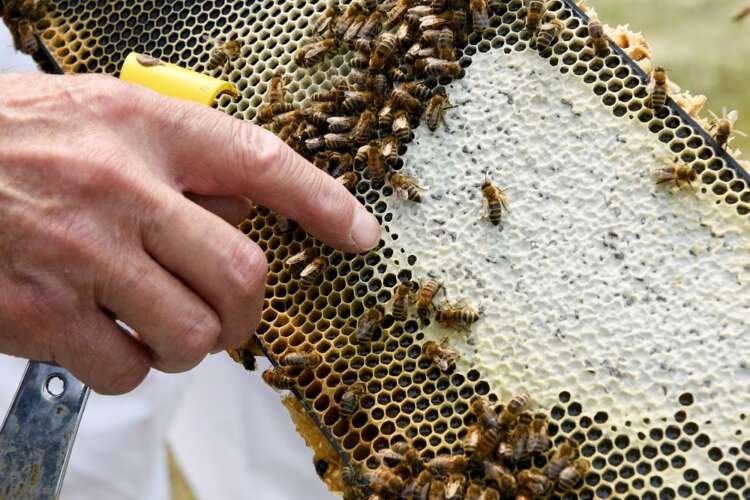
    GACKLE, North Dakota (Reuters) – There was barely a buzz in the air as John Miller pried the lid off of a crate, one of several “bee boxes” stacked in eight neat piles beside a cattle grazing pasture outside Gackle, North Dakota.

    “Nothing,” Miller said as he lifted a plastic hive frame from the box, squirming with only a few dozen bees. “Normally this would be dripping, full of honey. But not this year.”

    A scorching drought is slashing honey production in North Dakota, the top producing state of the sweet syrup, and a shortage of bees needed to pollinate fruits and flowers puts West Coast cash crops like almonds, plums and apples at risk, according to more than a dozen interviews with farmers, bee experts, economists and farm industry groups.

    Miller and other Midwestern apiarists haul their drought-weakened insects by truck to California almond farms in the winter to pollinate orchards in the top global producer of the nuts increasingly in demand for milk substitutes. Then they move on to other fruits.

    The drought’s impact therefore will be felt far beyond North Dakota, where withered alfalfa fields and parched pastures usually teeming with sweet clover and gumweed are providing bees little nectar this summer.

    The dearth of strong bee colonies and the resulting higher costs to lease them for pollination services will add to the challenges of West Coast growers already dealing with drought and, in California, soaring water costs. It could also add to soaring costs consumers are facing at grocery stores.

    Scientists have linked weather extremes from severe heat to floods and droughts to climate change. Such weather events are rippling through the food chain, raising food costs and heaping economic pain on small-scale farmer — and devastating bee colonies.

    The 2.7 million managed honey bee colonies in the United States, one in five of them in North Dakota, are crucial to pollinating scores of crops, including cherries and peaches as well as almonds and apples. Income from pollination services totaled $254 million in 2020, according to U.S. government data.

    Many beekeepers produce honey during summer in the northern Midwest and Plains, where bees forage on pastures and rangelands, harvesting what honey the bees do not consume or stow away to nourish their young.

    North and South Dakota, Montana and Minnesota accounted for 46% of all U.S. honey production last year, according to the U.S. Department of Agriculture (USDA).

    Apiarists truck the bee hives to milder climates like California during the fall and winter, generating crucial income by leasing colonies to fruit and nut farms to pollinate crops.

    Poor summer weather on the prairies has left colonies weakened, with fewer bees. A smaller amount of nectar also forces beekeepers to help feed their colonies with less nutritious sugar solution or corn syrup, an added expense for producers already hurt by a smaller honey harvest.

    “What happens in North Dakota in August has a direct impact on what happens in California in February,” Miller said. “Weak colonies that lack sufficient stores of honey going into winter will not be in good shape for the upcoming almond bloom.”

    Miller expects less than 30 pounds of harvestable honey per colony from his roughly 16,000 hives this summer, down from around 50 pounds in recent years and the least in his 52 years of records, as North Dakota suffers its worst drought since 1988, according to climatologists.

    Beekeeper Dwight Gunter also expects less than half of his normal honey harvest this summer. Honey prices have increased about 15% to 20% so far this year as supplies tighten. Gunter’s farm near Towner, North Dakota, is in the driest part of the state, with his entire county under “exceptional” drought.

    “Last fall, it was dry as a bone and we never got any rain in this area. No winter snow either,” he said. “The pollen flow this year has been considerably less.”

    The drought is expected to weaken bee colonies across the region, said Joan Gunter, Dwight’s wife and the president of the American Beekeeping Federation.

    “This is really going to affect bee health. We’re used to having good nutrition for the bees and they’re probably not going to get that this year,” she said.

    Iowa-based cooperative Sioux Honey, which produces 20% to 25% of U.S. honey under the Sue Bee brand, estimates the drought could drag domestic production down 25% to as much as 40% this year. Some 75% of the cooperative’s honey comes from Montana, the Dakotas and Minnesota.

    President and Chief Executive Mark Mammen worries that the drought will be a “double-edged sword” for his more than 200 producers as honey revenue drops and as weaker colonies may earn less from pollination services.

    “Without pollination revenue, it would be very tough for beekeepers to survive these days.”

    HIGHER POLLINATION COSTS

    California’s drought-hit almond growers, who account for around 80% of global production, may be in for a shock come September or October as they negotiate pollination contracts for the upcoming season, said agricultural economist Brittney Goodrich, at the University of California at Davis.

    Almond growers required about 2.5 million colonies last year to pollinate acres that have more than doubled in the last 15 years as demand for almond milk and health foods has grown. That represented around 88% of all managed U.S. hives, Goodrich said, adding that supplies of strong hives will remain tight this year.

    “This certainly has the potential to impact almond yields,” she said.

    Pollination services are among the largest input costs for almond farms, and those costs are set to rise at least 5% to 10% for the upcoming season, said Denise Qualls, pollination broker and founder of brokerage The Pollination Connection.

    “I’m definitely concerned about there being enough bees for pollination,” Qualls said. “If growers want good, quality hives, they’re going to have to pay for them.”

    Almond farmer Ben King has already seen his pollination cost rise from $210 per hive to $230 as demand for strong colonies has outpaced supply and beekeepers pass along their higher costs.

    The drought, meanwhile, is tightening bee supplies further. King’s beekeeper will only guarantee him 675 hives for the upcoming season, down from the 700 he normally would rent for his groves near Arbuckle, California.

    “Overall, you’re going to have less pollination because you’re going to have less hive strength,” he said. “Everybody is scrambling this year because of drought.”

    (Reporting by Karl Plume in Gackle, North Dakota; Editing by Caroline Stauffer and Nick Zieminski)

    By Karl Plume

    GACKLE, North Dakota (Reuters) – There was barely a buzz in the air as John Miller pried the lid off of a crate, one of several “bee boxes” stacked in eight neat piles beside a cattle grazing pasture outside Gackle, North Dakota.

    “Nothing,” Miller said as he lifted a plastic hive frame from the box, squirming with only a few dozen bees. “Normally this would be dripping, full of honey. But not this year.”

    A scorching drought is slashing honey production in North Dakota, the top producing state of the sweet syrup, and a shortage of bees needed to pollinate fruits and flowers puts West Coast cash crops like almonds, plums and apples at risk, according to more than a dozen interviews with farmers, bee experts, economists and farm industry groups.

    Miller and other Midwestern apiarists haul their drought-weakened insects by truck to California almond farms in the winter to pollinate orchards in the top global producer of the nuts increasingly in demand for milk substitutes. Then they move on to other fruits.

    The drought’s impact therefore will be felt far beyond North Dakota, where withered alfalfa fields and parched pastures usually teeming with sweet clover and gumweed are providing bees little nectar this summer.

    The dearth of strong bee colonies and the resulting higher costs to lease them for pollination services will add to the challenges of West Coast growers already dealing with drought and, in California, soaring water costs. It could also add to soaring costs consumers are facing at grocery stores.

    Scientists have linked weather extremes from severe heat to floods and droughts to climate change. Such weather events are rippling through the food chain, raising food costs and heaping economic pain on small-scale farmer — and devastating bee colonies.

    The 2.7 million managed honey bee colonies in the United States, one in five of them in North Dakota, are crucial to pollinating scores of crops, including cherries and peaches as well as almonds and apples. Income from pollination services totaled $254 million in 2020, according to U.S. government data.

    Many beekeepers produce honey during summer in the northern Midwest and Plains, where bees forage on pastures and rangelands, harvesting what honey the bees do not consume or stow away to nourish their young.

    North and South Dakota, Montana and Minnesota accounted for 46% of all U.S. honey production last year, according to the U.S. Department of Agriculture (USDA).

    Apiarists truck the bee hives to milder climates like California during the fall and winter, generating crucial income by leasing colonies to fruit and nut farms to pollinate crops.

    Poor summer weather on the prairies has left colonies weakened, with fewer bees. A smaller amount of nectar also forces beekeepers to help feed their colonies with less nutritious sugar solution or corn syrup, an added expense for producers already hurt by a smaller honey harvest.

    “What happens in North Dakota in August has a direct impact on what happens in California in February,” Miller said. “Weak colonies that lack sufficient stores of honey going into winter will not be in good shape for the upcoming almond bloom.”

    Miller expects less than 30 pounds of harvestable honey per colony from his roughly 16,000 hives this summer, down from around 50 pounds in recent years and the least in his 52 years of records, as North Dakota suffers its worst drought since 1988, according to climatologists.

    Beekeeper Dwight Gunter also expects less than half of his normal honey harvest this summer. Honey prices have increased about 15% to 20% so far this year as supplies tighten. Gunter’s farm near Towner, North Dakota, is in the driest part of the state, with his entire county under “exceptional” drought.

    “Last fall, it was dry as a bone and we never got any rain in this area. No winter snow either,” he said. “The pollen flow this year has been considerably less.”

    The drought is expected to weaken bee colonies across the region, said Joan Gunter, Dwight’s wife and the president of the American Beekeeping Federation.

    “This is really going to affect bee health. We’re used to having good nutrition for the bees and they’re probably not going to get that this year,” she said.

    Iowa-based cooperative Sioux Honey, which produces 20% to 25% of U.S. honey under the Sue Bee brand, estimates the drought could drag domestic production down 25% to as much as 40% this year. Some 75% of the cooperative’s honey comes from Montana, the Dakotas and Minnesota.

    President and Chief Executive Mark Mammen worries that the drought will be a “double-edged sword” for his more than 200 producers as honey revenue drops and as weaker colonies may earn less from pollination services.

    “Without pollination revenue, it would be very tough for beekeepers to survive these days.”

    HIGHER POLLINATION COSTS

    California’s drought-hit almond growers, who account for around 80% of global production, may be in for a shock come September or October as they negotiate pollination contracts for the upcoming season, said agricultural economist Brittney Goodrich, at the University of California at Davis.

    Almond growers required about 2.5 million colonies last year to pollinate acres that have more than doubled in the last 15 years as demand for almond milk and health foods has grown. That represented around 88% of all managed U.S. hives, Goodrich said, adding that supplies of strong hives will remain tight this year.

    “This certainly has the potential to impact almond yields,” she said.

    Pollination services are among the largest input costs for almond farms, and those costs are set to rise at least 5% to 10% for the upcoming season, said Denise Qualls, pollination broker and founder of brokerage The Pollination Connection.

    “I’m definitely concerned about there being enough bees for pollination,” Qualls said. “If growers want good, quality hives, they’re going to have to pay for them.”

    Almond farmer Ben King has already seen his pollination cost rise from $210 per hive to $230 as demand for strong colonies has outpaced supply and beekeepers pass along their higher costs.

    The drought, meanwhile, is tightening bee supplies further. King’s beekeeper will only guarantee him 675 hives for the upcoming season, down from the 700 he normally would rent for his groves near Arbuckle, California.

    “Overall, you’re going to have less pollination because you’re going to have less hive strength,” he said. “Everybody is scrambling this year because of drought.”

    (Reporting by Karl Plume in Gackle, North Dakota; Editing by Caroline Stauffer and Nick Zieminski)

    Related Posts
    Upgrading Wi-Fi For Coverage And Security To Protect Your Smart Home
    Upgrading Wi-Fi For Coverage And Security To Protect Your Smart Home
    Inside the World’s First Collection Industry Conglomerate: PCA Global’s Platform Strategy
    Inside the World’s First Collection Industry Conglomerate: PCA Global’s Platform Strategy
    Chase Buchanan Private Wealth Management Highlights Key Autumn 2025 Budget Takeaways for Expats
    Chase Buchanan Private Wealth Management Highlights Key Autumn 2025 Budget Takeaways for Expats
    PayLaju Strengthens Its Position as Malaysia’s Trusted Interest-Free Sharia-Compliant Loan Provider
    PayLaju Strengthens Its Position as Malaysia’s Trusted Interest-Free Sharia-Compliant Loan Provider
    A Notable Update for Employee Health Benefits:
    A Notable Update for Employee Health Benefits:
    Creating Equity Between Walls: How Mohak Chauhan is Using Engineering, Finance, and Community Vision to Reengineer Affordable Housing
    Creating Equity Between Walls: How Mohak Chauhan is Using Engineering, Finance, and Community Vision to Reengineer Affordable Housing
    Upcoming Book on Real Estate Investing: Harvard Grace Capital Founder Stewart Heath’s Puts Lessons in Print
    Upcoming Book on Real Estate Investing: Harvard Grace Capital Founder Stewart Heath’s Puts Lessons in Print
    ELECTIVA MARKS A LANDMARK FIRST YEAR WITH MAJOR SENIOR APPOINTMENTS AND EXPANSION MILESTONES
    ELECTIVA MARKS A LANDMARK FIRST YEAR WITH MAJOR SENIOR APPOINTMENTS AND EXPANSION MILESTONES
    Hebbia Processes One Billion Pages as Financial Institutions Deploy AI Infrastructure at Unprecedented Scale
    Hebbia Processes One Billion Pages as Financial Institutions Deploy AI Infrastructure at Unprecedented Scale
    Beyond Governance Fatigue: Making ESG Integration Work in Financial Markets
    Beyond Governance Fatigue: Making ESG Integration Work in Financial Markets
    Why I-9 Verification Matters for Financial Institutions: Building a Culture of Compliance and Trust
    Why I-9 Verification Matters for Financial Institutions: Building a Culture of Compliance and Trust
    Curvestone AI partners with The White Rose Finance Group to enhance compliance file reviews
    Curvestone AI partners with The White Rose Finance Group to enhance compliance file reviews

    Why waste money on news and opinions when you can access them for free?

    Take advantage of our newsletter subscription and stay informed on the go!

    Subscribe

    Previous Top Stories PostExclusive: Facebook selects local journalists paid in $5 million newsletter recruitment push
    Next Top Stories PostEU presidency calls for crisis meeting on Afghanistan

    More from Top Stories

    Explore more articles in the Top Stories category

    LinkedIn Influence in 2025: Insights from Stevo Jokic on Building Authority and Trust

    LinkedIn Influence in 2025: Insights from Stevo Jokic on Building Authority and Trust

    Should You Take the Dealer’s Bike Insurance or Buy Online Yourself? Here’s the Real Difference

    Should You Take the Dealer’s Bike Insurance or Buy Online Yourself? Here’s the Real Difference

    ID-Pal Unveils ID-Detect Enhancements to Counter Surge in Digital Manipulation and Deepfakes

    ID-Pal Unveils ID-Detect Enhancements to Counter Surge in Digital Manipulation and Deepfakes

    TRUST TAKES THE LEAD: HALF OF UK SHOPPERS HAVE ABANDONED ONLINE PURCHASES OVER SECURITY CONCERNS

    TRUST TAKES THE LEAD: HALF OF UK SHOPPERS HAVE ABANDONED ONLINE PURCHASES OVER SECURITY CONCERNS

    Why Choose Premium Driver Service in Miami Over Rideshare Apps for Business Travel and Special Events?

    Why Choose Premium Driver Service in Miami Over Rideshare Apps for Business Travel and Special Events?

    Over 30 Million Users Benefit From Ant International’s Bettr Credit Tech Solutions

    Over 30 Million Users Benefit From Ant International’s Bettr Credit Tech Solutions

    Side-Hustle Economics: How Part-Time Service Work Can Strengthen Your Financial Plan

    Side-Hustle Economics: How Part-Time Service Work Can Strengthen Your Financial Plan

    London to Host Major Summit on “New Horizons” for Islamic Economy in the UK

    London to Host Major Summit on “New Horizons” for Islamic Economy in the UK

    BLOXX Launches World’s First Home Equity Subscription, Creating a New Residential Asset Class

    BLOXX Launches World’s First Home Equity Subscription, Creating a New Residential Asset Class

    LiaFi Addresses Gap Between Business Transaction and Savings Accounts

    LiaFi Addresses Gap Between Business Transaction and Savings Accounts

    Ant Group Chairman Eric Jing Outlines Strategy for Inclusive AI, Collaboration on Tokenised Settlement

    Ant Group Chairman Eric Jing Outlines Strategy for Inclusive AI, Collaboration on Tokenised Settlement

    Deeply Cultivating the Syndicated Loan and Cross-Border Financing Fields: Empowering Chinese Banks’ Global Expansion with Professional Excellence

    Deeply Cultivating the Syndicated Loan and Cross-Border Financing Fields: Empowering Chinese Banks’ Global Expansion with Professional Excellence

    View All Top Stories Posts