
Top Stories
Spain’s Flood Disaster Was Its Worst in Recent History. Here’s What Went Wrong
Published by Uma Rajagopal
Posted on November 9, 2024
9 min readLast updated: January 28, 2026
Add as preferred source on Google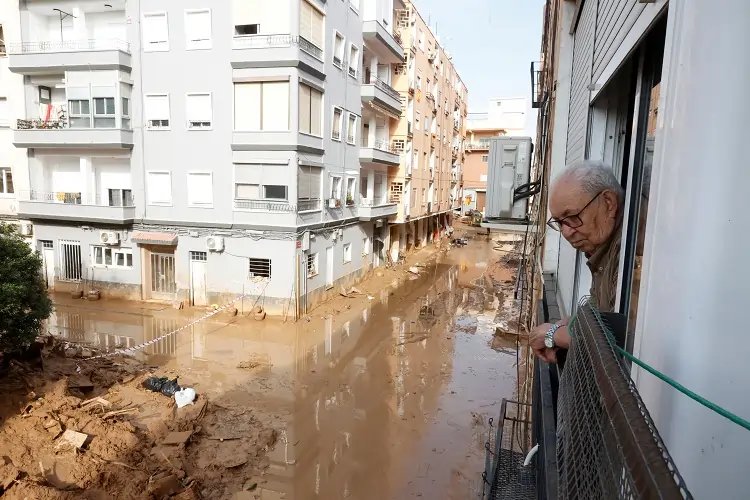
Published by Uma Rajagopal
Posted on November 9, 2024
9 min readLast updated: January 28, 2026
Add as preferred source on GoogleBy David Latona, Corina Pons, Pietro Lombardi and Aislinn Laing
By David Latona, Corina Pons, Pietro Lombardi and Aislinn Laing
PAIPORTA, Spain (Reuters) – The water was already knee-high on the ground floor of the hotel where Aitana Puchal had taken refugee when she received a text alert from the regional government of Valencia at 8 pm on Oct. 29 warning people to shelter in place from severe flash floods.
“We could have done with (the warning) about six hours earlier,” said the 23-year-old, who had fled with other local residents and guests to the first floor of the hotel near the town of Paiporta. “We were all calming down a little from the panic and drying our feet.”
Others were not so fortunate.
Carlos Martinez, another Paiporta resident, told local television the flood alert came when he was stranded in a tree “seeing bodies floating past.”
Dozens of inhabitants of flooded communities told Reuters that by the time they received the regional government’s alert, muddy water was already surrounding their cars, submerging streets of their towns and pouring into their homes.
After days of storm warnings from the national weather service since Oct 25, some municipalities and local institutions had raised the alarm much earlier. Valencia University had told its staff the day before not to come to work. Several town halls across the region of eastern Spain had suspended activities, shut down public facilities and told people to stay home.
But the mixed messages and confusion cost lives, dozens of local residents and experts told Reuters. More than 220 people died and nearly 80 are still missing in what is the most deadly deluge in a single European country since 1967, when floods in Portugal killed around 500.
The national weather service AEMET had raised its threat level for heavy rains to a red alert at 7.36am on Oct 29, following heavy rains in mountainous areas west of the city of Valencia from the early morning. In the 12 hours it took for the regional government’s shelter-in-place order to come through, waters running through the usually dry Poyo ravine – the epicentre of the flooding – had surged to more than three times the flow of Spain’s largest river.
As climate change exacerbates weather patterns along Spain’s Mediterranean coast, floods are becoming commonplace and some previous incidents have been deadly. But after at least five decades without a major catastrophe, many people in Valencia were unaware of the grave dangers posed by flash flooding or how to respond.
Puchal, the 23-year old who sought refuge in the hotel, said she had never received much information about the risks of floods.
“At school, they gave talks about fires,” she said. “But not floods.”
That, combined with poor coordination among regional and national authorities as well as political decisions taken years ago not to invest in waterways infrastructure, worsened the calamitous loss of life, seven experts consulted by Reuters said.
“It was foreseeable that we would have catastrophic flooding here,” said Felix Frances, professor of hydraulic engineering and environment at Valencia Polytechnic University.
Deaths were recorded in 14 of the 24 towns that had already been identified in environment ministry reports as at high risk of flooding, a Reuters review found.
Experts including hydraulic and civil engineers, geologists, urban planners and disaster relief specialists said successive failures – to conduct flood mitigation work on nearby rivers, better protect houses built on flood plains, educate people and warn residents quickly – added to the fatalities.
With better infrastructure, “those deaths would have been infinitely less,” said Luis Bañon, an engineer and professor of Transportation Engineering and Infrastructure at the University of Alicante.
One central government source said they expect multiple judicial enquiries to examine decisions made and to attribute responsibility for the high death toll.
As more of the world’s population settles on flood plains, climate events become more extreme and Europe warms faster than the global average, what happened in Valencia underscores the need for strategic, coordinated measures to protect people in European cities, said Sergio Palencia, professor of urbanization in Valencia Polytechnic University.
Frances said he had helped draw up a plan 17 years ago to build flood works for the Poyo ravine at a cost then of 150 million euros ($162 million). On Nov. 5, a week after the floods, the national government earmarked 10.6 billion euros to help victims.
The plan Frances worked on expired in 2017 because “no work had been initiated,” Spain’s State Secretary for the Environment Hugo Moran told Reuters. The government had to start from scratch and some works are underway, he said.
Frances said some people were so unaware of the risk they didn’t know, for example, that it would be unwise to go down to a basement “to save the car.”
AEMET had already warned of a storm known locally as DANA — a high-altitude isolated depression — on Oct. 25. In following days, its warnings became more specific until Oct. 29, when the alert was upgraded to red — the highest level, meaning high risks for the population.
At 8.45 am, the regional branch of AEMET posted footage on the social media platform X showing cars being swept down roads by a tide of brown water.
Just after noon, the public body managing the region’s river basins, the Júcar Hydrographic Confederation (CHJ) emailed regional authorities saying the flow of water through the Poyo ravine had reached 264 cubic meters per second. That’s stronger than the average flow of the Guadalquivir river, one of Spain’s largest.
The CHJ said it can only feed the information to regional emergency services, which are responsible for issuing alerts to citizens. Three experts told Reuters that once water started rising, it would take less than nine hours to reach the towns.
Over the next eight hours, officials from the regional and national governments, environmental authorities and emergency services exchanged phone calls, emails and held emergency meetings.
For some time that afternoon, the data from the CHJ suggested the flow was declining.
Carlos Mazon, the region’s president and the main person responsible for issuing a shelter-in-place alert, has become a focus for anger over authorities’ reaction to the storm. Despite signs of severe flooding, he did not change his schedule.
At a news conference at lunchtime, he cited a national weather forecast saying the storm’s intensity would decrease around 6pm, according to a tweet he later deleted.
As the day went on Mazon, a member of the conservative People’s Party that sits in opposition to the Socialist-run national government, appeared in photos tweeted by his staff receiving a sustainable tourism certification, and discussing budgetary matters.
His office did not respond to requests for comment on his handling of the disaster. Mazon told reporters on Thursday that he had a “work lunch” on Oct 29 and was constantly in touch with his team handling the situation.
At 5pm, as the authorities met again, the CHJ gave “verbal notification” of a generalised increase in water flows running through or near the towns, according to a statement.
At 6.43pm, CHJ sent another email warning that the flow of water through the ravine had reached 1,686 cubic metres per second — more than triple the pace of the Ebro, Spain’s largest river.
Twelve minutes later, the CHJ said the Poyo flow had risen to 2,282 cubic meters per second before destroying the sensor that measured it.
“That could fill an Olympic pool every second,” said Nahum Mendez, a geologist at Valencia University.
By 7pm, many towns were without power, making it difficult to send alerts immediately to phones or radio stations, officials said.
Maria Isabel Albalat, the mayor of Paiporta, which lies in the outskirts of the city of Valencia, said she called the national government delegate in the region to tell her that “my town was flooding” and “people were already dying.” Police drove through the town with sirens, lights and loudspeakers telling people to stay off the bridge and leave the streets.
At 8 pm, Spain’s environment secretary Moran, who was travelling in Colombia, called the regional official in charge of the emergency services Salomé Pradas to say there was a risk a dam would fail.
Pradas told local television on Thursday that a technical advisor then suggested the services send a text alert.
“How is it possible that with all the information that was available … the agencies responsible for activating the alarms did nothing?” Moran said.
Mazon, the regional head, later said the CHJ data showing water flows declining had added to the confusion and delays. Moran, whose department oversees the CHJ, told Reuters its task was just to provide real time information to emergency teams, not to make decisions on their response.
Paiporta mayor Albalat said that by the time the alert came, “we had been up to our necks in water for more than an hour and a half.”
Political decisions to not invest earlier in better flood defences to protect a wider area have multiplied the economic cost “by 200,” said Bañon, the Alicante professor.
“This type of works aren’t sexy, don’t give political profitability until something happens,” he said.
“Now they have no choice but to undertake the works.”
In other countries such as the United States and Japan, natural disasters are more commonplace so people have a better sense of how to respond, said María Jesus Romero, 50, Professor of Urban Planning Law at the Polytechnical University of Valencia.
Some Valencia residents remembered past floods, including a major one in 1957. After that, the city of Valencia was protected by hydraulic works completed under dictator General Francisco Franco in 1973.
Paiporta residents Rosario Masia, 84, and her husband Cristóbal Martínez, 87, said past floods were “nothing” compared with this one.
“We had a hard time, but not like now,” said Masia. “We are in pieces.”
Many properties hit by the floods were built before 2003 when revised guidance on building in flood zones was issued, experts said. The new guidance either bans construction or includes strict pre-requisites including that properties built in flood zones should not have basements.
In the largely working-class suburbs of Valencia, the car is vital to get to work. Many of those interviewed by Reuters in the flood zone said their first move when it rains is to move their cars out of underground car parks of their apartment blocks so the engines aren’t damaged by flooding.
($1 = 0.9267 euros)
(Reporting by David Latona in Paiporta, Corina Pons, Pietro Lombardi and Aislinn Laing in Madrid, additional reporting by Emma Pinedo and Andrei Khalip; Edited by Sara Ledwith)
Disaster management refers to the planning and coordination of resources and responsibilities to effectively respond to and recover from natural disasters, minimizing their impact on communities.
Climate change refers to significant changes in global temperatures and weather patterns over time, primarily driven by human activities such as burning fossil fuels and deforestation.
Risk management involves identifying, assessing, and prioritizing risks followed by coordinated efforts to minimize, monitor, and control the probability or impact of unfortunate events.
Insurance is a financial product that provides protection against financial loss or risk, where individuals or entities pay premiums to receive compensation for covered events.
Explore more articles in the Top Stories category











