Search
00
GBAF Logo
trophy
Top StoriesInterviewsBusinessFinanceBankingTechnologyInvestingTradingVideosAwardsMagazinesHeadlinesTrends

Subscribe to our newsletter

Get the latest news and updates from our team.

Global Banking & Finance Review®

Global Banking & Finance Review® - Subscribe to our newsletter

Company

    GBAF Logo
    • About Us
    • Profile
    • Privacy & Cookie Policy
    • Terms of Use
    • Contact Us
    • Advertising
    • Submit Post
    • Latest News
    • Research Reports
    • Press Release
    • Awards▾
      • About the Awards
      • Awards TimeTable
      • Submit Nominations
      • Testimonials
      • Media Room
      • Award Winners
      • FAQ
    • Magazines▾
      • Global Banking & Finance Review Magazine Issue 79
      • Global Banking & Finance Review Magazine Issue 78
      • Global Banking & Finance Review Magazine Issue 77
      • Global Banking & Finance Review Magazine Issue 76
      • Global Banking & Finance Review Magazine Issue 75
      • Global Banking & Finance Review Magazine Issue 73
      • Global Banking & Finance Review Magazine Issue 71
      • Global Banking & Finance Review Magazine Issue 70
      • Global Banking & Finance Review Magazine Issue 69
      • Global Banking & Finance Review Magazine Issue 66
    Top StoriesInterviewsBusinessFinanceBankingTechnologyInvestingTradingVideosAwardsMagazinesHeadlinesTrends

    Global Banking & Finance Review® is a leading financial portal and online magazine offering News, Analysis, Opinion, Reviews, Interviews & Videos from the world of Banking, Finance, Business, Trading, Technology, Investing, Brokerage, Foreign Exchange, Tax & Legal, Islamic Finance, Asset & Wealth Management.
    Copyright © 2010-2026 GBAF Publications Ltd - All Rights Reserved. | Sitemap | Tags | Developed By eCorpIT

    Editorial & Advertiser disclosure

    Global Banking & Finance Review® is an online platform offering news, analysis, and opinion on the latest trends, developments, and innovations in the banking and finance industry worldwide. The platform covers a diverse range of topics, including banking, insurance, investment, wealth management, fintech, and regulatory issues. The website publishes news, press releases, opinion and advertorials on various financial organizations, products and services which are commissioned from various Companies, Organizations, PR agencies, Bloggers etc. These commissioned articles are commercial in nature. This is not to be considered as financial advice and should be considered only for information purposes. It does not reflect the views or opinion of our website and is not to be considered an endorsement or a recommendation. We cannot guarantee the accuracy or applicability of any information provided with respect to your individual or personal circumstances. Please seek Professional advice from a qualified professional before making any financial decisions. We link to various third-party websites, affiliate sales networks, and to our advertising partners websites. When you view or click on certain links available on our articles, our partners may compensate us for displaying the content to you or make a purchase or fill a form. This will not incur any additional charges to you. To make things simpler for you to identity or distinguish advertised or sponsored articles or links, you may consider all articles or links hosted on our site as a commercial article placement. We will not be responsible for any loss you may suffer as a result of any omission or inaccuracy on the website.

    Home > Top Stories > Russian attacks on rail system fail to paralyse ‘lifeline of Ukraine’
    Top Stories

    Russian attacks on rail system fail to paralyse ‘lifeline of Ukraine’

    Published by Wanda Rich

    Posted on May 9, 2022

    5 min read

    Last updated: February 7, 2026

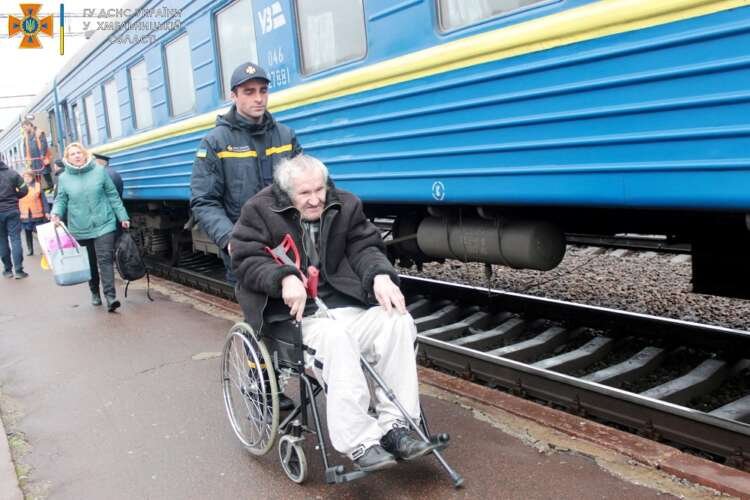
    The image depicts a busy Ukrainian railway station, symbolizing resilience amidst Russian attacks on critical infrastructure. This aligns with the article's focus on how the rail system remains operational despite ongoing conflict.
    Ukrainian railway station bustling with activity amidst ongoing conflict - Global Banking & Finance Review
    Why waste money on news and opinion when you can access them for free?

    Take advantage of our newsletter subscription and stay informed on the go!

    Subscribe

    Tags:Transportation Sectorhumanitarian aidfinancial stabilityeconomic growth

    By Jonathan Landay

    FASTIV, Ukraine (Reuters) -A salvo of missiles brought the Kremlin’s war on Ukraine to Fastiv, a quiet town abounding with flowering cherry trees and set in sweeping farmland hundreds of kilometres from the front lines.

    The strike on April 28, which injured two people, hit an electrical substation that feeds power to a confluence of railway lines that forms a key hub of networks linking central Europe, Russia, and Asia.

    The damage quickly was repaired, said Ukrainian officials, and a Reuters visit last week revealed no lingering impact. Trains plied between Kyiv and the southern port of Odesa, disgorging passengers into the station at Fastiv, a town of 45,000 people 75 km (45 miles) south of the capital.

    Officials said the attack was part of an escalating Russian assault on infrastructure, aimed in part at paralysing rail deliveries of Western-supplied arms and also reinforcements sustaining Ukrainian forces fighting in the east and south.

    So far, Moscow’s effort has failed, making state-owned Ukrainian Railways a leading symbol of the country’s resilience.

    “The longest delay we’ve had has been less than an hour,” said Oleksandr Kamyshin, 37, a former investment banker who keeps the trains running as the CEO of the railways, Ukraine’s largest employer.

    “They haven’t hit a single military train.”

    The Russian defences ministry has said Ukrainian facilities powering the railways have been targeted by missile strikes because trains are used to deliver foreign arms to Ukrainian forces.

    The rail system is being hit not just because it is critical to military supplies, Ukrainian officials said.

    Moscow’s “goal is to destroy critical infrastructure as much as possible for military, economic and social reasons,” Deputy Infrastructure Minister Yuri Vaskov said in an interview.

    With Russian warships blockading Black Sea ports, downed bridges and checkpoints obstructing roadways, and a fuel crunch snarling trucking, Ukraine’s 22,000 km (14,000 miles) of track are the main lifeline of the struggling economy and a passage to the outside world.

    Trains have evacuated millions of civilians fleeing to safer parts of the country or abroad.

    They have begun running small grain shipments to neighbouring counties to circumvent Russia’s maritime blockade. Ukraine was the world’s fourth largest grain exporter in the 2020/21 season and exports disrupted by the war have interrupted global food chains and helped fuel worldwide inflation.

    Internally, trains are distributing humanitarian aid and other cargoes. They enabled the restart of the AcelorMittal steel plant, in Kryvyi Rih, by bringing workers in and product out, said Kamyshin. They carry civilian casualties in hospital cars staffed by Doctors Without Borders.

    Since Russia invaded on Feb. 24, he said, trains have distributed more than 140,000 tonnes of food and will have carried some 1 million kilos of mail for the state postal service by mid-May.

    Russian attacks on some of the 1,000 stations have killed scores of civilians, including dozens killed in an attack in April in the station in the eastern city of Kramatorsk.

    That has not deterred passengers.

    Daily ridership has reached as many as 200,000 passengers, Kamyshin said in an interview on Saturday as he rode a train across a bridge that had been repaired after being badly damaged during Russia’s failed advance on Kyiv from the suburb of Irpin.

    Nor have the railway’s 230,000 personnel stayed home even though 122 have been killed and 155 others wounded on the job and in their houses, said Kamyshin.

    Moscow denies striking civilian targets in what it calls a “special military operation” to disarm Ukraine and rid it of what it calls anti-Russian nationalism fomented by the West. Ukraine and the West say Russia launched an unprovoked war of aggression.

    Reuters was not able to independently verify the assertions of Kamyshin and other Ukrainian officials about their successes keeping the railways going in wartime.

    UKRAINE’S ‘LIFELIFE’

    Helena Muskrivska, 56, the Irpin station master, said she worked for the first four days of the Russian assault, helping evacuate some 1,000 people and relaying local developments by landline to Kyiv. She took documents and equipment home when it became too dangerous.

    “I was here when the Russians came into the station. I didn’t want to see them face to face,” said Muskrivska.

    A group of current and former U.S. and European railway executives formed the International Support Ukraine Rail Task Force in March to raise money for protective gear, first aid kits and financial aid for railway staff.

    “There’s a lot of fundraising efforts everywhere for Ukraine, but none of it goes to the railroad,” said Jolene Molitoris, a former U.S. Federal Railroad Administration chief who chairs the group. “It is the lifeline of the country.”

    The group also aims to fund purchases of heavy machinery, rails and other equipment sought by the railways.

    Kamyshin said he is racing against the Russian attacks, deploying teams of workers and dispatchers around the clock to fix tracks and reroute trains. “It’s all about hours, not about days.”

    He and top aides constantly move, taking trains to inspect damage and repairs around Ukraine, he said, adding: “Once they break it, we fix it”.

    Kamyshin said his top priority is redirecting grain exports from Ukraine’s southern ports to Poland, Romania, and the Baltic states to help revive the economy. He said Russia would remain a threat even after what he called its inevitable defeat.

    “This crazy neighbour will stay with us,” he said. “No one knows when they will come again.”

    (Additional reporting by Pavel PolityukEditing by Frances Kerry)

    Frequently Asked Questions about Russian attacks on rail system fail to paralyse ‘lifeline of Ukraine’

    1What is military supply?

    Military supply encompasses the provision of equipment, weapons, and logistical support to armed forces to ensure operational readiness and effectiveness in conflict situations.

    2What is economic growth?

    Economic growth is the increase in the production of goods and services in an economy over a period, typically measured by the rise in Gross Domestic Product (GDP).

    3What is infrastructure?

    Infrastructure refers to the fundamental facilities and systems serving a country, city, or area, including transportation, communication, sewage, water, and electric systems.

    4What is a railway system?

    A railway system is a network of tracks and trains used for transporting goods and passengers, playing a crucial role in economic and logistical operations.

    More from Top Stories

    Explore more articles in the Top Stories category

    Image for Lessons From the Ring and the Deal Table: How Boxing Shapes Steven Nigro’s Approach to Banking and Life
    Lessons From the Ring and the Deal Table: How Boxing Shapes Steven Nigro’s Approach to Banking and Life
    Image for Joe Kiani in 2025: Capital, Conviction, and a Focused Return to Innovation
    Joe Kiani in 2025: Capital, Conviction, and a Focused Return to Innovation
    Image for Marco Robinson – CLOSE THE DEAL AND SUDDENLY GROW RICH
    Marco Robinson – CLOSE THE DEAL AND SUDDENLY GROW RICH
    Image for Digital Tracing: Turning a regulatory obligation into a commercial advantage
    Digital Tracing: Turning a regulatory obligation into a commercial advantage
    Image for Exploring the Role of Blockchain and the Bitcoin Price Today in Education
    Exploring the Role of Blockchain and the Bitcoin Price Today in Education
    Image for Inside the World’s First Collection Industry Conglomerate: PCA Global’s Platform Strategy
    Inside the World’s First Collection Industry Conglomerate: PCA Global’s Platform Strategy
    Image for Chase Buchanan Private Wealth Management Highlights Key Autumn 2025 Budget Takeaways for Expats
    Chase Buchanan Private Wealth Management Highlights Key Autumn 2025 Budget Takeaways for Expats
    Image for PayLaju Strengthens Its Position as Malaysia’s Trusted Interest-Free Sharia-Compliant Loan Provider
    PayLaju Strengthens Its Position as Malaysia’s Trusted Interest-Free Sharia-Compliant Loan Provider
    Image for A Notable Update for Employee Health Benefits:
    A Notable Update for Employee Health Benefits:
    Image for Creating Equity Between Walls: How Mohak Chauhan is Using Engineering, Finance, and Community Vision to Reengineer Affordable Housing
    Creating Equity Between Walls: How Mohak Chauhan is Using Engineering, Finance, and Community Vision to Reengineer Affordable Housing
    Image for Upcoming Book on Real Estate Investing: Harvard Grace Capital Founder Stewart Heath’s Puts Lessons in Print
    Upcoming Book on Real Estate Investing: Harvard Grace Capital Founder Stewart Heath’s Puts Lessons in Print
    Image for ELECTIVA MARKS A LANDMARK FIRST YEAR WITH MAJOR SENIOR APPOINTMENTS AND EXPANSION MILESTONES
    ELECTIVA MARKS A LANDMARK FIRST YEAR WITH MAJOR SENIOR APPOINTMENTS AND EXPANSION MILESTONES
    View All Top Stories Posts
    Previous Top Stories PostIKEA to spend 3 billion euros on stores as it adapts to e-commerce
    Next Top Stories PostAnalysis: Markets must face up to tightening financial conditions