
Top Stories
Russia to Evacuate Village for First Lunar Lander Mission in Half Century
Published by Uma Rajagopal
Posted on August 7, 2023
2 min readLast updated: February 1, 2026
Add as preferred source on Google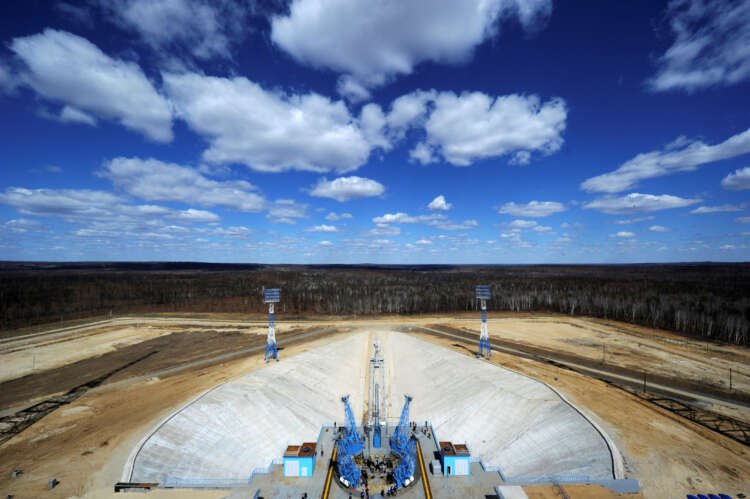
Published by Uma Rajagopal
Posted on August 7, 2023
2 min readLast updated: February 1, 2026
Add as preferred source on Google(Reuters) – Russia will evacuate a village in its far east on Aug. 11 as part of the launch of Russia’s first lunar lander mission in nearly half a century, a local official said on Monday.
(Reuters) – Russia will evacuate a village in its far east on Aug. 11 as part of the launch of Russia’s first lunar lander mission in nearly half a century, a local official said on Monday.
The Luna-25 lunar lander, Russia’s first since 1976, will be launched from the Vostochny Cosmodrome, some 3,450 miles (5,550 km) east of Moscow, according to Russia’s Roscosmos space agency.
The residents of the Shakhtinskyi settlement in Russia’s Khabarovsk region, southeast of the launch site, will be evacuated early morning on Aug. 11, as the village lies in the predicted area where the rocket boosters will fall after they separate.
“The mouth of the Umalta, Ussamakh, Lepikan, Tastakh, Saganar rivers and the area of the ferry crossing on the Bureya River fall into the predicted (booster) fall zone,” Alexei Maslov, head of the Verkhnebureinskyi district in the Khabarovsk region, said on the Telegram messaging app. “The residents of Shakhtinskyi will be evacuated.”
Luna-25 will launch on a Soyuz-2 Fregat booster and will be the first lander to arrive on the South Pole of the moon, Roscosmos has said.
The main objective of the mission will be the development of soft-landing technologies, research of the internal structure of the Moon and exploration for resources, including water.
The lander is expected to operate on the lunar surface for one year.
(Reporting by Lidia Kelly in Melbourne; Editing by Gerry Doyle)
A lunar lander is a spacecraft designed to land on the surface of the moon. It is used for exploration and scientific research, such as studying the moon's geology and potential resources.
Soft-landing technology refers to methods and systems that allow a spacecraft to land gently on a surface, minimizing damage to the vehicle and ensuring safe deployment of instruments or crew.
The South Pole of the moon is significant for exploration due to its potential water ice deposits, which could be crucial for future lunar missions and sustaining human presence on the moon.
The purpose of the Luna-25 mission is to develop soft-landing technologies, research the moon's internal structure, and explore for resources, including water, on the lunar surface.
Explore more articles in the Top Stories category











