Search
00
GBAF Logo
trophy
Top StoriesInterviewsBusinessFinanceBankingTechnologyInvestingTradingVideosAwardsMagazinesHeadlinesTrends

Subscribe to our newsletter

Get the latest news and updates from our team.

Global Banking & Finance Review®

Global Banking & Finance Review® - Subscribe to our newsletter

Company

    GBAF Logo
    • About Us
    • Advertising and Sponsorship
    • Profile & Readership
    • Contact Us
    • Latest News
    • Privacy & Cookies Policies
    • Terms of Use
    • Advertising Terms
    • Issue 81
    • Issue 80
    • Issue 79
    • Issue 78
    • Issue 77
    • Issue 76
    • Issue 75
    • Issue 74
    • Issue 73
    • Issue 72
    • Issue 71
    • Issue 70
    • View All
    • About the Awards
    • Awards Timetable
    • Awards Winners
    • Submit Nominations
    • Testimonials
    • Media Room
    • FAQ
    • Asset Management Awards
    • Brand of the Year Awards
    • Business Awards
    • Cash Management Banking Awards
    • Banking Technology Awards
    • CEO Awards
    • Customer Service Awards
    • CSR Awards
    • Deal of the Year Awards
    • Corporate Governance Awards
    • Corporate Banking Awards
    • Digital Transformation Awards
    • Fintech Awards
    • Education & Training Awards
    • ESG & Sustainability Awards
    • ESG Awards
    • Forex Banking Awards
    • Innovation Awards
    • Insurance & Takaful Awards
    • Investment Banking Awards
    • Investor Relations Awards
    • Leadership Awards
    • Islamic Banking Awards
    • Real Estate Awards
    • Project Finance Awards
    • Process & Product Awards
    • Telecommunication Awards
    • HR & Recruitment Awards
    • Trade Finance Awards
    • The Next 100 Global Awards
    • Wealth Management Awards
    • Travel Awards
    • Years of Excellence Awards
    • Publishing Principles
    • Ownership & Funding
    • Corrections Policy
    • Editorial Code of Ethics
    • Diversity & Inclusion Policy
    • Fact Checking Policy
    Original content: Global Banking and Finance Review - https://www.globalbankingandfinance.com

    A global financial intelligence and recognition platform delivering authoritative insights, data-driven analysis, and institutional benchmarking across Banking, Capital Markets, Investment, Technology, and Financial Infrastructure.

    Copyright © 2010-2026 - All Rights Reserved. | Sitemap | Tags

    Editorial & Advertiser disclosure

    Global Banking & Finance Review® is an online platform offering news, analysis, and opinion on the latest trends, developments, and innovations in the banking and finance industry worldwide. The platform covers a diverse range of topics, including banking, insurance, investment, wealth management, fintech, and regulatory issues. The website publishes news, press releases, opinion and advertorials on various financial organizations, products and services which are commissioned from various Companies, Organizations, PR agencies, Bloggers etc. These commissioned articles are commercial in nature. This is not to be considered as financial advice and should be considered only for information purposes. It does not reflect the views or opinion of our website and is not to be considered an endorsement or a recommendation. We cannot guarantee the accuracy or applicability of any information provided with respect to your individual or personal circumstances. Please seek Professional advice from a qualified professional before making any financial decisions. We link to various third-party websites, affiliate sales networks, and to our advertising partners websites. When you view or click on certain links available on our articles, our partners may compensate us for displaying the content to you or make a purchase or fill a form. This will not incur any additional charges to you. To make things simpler for you to identity or distinguish advertised or sponsored articles or links, you may consider all articles or links hosted on our site as a commercial article placement. We will not be responsible for any loss you may suffer as a result of any omission or inaccuracy on the website.

    1. Home
    2. >Technology
    3. >Ransomware is rife – are cryptocurrencies to blame?
    Technology

    Ransomware Is Rife – Are Cryptocurrencies to Blame?

    Published by Jessica Weisman-Pitts

    Posted on June 21, 2022

    4 min read

    Last updated: February 6, 2026

    Add as preferred source on Google
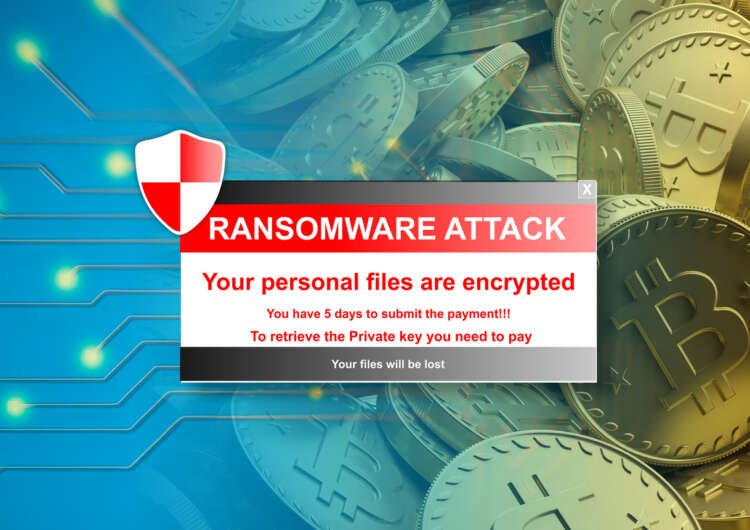
    An illustration depicting the connection between ransomware attacks and cryptocurrencies like Bitcoin. This image highlights the role of digital currencies in ransom payments, emphasizing the growing threat of cybercrime in the technology sector.
    Ransomware threat illustration with Bitcoin symbols - Global Banking & Finance Review
    Why waste money on news and opinion when you can access them for free?

    Take advantage of our newsletter subscription and stay informed on the go!

    Subscribe

    Tags:cybersecurityCryptocurrenciesblockchainFinancial crime

    By Charl van der Walt, Head of Security Research, Orange Cyberdefense

    It seems that hardly a day goes by without the issue of ‘ransomware’ hitting the headlines. In recent years there have been a number of incidents, one of the most high profile of which saw up to 1,500 businesses around the world impacted by a ransomware attack centred on US IT firm Kaseya. Businesses worldwide had critical files across their computer networks locked by the attack. The hackers reportedly demanded $70 million in Bitcoin, and Kaseya has, to date, refused to say whether an extortion payment was made.

    Cryptocurrency plays a central role in all major ransomware attacks. The rise of Bitcoin and other cryptocurrencies has enabled ransomware to become one of the most profitable business models in the cyber criminal’s arsenal. Bitcoin has been just the shot in the arm that the ransomware industry needed. It is a safe, cheap and reliable means of payment with a high degree of anonymity.

    Hackers just need to monitor the public blockchain to find out if, and when, their target has paid up. They can also create a unique payment address for each victim and have the locked files automatically released on confirmation of payment.

    The threat, and the consequences, of ransomware attacks are now clear to many people, and the problem doesn’t look like it’s going away. So, what can be done to mitigate the potential impact?

    Firstly, it must be understood how easy it is for criminals to gain access to IT systems. Take the example of WannaCry, a global attack which targeted the Microsoft Windows operating system, and infected hundreds of thousands of computers across more than 150 countries in a matter of hours. Although Microsoft had released a critical patch a month before the original attack, there were still many Windows users with unpatched systems. Such an apparently simple and routine action to take, but, for whatever reason, patches were not implemented and the resulting attack was potentially catastrophic.

    There is no single solution to beating cybercriminals, but starting with the basics is crucial. Anyone with a network needs to conduct a thorough review of organisational processes and procedures around security, both from a technological and a human viewpoint. Ensure a high degree of cyber-hygiene, with modern anti-virus protection, tight network filtering, careful user rights management and timely software patching. Business continuity plans should always include an offline back-up of all data so that payment is not required to get it back. Identify all the potential risks, address them, and never assume that you won’t be a target.

    One vital step – despite sounding like it’s a million miles away from a solution to ransomware – is to start using the correct terminology for such crimes. It isn’t just ransomware that crypto is enabling huge growth for, it’s cyber extortion (Cy-X) in general. It might sound like semantics, but ransomware is – of course – a very particular use of malware to hijack a computer or network and extort money for its safe return. What we are witnessing a growth in, what we call Cy-X, isn’t just about patches and anti-virus, it’s about a criminal business model in which security is compromised, an asset is taken away, and held captive until a ransom is paid. This opportunistic and malicious crime requires a systemic and almost psychological response.

    To look at Cy-X as a whole, not just ransomware, is to see an entire hive of extortion-led, crypto-enabled cybercrime which requires a consistent and methodical response from all of us in the industry to counter. We need to minimise the attack surface of victims, ensure they’re adopting best practice behaviours, and sharing fewer valuable assets online. Then we need to demotivate the offenders responsible, whether the initial access broker, their affiliates or operators, and have a concerted response by law enforcement to minimise the flow of funds from victim to perpetrator. Finally, we need to educate the wider community on constant vigilance – it’s a community-led approach that’s required to curtail the issue of cyber extortion.

    Ultimately, ransomware, cyber extortion, and their ilk, are an infection, and will only be controlled if everyone plays their part in ensuring that their security is the best it can possibly be. The market conditions for ransomware, the availability of cryptocurrency, and the head-in-the-sand approach of many organisations, has created a fertile environment. We must all work together to prevent further growth.

    Frequently Asked Questions about Ransomware is rife – are cryptocurrencies to blame?

    1What is ransomware?

    Ransomware is a type of malicious software that encrypts a victim's files, making them inaccessible until a ransom is paid to the attacker.

    2What are cryptocurrencies?

    Cryptocurrencies are digital or virtual currencies that use cryptography for security and operate on decentralized networks based on blockchain technology.

    3What is cyber extortion?

    Cyber extortion is a form of cybercrime where attackers threaten to release sensitive data or disrupt services unless a ransom is paid.

    More from Technology

    Explore more articles in the Technology category

    Image for Showcasing Digital Leadership – Best Bank for Social Media 2026
    Showcasing Digital Leadership – Best Bank for Social Media 2026
    Image for Innovation Through Partnership: The Role of External Tech Teams
    Innovation Through Partnership: The Role of External Tech Teams
    Image for Nominations Open for Technology Awards 2026
    Nominations Open for Technology Awards 2026
    Image for Nominations Open for Innovation Awards 2026
    Nominations Open for Innovation Awards 2026
    Image for Archie earns industry recognition across G2, Capterra, and SoftwareReviews
    Archie Earns Industry Recognition Across G2, Capterra, and SoftwareReviews
    Image for The Bankaool Transformation: How a Regional Mexican Bank Became a Fintech Disruptor
    The Bankaool Transformation: How a Regional Mexican Bank Became a FinTech Disruptor
    Image for Submit Your Entry Today for Digital Banking Awards 2026
    Submit Your Entry Today for Digital Banking Awards 2026
    Image for Behavioral AI in Financial Services: Moving Beyond Automation Toward Human Understanding
    Behavioral AI in Financial Services: Moving Beyond Automation Toward Human Understanding
    Image for Submit Your Entry for Brand of the Year Awards Technology Bahrain 2026
    Submit Your Entry for Brand of the Year Awards Technology Bahrain 2026
    Image for Entries Now Open for Best Islamic Open Banking Burkina Faso APIs 2026
    Entries Now Open for Best Islamic Open Banking Burkina Faso APIs 2026
    Image for Entrepreneurial Discipline in the AI Economy: Insights from Dmytro Lavryniuk
    Entrepreneurial Discipline in the AI Economy: Insights From Dmytro Lavryniuk
    Image for Entries Now Open for Best New Digital Wallet Innovation Award 2026
    Entries Now Open for Best New Digital Wallet Innovation Award 2026
    View All Technology Posts
    Previous Technology PostAI – the Hidden Weapon in the Battle Against Financial Crime
    Next Technology PostRethinking Cyber-Security for the Financial Sector