
Top Stories
Historic Stone of Scone Moved to London for King Charles’ Coronation
Published by Wanda Rich
Posted on April 28, 2023
2 min readLast updated: February 1, 2026
Add as preferred source on Google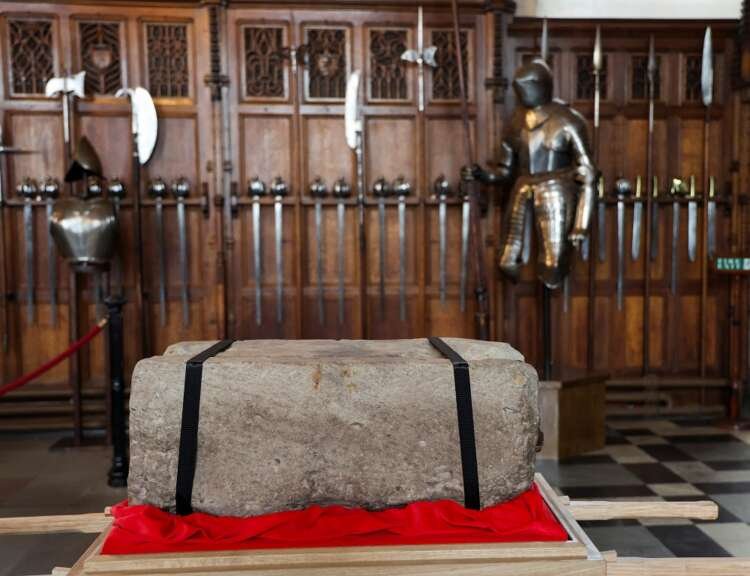
Published by Wanda Rich
Posted on April 28, 2023
2 min readLast updated: February 1, 2026
Add as preferred source on GoogleLONDON (Reuters) – The historic Stone of Scone, the ancient coronation stone upon which monarchs in Britain have been crowned for centuries, has left Scotland for London under tight security ahead of next week’s coronation of King Charles III, officials said on Friday.
LONDON (Reuters) – The historic Stone of Scone, the ancient coronation stone upon which monarchs in Britain have been crowned for centuries, has left Scotland for London under tight security ahead of next week’s coronation of King Charles III, officials said on Friday.
Also known as the Stone of Destiny and regarded as a sacred, historic symbol of Scotland’s monarchy and nationhood, it is being moved from its permanent home at Edinburgh Castle for the first time in more than 25 years, Historic Environment Scotland (HES) said.
HES, which looks after the stone – an oblong block of red sandstone, said it had worked with police and other agencies to ensure it “can be transported safely and securely”, saying it was being taken in a special carrier constructed largely from Scottish oak.
It was removed from the castle on Thursday in a ceremonial procession involving Joseph Morrow, the Lord Lyon King of Arms and the monarch’s representative in Scotland, along with Scotland’s First Minister Humza Yousaf, in his role as the Keeper of the Great Seal of Scotland, HES said.
“It is … a great responsibility to ensure the safe voyage and return of such an important national symbol, and one which has required the care, skill and expertise of a range of different specialist teams across our organisation,” said Kathy Richmond, head of collections at HES.
The stone’s origins are unknown, but it was believed to have been used in the inauguration of Scottish kings as far back as the early 9th century.
England’s King Edward I seized the stone from the Scots in 1296, and it was incorporated into the Coronation Chair he ordered in 1308 for London’s Westminster Abbey.
That chair has since been used in the coronation ceremonies of English and British monarchs since Henry IV in 1399.
On Christmas Day in 1950, the stone was taken by Scottish nationalists from Westminster but was recovered a few months later 500 miles (800 km) away on the high altar of Arbroath Abbey in Scotland.
However, it was officially moved to Scotland on a permanent basis in 1996 and will return there after Charles’ coronation.
(Reporting by Michael Holden; editing by Jonathan Oatis)
The Stone of Scone, also known as the Stone of Destiny, is a historic symbol of Scotland used in the coronation of Scottish kings since the early 9th century.
A coronation is a formal ceremony marking the investiture of a monarch, often involving the anointing and crowning of the sovereign.
Edinburgh Castle is a historic fortress located on Castle Rock in Scotland, serving as a symbol of Scottish heritage and the monarchy.
Security measures in transport refer to protocols and systems implemented to ensure the safe movement of valuable items, including the use of specialized carriers and police protection.
The Lord Lyon King of Arms is the heraldic authority in Scotland, responsible for overseeing matters related to coats of arms and heraldry.
Explore more articles in the Top Stories category











