
Top Stories
Ferrari CEO Says E-Fuel Cars Do Not Compromise Carbon Goals
Published by Uma Rajagopal
Posted on May 9, 2023
2 min readLast updated: February 1, 2026
Add as preferred source on Google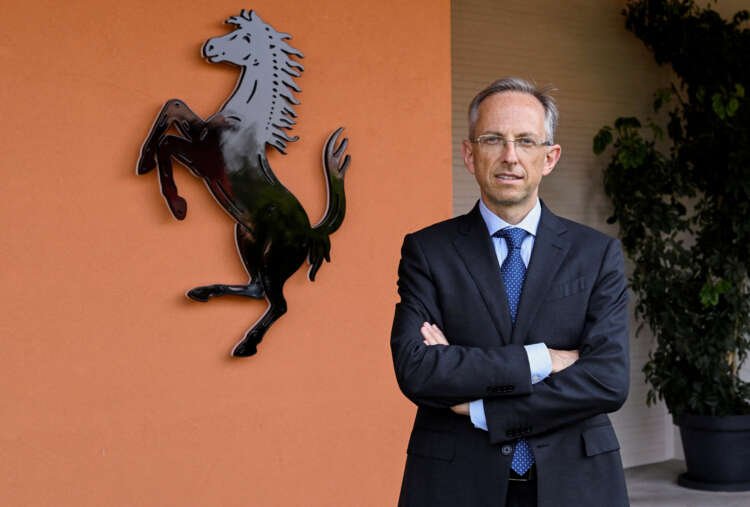
Published by Uma Rajagopal
Posted on May 9, 2023
2 min readLast updated: February 1, 2026
Add as preferred source on GoogleMILAN (Reuters) – Ferrari’s plans to continue building internal combustion engine cars powered by so called e-fuels does not conflict with its target to become carbon neutral by 2030, its chief executive said on Tuesday.
MILAN (Reuters) – Ferrari’s plans to continue building internal combustion engine cars powered by so called e-fuels does not conflict with its target to become carbon neutral by 2030, its chief executive said on Tuesday.
“The two (targets) are very much compatible,” CEO Benedetto Vigna told the Financial Times’ ‘Future of the Car’ conference.
Vigna had previously welcomed a European Union decision to exempt cars that run on e-fuels from its planned 2035 phase-out – or 2036 for so-called small volume manufacturers like Ferrari – of combustion engine vehicles.
“We thought this (EU decision) was happening in 2025 or 2026, it has happened two years before and this is very good for us, because you can run a thermal car with a fuel that is (carbon) neutral,” Vigna said.
E-fuels are made by synthesizing captured CO2 emissions and hydrogen produced using renewable or CO2-free electricity.
Ferrari, which is renowned for its powerful petrol engines, is already producing plug-in hybrid cars and has promised its first full-electric vehicle for 2025. However it has never provided a roadmap for going all electric.
Presenting its business plan last year, Ferrari said fully-electric and hybrid models would make up 80% of those in its range by 2030, while 20% would still be powered by internal combustion engines.
Vigna on Tuesday also reiterated Ferrari, which sold over 13,200 cars in 2022, had no plans to widely expand production despite recently reopening orders for its new four-door, four-seater model Purosangue, for which requests were much higher than expected.
“We don’t want to make 50-60% of our volumes with just one model,” he said.
“When you are on a road and you see too many times in a day the same kind of car, our eyes get used to it … you don’t perceive any more desirability”.
(Reporting by Giulio Piovaccari, editing by Gavin Jones and Keith Weir)
Carbon neutrality refers to achieving net-zero carbon emissions by balancing emitted carbon with an equivalent amount of carbon offsets or reductions.
E-fuels, or electro-fuels, are synthetic fuels produced by combining captured carbon dioxide with hydrogen derived from renewable energy sources.
A plug-in hybrid vehicle is a type of hybrid car that can be recharged from an external power source and operates on both electricity and gasoline.
A full-electric vehicle is a car powered entirely by electricity, using batteries to store energy and having no internal combustion engine.
The EU's decision to exempt e-fuel vehicles from the combustion engine phase-out allows manufacturers like Ferrari to continue producing traditional cars while pursuing sustainability goals.
Explore more articles in the Top Stories category











