
Top Stories
FEATURE-Evicted Villagers Pay a High Price for India’s Hydropower Push
Published by Wanda Rich
Posted on June 1, 2022
6 min readLast updated: February 6, 2026
Add as preferred source on Google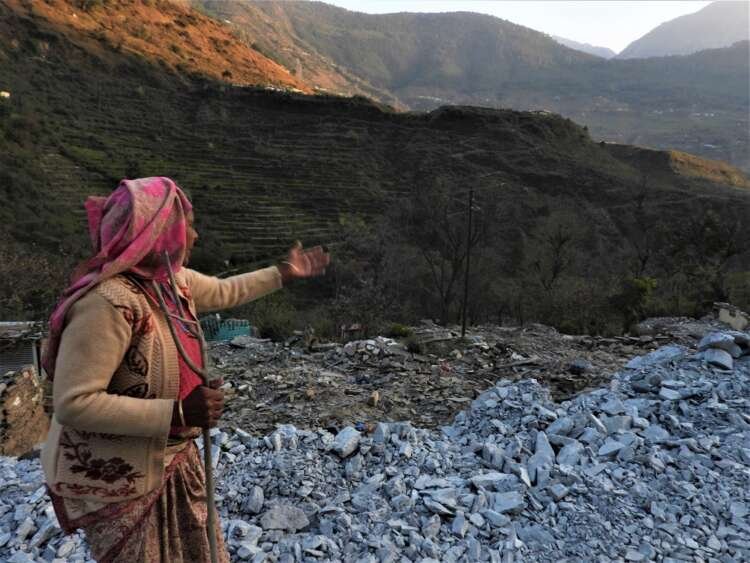
Published by Wanda Rich
Posted on June 1, 2022
6 min readLast updated: February 6, 2026
Add as preferred source on Google• India’s Himalayas are dotted with dozens of hydropower projects
• India’s Himalayas are dotted with dozens of hydropower projects
• Critics say environmental damage from hydro outweighs benefits
• India wants half of its energy to come from renewables by 2030
By Athar Parvaiz
HAAT VILLAGE, India, May 30 (Thomson Reuters Foundation) – Narmada Devi pointed to an expanse of rubble and dirt, at the spot where her home in the north Indian state of Uttarakhand stood until last year.
The flattened remains of her house and those of her neighbours in Haat village lay scattered around, buried in construction waste from a nearby hydroelectric power plant.
Between the village and the plant, an important Hindu temple stands surrounded by debris.
“This is where the remains of my house lie, under the muck,” Devi told the Thomson Reuters Foundation. “What kind of development is this, when you rob poor people of their homes to supply electricity to others?”
Devi’s family is among the more than 240 households in the village who lost their homes during the construction of the 444-megawatt (MW) hydropower project on the Alaknanda river.
The World Bank-financed power plant is one of dozens of hydroelectric projects either being built or already operating across India’s Himalayan states, in a bid to cut down the country’s carbon emissions.
The government has said hydropower, along with solar and wind, is vital to meeting India’s pledge to get half of its energy from non-fossil fuel sources by 2030.
As countries look for ways to curb global warming, backers of hydropower note that it provides massive amounts of clean electricity and can be ramped up quickly when more weather-dependent solar and wind projects fail to meet demand.
But green groups and communities affected by hydroelectric projects say the high environmental and social costs are hard to justify.
Devi, 63, said that when officials from government-owned power company Tehri Hydro Development Corporation (THDC) came last year asking to buy locals’ land, anyone who refused was “bundled into a truck” and taken to a police station for several hours while their homes were demolished.
Those who had earlier agreed to sell up were given “nominal” compensation of 1 million Indian rupees ($12,887) each, said homemaker Devi, who now lives with her family in a nearby village.
Sandeep Gupta, assistant general manager of the THDC project, said Haat residents had all agreed to voluntarily resettle themselves and were fairly compensated, adding that the project was being monitored by government agencies for any environmental damage.
“No adverse impact has been reported by the agencies to date,” Gupta said.
UNTAPPED POTENTIAL
In a June 2021 report, the International Energy Agency called hydropower “the forgotten giant of clean electricity” and urged countries to include it in their energy mix to have a chance of reaching net-zero emissions.
India currently has 46 gigawatts of installed hydropower capacity – only a third of what it could potentially generate, according to government figures.
To boost capacity, the government in 2019 officially declared hydroelectric projects of over 25 MW a renewable energy source, and made it obligatory for power companies to use hydro for a share of their supply.
Before then, only smaller hydropower plants had been classed as renewable.
Arun Kumar, a professor of hydropower and renewable energy at the Indian Institute of Technology-Roorkee, said that expanding India’s hydropower sector was about more than generating electricity.
Hydroelectric dams can also provide a reliable water supply for homes, businesses and farmers, said Kumar, who sits on the board of the London-based International Hydropower Association.
In addition, big projects can attract tourists and bring jobs, electricity, roads and railways to nearby communities, improving “the quality of life in backward areas”, Kumar said.
But building more hydropower plants makes little economic sense when India can get cheaper clean energy from solar and wind projects, said Himanshu Thakkar, coordinator of the South Asia Network on Dams, Rivers and People, an advocacy group.
He said installing 1 MW of hydroelectric capacity in India costs more than 100 million rupees, about double the amount for the same solar or wind-based capacity.
Corruption and lax regulation, he added, are the only reasons India’s authorities are so focused on hydropower.
“There is huge scope for padding up the costs in the absence of credible regulatory oversight,” Thakkar said.
RISING DISASTER RISK
As for hydropower’s reputation as a green energy source, some environmentalists say the sector does more harm than good.
Hydro projects can clear forests, divert rivers, slow or stop groundwater recharge and shift huge amounts of earth, all of which make nearby communities more vulnerable to the effects of increasingly destructive extreme weather, they say.
S.P. Sati, who teaches environmental science at the College of Forestry-Ranichauri in Uttarakhand, pointed to devastating floods in the state in 2013 that killed about 6,000 people, according to state government estimates.
A committee appointed by India’s Supreme Court concluded that hydroelectric projects had exacerbated the flood damage, as the rushing water carried mountains of excavated boulders, silt and sand downstream, burying low-lying communities.
The committee also noted in a report that digging and use of explosives while building the plants “can trigger landslides or slope failure”.
“If you don’t care about the sensitivity, fragility and carrying capacity of the terrain, (hydropower) is bound to trigger big disasters,” Sati said.
Haat village head Rajendra Prasad Hatwal said residents would keep on holding protests and lobbying the local government until the hydropower plant developers stopped using their home as a dumping site and properly compensated displaced families.
He also questioned why India is leaning so heavily into hydropower, when countries like the United States, Brazil and China have suffered huge disruptions in hydropower generation due to climate change-driven droughts in the past few years.
Another concern is the clearing of thousands of trees for the power plant, he said, when “we hear so much about saving forests to fight climate change”.
“It is so confusing and frustrating,” he added.
($1 = 77.5956 Indian rupees)
(Reporting by Athar Parvaiz; editing by Jumana Farouky and Megan Rowling. Please credit the Thomson Reuters Foundation, the charitable arm of Thomson Reuters, that covers the lives of people around the world who struggle to live freely or fairly. Visit http://news.trust.org)
((jumana.farouky@thomsonreuters.com))
Content provided by Thomson Reuters Foundation, via Reuters Connect
Hydropower is a form of renewable energy that generates electricity by using the flow of water, typically from rivers or dams, to turn turbines.
Renewable energy sources are energy sources that are replenished naturally, such as solar, wind, and hydropower, and are considered more sustainable than fossil fuels.
Environmental damage refers to the harm caused to ecosystems and natural resources, often due to human activities like construction, pollution, and deforestation.
Compensation in displacement refers to the financial or material restitution provided to individuals or communities who lose their homes or land due to development projects.
The World Bank provides funding and support for hydropower projects, aiming to promote renewable energy and reduce carbon emissions in developing countries.
Explore more articles in the Top Stories category











