Search
00
GBAF Logo
trophy
Top StoriesInterviewsBusinessFinanceBankingTechnologyInvestingTradingVideosAwardsMagazinesHeadlinesTrends

Subscribe to our newsletter

Get the latest news and updates from our team.

Global Banking & Finance Review®

Global Banking & Finance Review® - Subscribe to our newsletter

Company

    GBAF Logo
    • About Us
    • Profile
    • Privacy & Cookie Policy
    • Terms of Use
    • Contact Us
    • Advertising
    • Submit Post
    • Latest News
    • Research Reports
    • Press Release
    • Awards▾
      • About the Awards
      • Awards TimeTable
      • Submit Nominations
      • Testimonials
      • Media Room
      • Award Winners
      • FAQ
    • Magazines▾
      • Global Banking & Finance Review Magazine Issue 79
      • Global Banking & Finance Review Magazine Issue 78
      • Global Banking & Finance Review Magazine Issue 77
      • Global Banking & Finance Review Magazine Issue 76
      • Global Banking & Finance Review Magazine Issue 75
      • Global Banking & Finance Review Magazine Issue 73
      • Global Banking & Finance Review Magazine Issue 71
      • Global Banking & Finance Review Magazine Issue 70
      • Global Banking & Finance Review Magazine Issue 69
      • Global Banking & Finance Review Magazine Issue 66
    Top StoriesInterviewsBusinessFinanceBankingTechnologyInvestingTradingVideosAwardsMagazinesHeadlinesTrends

    Global Banking & Finance Review® is a leading financial portal and online magazine offering News, Analysis, Opinion, Reviews, Interviews & Videos from the world of Banking, Finance, Business, Trading, Technology, Investing, Brokerage, Foreign Exchange, Tax & Legal, Islamic Finance, Asset & Wealth Management.
    Copyright © 2010-2026 GBAF Publications Ltd - All Rights Reserved. | Sitemap | Tags | Developed By eCorpIT

    Editorial & Advertiser disclosure

    Global Banking & Finance Review® is an online platform offering news, analysis, and opinion on the latest trends, developments, and innovations in the banking and finance industry worldwide. The platform covers a diverse range of topics, including banking, insurance, investment, wealth management, fintech, and regulatory issues. The website publishes news, press releases, opinion and advertorials on various financial organizations, products and services which are commissioned from various Companies, Organizations, PR agencies, Bloggers etc. These commissioned articles are commercial in nature. This is not to be considered as financial advice and should be considered only for information purposes. It does not reflect the views or opinion of our website and is not to be considered an endorsement or a recommendation. We cannot guarantee the accuracy or applicability of any information provided with respect to your individual or personal circumstances. Please seek Professional advice from a qualified professional before making any financial decisions. We link to various third-party websites, affiliate sales networks, and to our advertising partners websites. When you view or click on certain links available on our articles, our partners may compensate us for displaying the content to you or make a purchase or fill a form. This will not incur any additional charges to you. To make things simpler for you to identity or distinguish advertised or sponsored articles or links, you may consider all articles or links hosted on our site as a commercial article placement. We will not be responsible for any loss you may suffer as a result of any omission or inaccuracy on the website.

    Home > Top Stories > Factbox-What happens if Russia turns off gas flows to Germany?
    Top Stories

    Factbox-What happens if Russia turns off gas flows to Germany?

    Published by Wanda Rich

    Posted on March 29, 2022

    3 min read

    Last updated: January 20, 2026

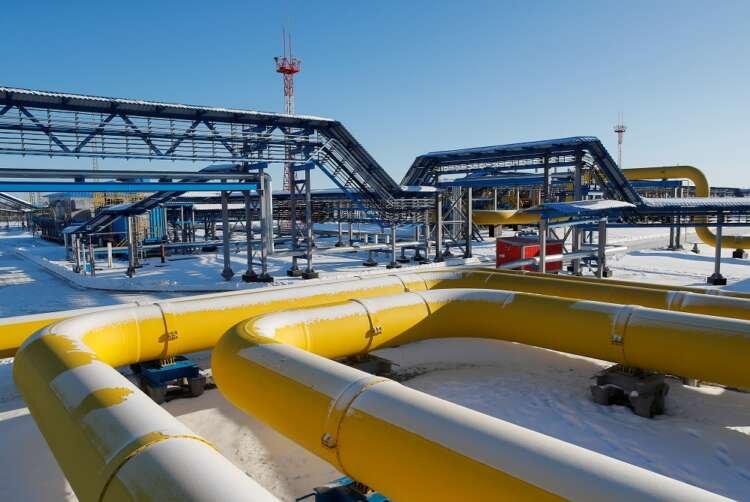
    Gas pipelines are pictured at the Atamanskaya compressor station, facility of Gazprom’s Power Of Siberia project outside the far eastern town of Svobodny
    Why waste money on news and opinion when you can access them for free?

    Take advantage of our newsletter subscription and stay informed on the go!

    Subscribe

    Quick Summary

    FRANKFURT (Reuters) – Russia’s demand that some buyers pay for its gas in roubles has raised concerns in Germany, which relies on Russian fuel, that the payment dispute could escalate and disrupt supplies.

    FRANKFURT (Reuters) – Russia’s demand that some buyers pay for its gas in roubles has raised concerns in Germany, which relies on Russian fuel, that the payment dispute could escalate and disrupt supplies.

    Russia accounted for 55% of Germany’s gas imports in 2021. Although that figure fell to 40% in the first quarter of 2022, Economy Minister Robert Habeck has said Germany will not achieve full independence from Russian supplies before mid-2024.

    WHAT’S THE PROBLEM?

    Moscow said last week it would draw up a mechanism by March 31 under which so-called “unfriendly” countries – those behind sanctions imposed over Russia’s invasion of Ukraine – would pay for gas in roubles. That includes Germany, Europe’s industrial powerhouse, and other European allies.

    Most now pay in euros or dollars.

    Habeck, who is the minister responsible for Germany’s energy security, has rejected Russia’s demand, saying contracts would be honoured under current terms.

    Responding to a question related to Russia’s latest plans, Kremlin spokesman Dmitry Peskov said: “No payment – no gas.”

    Russia’s biggest German customers are Uniper, RWE and EnBW’s VNG, which all have long-term gas supply contracts. They have not commented on questions about individual preparations for any disruption.

    WHAT HAPPENS IF SUPPLY IS DISRUPTED OR STOPS?

    Germany’s utility association BDEW has called on the government to draw up a national emergency plan to prepare for disruptions to Russian gas supplies.

    Berlin already has an “Emergency Plan Gas” that outlines three crisis levels to deal with such an event.

    The first level is the early warning, when there are signs a supply emergency is developing. The second is alarm, when a disruption to supply or extraordinarily high demand upsets the usual balance but can still be corrected without intervention.

    The third level is emergency, when market-based measures have failed to remedy shortages. At this stage, Germany’s network regulator, the Bundesnetzagentur, must decide on how to distribute remaining gas supplies across the country.

    Till now, the authorities have not indicated that any of these levels have been reached.

    WHO IS FIRST AFFECTED?

    If Germany does not secure enough gas, industry will be hit first. It accounts for a quarter of German gas demand.

    “This means that industrial production gets lost, that supply chains get lost,” Leonhard Birnbaum, chief executive of German energy group E.ON, told public broadcaster ARD. “We are certainly talking about very heavy damages.”

    Private households will have priority over industry, while hospitals, care facilities and other public sector institutions with special needs would be last to be affected by a disruption.

    (Reporting by Vera Eckert, Christoph Steitz and Tom Kaeckenhoff; Editing by Nina Chestney and Edmund Blair)

    More from Top Stories

    Explore more articles in the Top Stories category

    Image for Lessons From the Ring and the Deal Table: How Boxing Shapes Steven Nigro’s Approach to Banking and Life
    Lessons From the Ring and the Deal Table: How Boxing Shapes Steven Nigro’s Approach to Banking and Life
    Image for Joe Kiani in 2025: Capital, Conviction, and a Focused Return to Innovation
    Joe Kiani in 2025: Capital, Conviction, and a Focused Return to Innovation
    Image for Marco Robinson – CLOSE THE DEAL AND SUDDENLY GROW RICH
    Marco Robinson – CLOSE THE DEAL AND SUDDENLY GROW RICH
    Image for Digital Tracing: Turning a regulatory obligation into a commercial advantage
    Digital Tracing: Turning a regulatory obligation into a commercial advantage
    Image for Exploring the Role of Blockchain and the Bitcoin Price Today in Education
    Exploring the Role of Blockchain and the Bitcoin Price Today in Education
    Image for Inside the World’s First Collection Industry Conglomerate: PCA Global’s Platform Strategy
    Inside the World’s First Collection Industry Conglomerate: PCA Global’s Platform Strategy
    Image for Chase Buchanan Private Wealth Management Highlights Key Autumn 2025 Budget Takeaways for Expats
    Chase Buchanan Private Wealth Management Highlights Key Autumn 2025 Budget Takeaways for Expats
    Image for PayLaju Strengthens Its Position as Malaysia’s Trusted Interest-Free Sharia-Compliant Loan Provider
    PayLaju Strengthens Its Position as Malaysia’s Trusted Interest-Free Sharia-Compliant Loan Provider
    Image for A Notable Update for Employee Health Benefits:
    A Notable Update for Employee Health Benefits:
    Image for Creating Equity Between Walls: How Mohak Chauhan is Using Engineering, Finance, and Community Vision to Reengineer Affordable Housing
    Creating Equity Between Walls: How Mohak Chauhan is Using Engineering, Finance, and Community Vision to Reengineer Affordable Housing
    Image for Upcoming Book on Real Estate Investing: Harvard Grace Capital Founder Stewart Heath’s Puts Lessons in Print
    Upcoming Book on Real Estate Investing: Harvard Grace Capital Founder Stewart Heath’s Puts Lessons in Print
    Image for ELECTIVA MARKS A LANDMARK FIRST YEAR WITH MAJOR SENIOR APPOINTMENTS AND EXPANSION MILESTONES
    ELECTIVA MARKS A LANDMARK FIRST YEAR WITH MAJOR SENIOR APPOINTMENTS AND EXPANSION MILESTONES
    View All Top Stories Posts
    Previous Top Stories PostLME board to evaluate lessons from nickel halt – HKEX
    Next Top Stories PostExclusive-ECB ready to set up money exchange for Ukrainian refugees with EU guarantee