Search
00
GBAF Logo
trophy
Top StoriesInterviewsBusinessFinanceBankingTechnologyInvestingTradingVideosAwardsMagazinesHeadlinesTrends

Subscribe to our newsletter

Get the latest news and updates from our team.

Global Banking & Finance Review®

Global Banking & Finance Review® - Subscribe to our newsletter

Company

    GBAF Logo
    • About Us
    • Profile
    • Privacy & Cookie Policy
    • Terms of Use
    • Contact Us
    • Advertising
    • Submit Post
    • Latest News
    • Research Reports
    • Press Release
    • Awards▾
      • About the Awards
      • Awards TimeTable
      • Submit Nominations
      • Testimonials
      • Media Room
      • Award Winners
      • FAQ
    • Magazines▾
      • Global Banking & Finance Review Magazine Issue 79
      • Global Banking & Finance Review Magazine Issue 78
      • Global Banking & Finance Review Magazine Issue 77
      • Global Banking & Finance Review Magazine Issue 76
      • Global Banking & Finance Review Magazine Issue 75
      • Global Banking & Finance Review Magazine Issue 73
      • Global Banking & Finance Review Magazine Issue 71
      • Global Banking & Finance Review Magazine Issue 70
      • Global Banking & Finance Review Magazine Issue 69
      • Global Banking & Finance Review Magazine Issue 66
    Top StoriesInterviewsBusinessFinanceBankingTechnologyInvestingTradingVideosAwardsMagazinesHeadlinesTrends

    Global Banking & Finance Review® is a leading financial portal and online magazine offering News, Analysis, Opinion, Reviews, Interviews & Videos from the world of Banking, Finance, Business, Trading, Technology, Investing, Brokerage, Foreign Exchange, Tax & Legal, Islamic Finance, Asset & Wealth Management.
    Copyright © 2010-2026 GBAF Publications Ltd - All Rights Reserved. | Sitemap | Tags | Developed By eCorpIT

    Editorial & Advertiser disclosure

    Global Banking & Finance Review® is an online platform offering news, analysis, and opinion on the latest trends, developments, and innovations in the banking and finance industry worldwide. The platform covers a diverse range of topics, including banking, insurance, investment, wealth management, fintech, and regulatory issues. The website publishes news, press releases, opinion and advertorials on various financial organizations, products and services which are commissioned from various Companies, Organizations, PR agencies, Bloggers etc. These commissioned articles are commercial in nature. This is not to be considered as financial advice and should be considered only for information purposes. It does not reflect the views or opinion of our website and is not to be considered an endorsement or a recommendation. We cannot guarantee the accuracy or applicability of any information provided with respect to your individual or personal circumstances. Please seek Professional advice from a qualified professional before making any financial decisions. We link to various third-party websites, affiliate sales networks, and to our advertising partners websites. When you view or click on certain links available on our articles, our partners may compensate us for displaying the content to you or make a purchase or fill a form. This will not incur any additional charges to you. To make things simpler for you to identity or distinguish advertised or sponsored articles or links, you may consider all articles or links hosted on our site as a commercial article placement. We will not be responsible for any loss you may suffer as a result of any omission or inaccuracy on the website.

    Home > Top Stories > Explainer-Might Russia use nuclear weapons in the Ukraine war?
    Top Stories

    Explainer-Might Russia use nuclear weapons in the Ukraine war?

    Published by Wanda Rich

    Posted on May 6, 2022

    5 min read

    Last updated: February 7, 2026

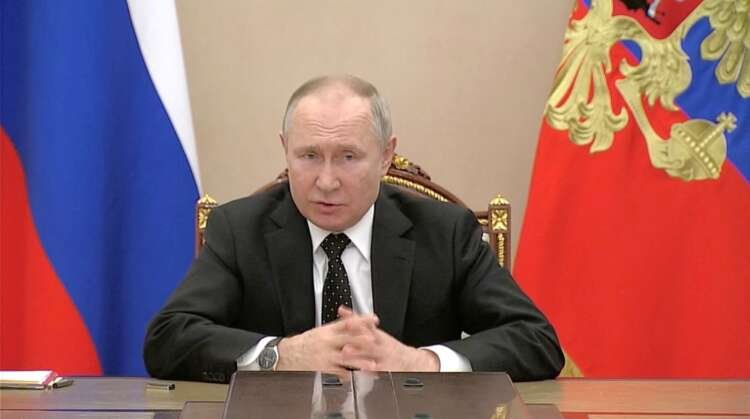
    Russian President Vladimir Putin speaks about the possibility of nuclear weapons use during the Ukraine war, emphasizing threats to national security. This image highlights the tense geopolitical climate surrounding nuclear deterrence strategies.
    Russian President Vladimir Putin discusses nuclear deterrent forces amid Ukraine conflict - Global Banking & Finance Review
    Why waste money on news and opinion when you can access them for free?

    Take advantage of our newsletter subscription and stay informed on the go!

    Subscribe

    Tags:financial crisisinternational financial institutionforeign currencyinvestment portfoliosfinancial management

    By Arshad Mohammed and Robin Emmott

    (Reuters) – At the start of Russia’s invasion of Ukraine, Russian President Vladimir Putin obliquely raised the possibility of a nuclear strike against anyone who intervened in the conflict.

    Below are some of the key issues surrounding the possibility – viewed as remote by many analysts and Western diplomats – that Putin might actually use nuclear weapons.

    WHAT HAS RUSSIA SAID ABOUT NUCLEAR ARMS IN THE UKRAINE WAR?

    In a speech announcing the invasion of Ukraine on Feb. 24, Putin gave a veiled but unmistakable warning that if the West intervened in what he has called a “special military operation” he could use nuclear weapons in response.

    “No matter who tries to stand in our way or … create threats for our country and our people, they must know that Russia will respond immediately, and the consequences will be such as you have never seen in your entire history,” he said according to a Kremlin translation.

    Three days later on Feb. 27, Putin ordered his military command to put Russia’s nuclear deterrent forces on high alert, citing what he called aggressive statements by NATO leaders and Western economic sanctions against Moscow.

    Russian Foreign Minister Sergei Lavrov, a veteran diplomat, has also talked about the risk of nuclear war, though he said Moscow was doing its utmost to prevent one.

    “I would not want to elevate those risks artificially. Many would like that. The danger is serious, real. And we must not underestimate it,” he said last week, prompting the U.S. State Department to call his remarks “the height of irresponsibility”.

    While Washington has not seen any actions suggesting Russian nuclear forces are on high alert, experts and Western officials warned against dismissing the comments as bluster given the risk Putin could use nuclear arms if he felt cornered in Ukraine or if NATO entered the war.

    WHAT HAS THE WEST SAID ABOUT PUTIN’S VEILED THREATS?

    U.S. officials quickly called Putin’s comments about putting Russian nuclear forces on high alert dangerous, escalatory and totally unacceptable, while NATO Secretary General Jens Stoltenberg criticized them as aggressive and irresponsible.

    However, U.S. officials also immediately made clear they had seen no signs Russian forces had changed their nuclear posture and the U.S. military said it saw no need to alter its own.

    On Feb. 28, U.S. President Joe Biden told Americans not to worry about a nuclear war with Russia. Responding to a shouted question about whether U.S. citizens should be concerned about a nuclear war erupting, Biden said “no.”

    WHAT ARE THE CHANCES OF RUSSIA USING NUCLEAR WEAPONS?

    Biden’s comment appeared to reflect a widespread view among U.S. experts and Western officials that the chances of Russia using nuclear weapons in the Ukraine war are extremely low.

    “Since 1945, every leader of a nuclear power … has rejected the use of nuclear weapons in battle for excellent reasons,” Gideon Rose, the former editor of Foreign Affairs magazine, wrote last week.

    “Putin will be no exception, acting not from a soft heart but a hard head. He knows that extraordinary retaliation and universal opprobrium would follow, with no remotely comparable strategic upsides to justify them,” he added.

    The main aim of Russia’s elliptical threats of a nuclear strike seems to be to deter Washington and its NATO allies from direct involvement in the war, experts and Western diplomats said.

    “They are not credible,” said one Western diplomat who like others spoke on condition of anonymity because of the sensitivity of the issue. “He is trying to scare the West.”

    HOW MIGHT RUSSIA USE A NUCLEAR WEAPON?

    While Western nations have poured arms into Ukraine since the invasion, Biden last year said putting U.S. troops on the ground in Ukraine was “not on the table.”

    The United States and its allies have no desire to get into a conventional shooting war with Russia, let alone do anything that might spark a nuclear exchange.

    If Russia were to use nuclear weapons, experts saw a range of possibilities, from a detonation over the Black Sea or an uninhabited part of Ukraine to demonstrate its capabilities to a strike against a Ukrainian military target or on a city.

    However, using a nuclear weapon in Ukraine could endanger Russian troops and draw radioactive blowback on Russia itself.

    HOW MIGHT THE WEST RESPOND?

    Some analysts said Washington could opt for a conventional military response rather than a proportional nuclear counter-strike, which could harm U.S. allies or lead to a further nuclear escalation endangering Europe or the U.S. homeland.

    “What I would suggest instead is that the United States and NATO respond with overwhelming conventional military, political and diplomatic force to further isolate Russia and to seek to end the conflict without escalation to all-out nuclear war,” said Daryl Kimball of the Arms Control Association, a nonprofit group that seeks to educate the public about arms control.

    HOW MIGHT A RUSSIAN STRIKE CHANGE THE NUCLEAR LANDSCAPE?

    NATO might seek to redesign its U.S.-built ballistic missile shield in Poland and Romania to shoot down Russian rockets in future. NATO has long said the current design aims to counter missiles from Iran, Syria and rogue actors in the Middle East.

    It remains unclear whether a Russian strike might make other nuclear states such as India and Pakistan more likely to use such weapons. If it led to global condemnation, experts said this could reduce the chances of others using nuclear weapons.

    (Reporting by Arshad Mohammed in Saint Paul, Minn. and by Robin Emmott in Brussels; Additional reporting by Sabine Siebold in Brussels; Editing by Mary Milliken and Andrew Heavens)

    Frequently Asked Questions about Explainer-Might Russia use nuclear weapons in the Ukraine war?

    1What is a nuclear deterrent?

    A nuclear deterrent is a military strategy that uses the threat of nuclear weapons to prevent an adversary from taking aggressive actions, based on the understanding that such actions would lead to devastating retaliation.

    2What is NATO?

    NATO, or the North Atlantic Treaty Organization, is a military alliance of countries from North America and Europe that was established for mutual defense against aggression.

    3What are economic sanctions?

    Economic sanctions are restrictions imposed by countries or international organizations to influence or punish a nation or group, often to compel compliance with international laws or norms.

    4What is a conventional military response?

    A conventional military response refers to the use of standard military forces and tactics, excluding nuclear weapons, to address a conflict or threat.

    More from Top Stories

    Explore more articles in the Top Stories category

    Image for Lessons From the Ring and the Deal Table: How Boxing Shapes Steven Nigro’s Approach to Banking and Life
    Lessons From the Ring and the Deal Table: How Boxing Shapes Steven Nigro’s Approach to Banking and Life
    Image for Joe Kiani in 2025: Capital, Conviction, and a Focused Return to Innovation
    Joe Kiani in 2025: Capital, Conviction, and a Focused Return to Innovation
    Image for Marco Robinson – CLOSE THE DEAL AND SUDDENLY GROW RICH
    Marco Robinson – CLOSE THE DEAL AND SUDDENLY GROW RICH
    Image for Digital Tracing: Turning a regulatory obligation into a commercial advantage
    Digital Tracing: Turning a regulatory obligation into a commercial advantage
    Image for Exploring the Role of Blockchain and the Bitcoin Price Today in Education
    Exploring the Role of Blockchain and the Bitcoin Price Today in Education
    Image for Inside the World’s First Collection Industry Conglomerate: PCA Global’s Platform Strategy
    Inside the World’s First Collection Industry Conglomerate: PCA Global’s Platform Strategy
    Image for Chase Buchanan Private Wealth Management Highlights Key Autumn 2025 Budget Takeaways for Expats
    Chase Buchanan Private Wealth Management Highlights Key Autumn 2025 Budget Takeaways for Expats
    Image for PayLaju Strengthens Its Position as Malaysia’s Trusted Interest-Free Sharia-Compliant Loan Provider
    PayLaju Strengthens Its Position as Malaysia’s Trusted Interest-Free Sharia-Compliant Loan Provider
    Image for A Notable Update for Employee Health Benefits:
    A Notable Update for Employee Health Benefits:
    Image for Creating Equity Between Walls: How Mohak Chauhan is Using Engineering, Finance, and Community Vision to Reengineer Affordable Housing
    Creating Equity Between Walls: How Mohak Chauhan is Using Engineering, Finance, and Community Vision to Reengineer Affordable Housing
    Image for Upcoming Book on Real Estate Investing: Harvard Grace Capital Founder Stewart Heath’s Puts Lessons in Print
    Upcoming Book on Real Estate Investing: Harvard Grace Capital Founder Stewart Heath’s Puts Lessons in Print
    Image for ELECTIVA MARKS A LANDMARK FIRST YEAR WITH MAJOR SENIOR APPOINTMENTS AND EXPANSION MILESTONES
    ELECTIVA MARKS A LANDMARK FIRST YEAR WITH MAJOR SENIOR APPOINTMENTS AND EXPANSION MILESTONES
    View All Top Stories Posts
    Previous Top Stories PostTake Five: The tightrope trick
    Next Top Stories PostNetflix drops Meghan Markle’s animated series ‘Pearl’