Search
00
GBAF Logo
trophy
Top StoriesInterviewsBusinessFinanceBankingTechnologyInvestingTradingVideosAwardsMagazinesHeadlinesTrends

Subscribe to our newsletter

Get the latest news and updates from our team.

Global Banking and Finance Review

Global Banking & Finance Review

Company

    GBAF Logo
    • About Us
    • Profile
    • Privacy & Cookie Policy
    • Terms of Use
    • Contact Us
    • Advertising
    • Submit Post
    • Latest News
    • Research Reports
    • Press Release
    • Awards▾
      • About the Awards
      • Awards TimeTable
      • Submit Nominations
      • Testimonials
      • Media Room
      • Award Winners
      • FAQ
    • Magazines▾
      • Global Banking & Finance Review Magazine Issue 79
      • Global Banking & Finance Review Magazine Issue 78
      • Global Banking & Finance Review Magazine Issue 77
      • Global Banking & Finance Review Magazine Issue 76
      • Global Banking & Finance Review Magazine Issue 75
      • Global Banking & Finance Review Magazine Issue 73
      • Global Banking & Finance Review Magazine Issue 71
      • Global Banking & Finance Review Magazine Issue 70
      • Global Banking & Finance Review Magazine Issue 69
      • Global Banking & Finance Review Magazine Issue 66
    Top StoriesInterviewsBusinessFinanceBankingTechnologyInvestingTradingVideosAwardsMagazinesHeadlinesTrends

    Global Banking & Finance Review® is a leading financial portal and online magazine offering News, Analysis, Opinion, Reviews, Interviews & Videos from the world of Banking, Finance, Business, Trading, Technology, Investing, Brokerage, Foreign Exchange, Tax & Legal, Islamic Finance, Asset & Wealth Management.
    Copyright © 2010-2025 GBAF Publications Ltd - All Rights Reserved.

    Editorial & Advertiser disclosure

    Global Banking and Finance Review is an online platform offering news, analysis, and opinion on the latest trends, developments, and innovations in the banking and finance industry worldwide. The platform covers a diverse range of topics, including banking, insurance, investment, wealth management, fintech, and regulatory issues. The website publishes news, press releases, opinion and advertorials on various financial organizations, products and services which are commissioned from various Companies, Organizations, PR agencies, Bloggers etc. These commissioned articles are commercial in nature. This is not to be considered as financial advice and should be considered only for information purposes. It does not reflect the views or opinion of our website and is not to be considered an endorsement or a recommendation. We cannot guarantee the accuracy or applicability of any information provided with respect to your individual or personal circumstances. Please seek Professional advice from a qualified professional before making any financial decisions. We link to various third-party websites, affiliate sales networks, and to our advertising partners websites. When you view or click on certain links available on our articles, our partners may compensate us for displaying the content to you or make a purchase or fill a form. This will not incur any additional charges to you. To make things simpler for you to identity or distinguish advertised or sponsored articles or links, you may consider all articles or links hosted on our site as a commercial article placement. We will not be responsible for any loss you may suffer as a result of any omission or inaccuracy on the website.

    Home > Top Stories > EUROPEAN BANKS’ RETURNS REVEAL RELUCTANT RECOVERY
    Top Stories

    EUROPEAN BANKS’ RETURNS REVEAL RELUCTANT RECOVERY

    EUROPEAN BANKS’ RETURNS REVEAL RELUCTANT RECOVERY

    Published by Gbaf News

    Posted on August 1, 2014

    Featured image for article about Top Stories

    The long-awaited recovery of European banks has yet to happen, as SNL Financial’s ROE figures demonstrate.

    Indubitably, the ROE numbers in our analysis make for depressing yet insightful reading.

    Between 2010 and 2014, the five major economies of France, Germany, Italy, Spain and the U.K. did not once see their banks achieve double-digit returns.

    Given that a figure of around 10% is generally seen as the cost of capital for a bank, few banks in those countries have recently managed to earn their cost of equity. Indeed, the mainly traditional Italian and Spanish banks have clearly endured heavy loan losses during the long crisis-driven recession. Recapitalization, deleveraging and retaining dividends have been themes everywhere as losses were absorbed.

    The smaller economies have fared somewhat better but far from all.

    In 2013, only the Czech Republic, Sweden, Estonia, Slovakia and maybe Poland met their cost of capital, according to SNL data, while Slovenia, Cyprus, Ireland, Portugal, Austria and Hungary achieved negative to very negative returns.

    Investors remain concerned about the level and quality of bank returns. J. Christopher Flowers, the private equity fund investor, told the Financial Times July 20: “All the stuff that has happened and all the rules we’ve introduced have depressed profitability and that is a real vulnerability. Nobody is going to invest in an industry with returns of 5%.” He further observed that it was impossible to turn banks into utilities and that bank crises would continue to take place.

    Subjectively, the ROE figures look far worse than one might expect after a season of monitoring bank reports and presentations. Here, professional optimism does rule. It is hard to believe the picture is as bad as our figures show.

    The reason is clear. Banks restate their returns to create underlying figures or core results. These typically exclude one-offs from litigation, fines and redress costs as well as the costs of restructuring and losses incurred on noncore assets either destined for sale or rundown. In the case of major provisioning for credit losses, it is useful to talk positively about the future and treat the past as another country.

    Moreover, because the banks’ restated figures are calculated in different ways, they are not at all comparable. One bank’s restated 12% ROE is not the same as another’s.
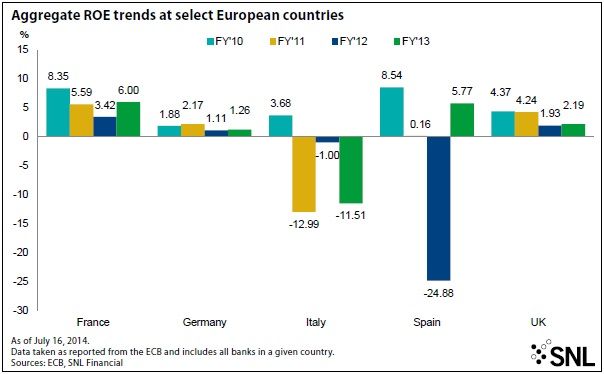
    By contrast, our figures for select European banks for the first quarter of 2014 are comparable, thus indicating their relative performance as well as their ability to pay dividends and retain not to mention expand capital.

    One main exception to these findings comes from the Nordic countries, where the banking system manages to combine high capital and high returns.

    Then there is Russia and Turkey, countries whose banks show high returns but are being affected by political turmoil and the prospect of weaker growth. Returns look destined to fall with international sanctions being imposed against Russia over the turmoil in Ukraine while domestic tensions remain in Turkey.Neither system is a picture of health.

    The performance of OAO Sberbank of Russia looks strong but actually reflects a more troubled present. At one stage, in the not-too-distant past, the leading Russian bank was looking at achieving a 30% return on capital.

    Thus, the question of when bank returns might again become healthy looms large — and bankers are now talking about running their business for returns.

    French banks, which are widely seen to be among the strongest of the five leading economies, have unveiled ROE targets for 2016 or 2017; in the case of BNP Paribas SA and Société Générale SA of just 10% or higher. This is not much greater than their cost of capital and underlines how much work still has to be done — in what is a relatively strong economy where the banks enjoy good margins and demonstrate credible business models.

    All measures are open to criticism. However, the return figures are satisfyingly capitalistic and illustrate why it might be better to be a bank depositor, creditor or shareholder. They calibrate the distance between success and failure.

    “The bottom line is that the ROE is the number that ultimately matters; everything is linked to that, be it capital deficits or the discussions around the pressure on earnings,” Nick Anderson, a bank analyst at Berenberg, told SNL. “It is the bottom-line number.”
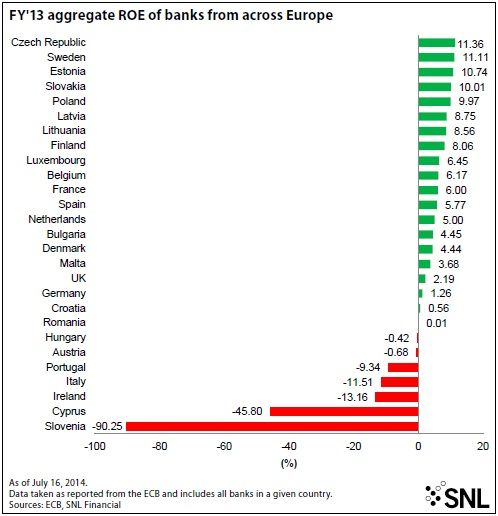
    This number does illustrate the scale of challenges the banks face to recover, not least from the overhang of individual and state indebtedness in Europe. Anderson said: “The multiple problems of the banking system will take a long time to correct. None of the fundamental changes has really started to happen yet. The system has to pay off the debt — without regard to whose name is on the IOU, it is the system that matters.”

    The problem of promoting growth when bank balance sheets are weak and impaired looks set to slow the European recovery. Indeed, since the French banks are looking to 2016 and 2017 for stronger returns, this state of affairs could last for a good while.
    Mike Wolff, a credit analyst and strategist at Landesbank Baden-Württemberg, told SNL: “The sole countries that are functioning well are the Nordics. They are performing well, doing the right things. Some of them have core Tier 1 capital of around 20%. They really are super-solid banks.”
    But generally, he continued, “the banking system has not yet reached the recovery phase; we must wait to see what the ECB-POLICY-RATES-82f6314e-6203-420b-bc8b-70a978546822>ECB publishes [in the autumn] before we really know about asset quality. No new risks can be undertaken and without new risks, there will be no earnings [growth].”

    There are some signs of recovery. Among the banks appearing in SNL’s first-quarter 2014 table, HSBC Holdings Plc, KBC Group NV and Lloyds Banking Group Plc stand out because their earnings almost certainly sufficed to cover their cost of capital. This looks a clear improvement on the Belgian and British systems in 2013. The roll-call of underperformers remains, however, long and impressive.

    This picture of present difficulties has not prevented a recent recovery in peripheral banks share prices. However, over five years the STOXX Europe 600 Banks index is virtually unchanged.

    Wolf said: “The bank shareholders have had bad years and they will probably continue to see bad years. They are the losers, that is for sure.”

    Related Posts
    Chase Buchanan Private Wealth Management Highlights Key Autumn 2025 Budget Takeaways for Expats
    Chase Buchanan Private Wealth Management Highlights Key Autumn 2025 Budget Takeaways for Expats
    PayLaju Strengthens Its Position as Malaysia’s Trusted Interest-Free Sharia-Compliant Loan Provider
    PayLaju Strengthens Its Position as Malaysia’s Trusted Interest-Free Sharia-Compliant Loan Provider
    A Notable Update for Employee Health Benefits:
    A Notable Update for Employee Health Benefits:
    Creating Equity Between Walls: How Mohak Chauhan is Using Engineering, Finance, and Community Vision to Reengineer Affordable Housing
    Creating Equity Between Walls: How Mohak Chauhan is Using Engineering, Finance, and Community Vision to Reengineer Affordable Housing
    Upcoming Book on Real Estate Investing: Harvard Grace Capital Founder Stewart Heath’s Puts Lessons in Print
    Upcoming Book on Real Estate Investing: Harvard Grace Capital Founder Stewart Heath’s Puts Lessons in Print
    ELECTIVA MARKS A LANDMARK FIRST YEAR WITH MAJOR SENIOR APPOINTMENTS AND EXPANSION MILESTONES
    ELECTIVA MARKS A LANDMARK FIRST YEAR WITH MAJOR SENIOR APPOINTMENTS AND EXPANSION MILESTONES
    Hebbia Processes One Billion Pages as Financial Institutions Deploy AI Infrastructure at Unprecedented Scale
    Hebbia Processes One Billion Pages as Financial Institutions Deploy AI Infrastructure at Unprecedented Scale
    Beyond Governance Fatigue: Making ESG Integration Work in Financial Markets
    Beyond Governance Fatigue: Making ESG Integration Work in Financial Markets
    Why I-9 Verification Matters for Financial Institutions: Building a Culture of Compliance and Trust
    Why I-9 Verification Matters for Financial Institutions: Building a Culture of Compliance and Trust
    Curvestone AI partners with The White Rose Finance Group to enhance compliance file reviews
    Curvestone AI partners with The White Rose Finance Group to enhance compliance file reviews
    LinkedIn Influence in 2025: Insights from Stevo Jokic on Building Authority and Trust
    LinkedIn Influence in 2025: Insights from Stevo Jokic on Building Authority and Trust
    Should You Take the Dealer’s Bike Insurance or Buy Online Yourself? Here’s the Real Difference
    Should You Take the Dealer’s Bike Insurance or Buy Online Yourself? Here’s the Real Difference

    Why waste money on news and opinions when you can access them for free?

    Take advantage of our newsletter subscription and stay informed on the go!

    Subscribe

    More from Top Stories

    Explore more articles in the Top Stories category

    ID-Pal Unveils ID-Detect Enhancements to Counter Surge in Digital Manipulation and Deepfakes

    ID-Pal Unveils ID-Detect Enhancements to Counter Surge in Digital Manipulation and Deepfakes

    TRUST TAKES THE LEAD: HALF OF UK SHOPPERS HAVE ABANDONED ONLINE PURCHASES OVER SECURITY CONCERNS

    TRUST TAKES THE LEAD: HALF OF UK SHOPPERS HAVE ABANDONED ONLINE PURCHASES OVER SECURITY CONCERNS

    Why Choose Premium Driver Service in Miami Over Rideshare Apps for Business Travel and Special Events?

    Why Choose Premium Driver Service in Miami Over Rideshare Apps for Business Travel and Special Events?

    Over 30 Million Users Benefit From Ant International’s Bettr Credit Tech Solutions

    Over 30 Million Users Benefit From Ant International’s Bettr Credit Tech Solutions

    Side-Hustle Economics: How Part-Time Service Work Can Strengthen Your Financial Plan

    Side-Hustle Economics: How Part-Time Service Work Can Strengthen Your Financial Plan

    London to Host Major Summit on “New Horizons” for Islamic Economy in the UK

    London to Host Major Summit on “New Horizons” for Islamic Economy in the UK

    BLOXX Launches World’s First Home Equity Subscription, Creating a New Residential Asset Class

    BLOXX Launches World’s First Home Equity Subscription, Creating a New Residential Asset Class

    LiaFi Addresses Gap Between Business Transaction and Savings Accounts

    LiaFi Addresses Gap Between Business Transaction and Savings Accounts

    Ant Group Chairman Eric Jing Outlines Strategy for Inclusive AI, Collaboration on Tokenised Settlement

    Ant Group Chairman Eric Jing Outlines Strategy for Inclusive AI, Collaboration on Tokenised Settlement

    Deeply Cultivating the Syndicated Loan and Cross-Border Financing Fields: Empowering Chinese Banks’ Global Expansion with Professional Excellence

    Deeply Cultivating the Syndicated Loan and Cross-Border Financing Fields: Empowering Chinese Banks’ Global Expansion with Professional Excellence

    Ant International’s Antom Launches AI‑Powered MSME App for Finance and Business Operations

    Ant International’s Antom Launches AI‑Powered MSME App for Finance and Business Operations

    A Gateway for U.S. Capital: Inside Kazakhstan’s Expanding Financial Hub

    A Gateway for U.S. Capital: Inside Kazakhstan’s Expanding Financial Hub

    View All Top Stories Posts
    Previous Top Stories PostPBZ, IN COLLABORATION WITH INTESA SANPAOLO CARD LTD., IS THE FIRST TO TEST HCE FOR MOBILE NFC PAYMENTS ON THE GLOBAL AMERICAN EXPRESS NETWORK
    Next Top Stories PostADRIAN KAMELLARD TO STEP DOWN AS PAYMENTS COUNCIL CHIEF EXECUTIVE