Search
00
GBAF Logo
trophy
Top StoriesInterviewsBusinessFinanceBankingTechnologyInvestingTradingVideosAwardsMagazinesHeadlinesTrends

Subscribe to our newsletter

Get the latest news and updates from our team.

Global Banking & Finance Review®

Global Banking & Finance Review® - Subscribe to our newsletter

Company

    GBAF Logo
    • About Us
    • Profile
    • Privacy & Cookie Policy
    • Terms of Use
    • Contact Us
    • Advertising
    • Submit Post
    • Latest News
    • Research Reports
    • Press Release
    • Awards▾
      • About the Awards
      • Awards TimeTable
      • Submit Nominations
      • Testimonials
      • Media Room
      • Award Winners
      • FAQ
    • Magazines▾
      • Global Banking & Finance Review Magazine Issue 79
      • Global Banking & Finance Review Magazine Issue 78
      • Global Banking & Finance Review Magazine Issue 77
      • Global Banking & Finance Review Magazine Issue 76
      • Global Banking & Finance Review Magazine Issue 75
      • Global Banking & Finance Review Magazine Issue 73
      • Global Banking & Finance Review Magazine Issue 71
      • Global Banking & Finance Review Magazine Issue 70
      • Global Banking & Finance Review Magazine Issue 69
      • Global Banking & Finance Review Magazine Issue 66
    Top StoriesInterviewsBusinessFinanceBankingTechnologyInvestingTradingVideosAwardsMagazinesHeadlinesTrends

    Global Banking & Finance Review® is a leading financial portal and online magazine offering News, Analysis, Opinion, Reviews, Interviews & Videos from the world of Banking, Finance, Business, Trading, Technology, Investing, Brokerage, Foreign Exchange, Tax & Legal, Islamic Finance, Asset & Wealth Management.
    Copyright © 2010-2026 GBAF Publications Ltd - All Rights Reserved. | Sitemap | Tags | Developed By eCorpIT

    Editorial & Advertiser disclosure

    Global Banking & Finance Review® is an online platform offering news, analysis, and opinion on the latest trends, developments, and innovations in the banking and finance industry worldwide. The platform covers a diverse range of topics, including banking, insurance, investment, wealth management, fintech, and regulatory issues. The website publishes news, press releases, opinion and advertorials on various financial organizations, products and services which are commissioned from various Companies, Organizations, PR agencies, Bloggers etc. These commissioned articles are commercial in nature. This is not to be considered as financial advice and should be considered only for information purposes. It does not reflect the views or opinion of our website and is not to be considered an endorsement or a recommendation. We cannot guarantee the accuracy or applicability of any information provided with respect to your individual or personal circumstances. Please seek Professional advice from a qualified professional before making any financial decisions. We link to various third-party websites, affiliate sales networks, and to our advertising partners websites. When you view or click on certain links available on our articles, our partners may compensate us for displaying the content to you or make a purchase or fill a form. This will not incur any additional charges to you. To make things simpler for you to identity or distinguish advertised or sponsored articles or links, you may consider all articles or links hosted on our site as a commercial article placement. We will not be responsible for any loss you may suffer as a result of any omission or inaccuracy on the website.

    Home > Top Stories > EU considers ban on ‘forever chemicals’, urges search for alternatives
    Top Stories

    EU considers ban on ‘forever chemicals’, urges search for alternatives

    Published by Wanda Rich

    Posted on February 7, 2023

    4 min read

    Last updated: February 2, 2026

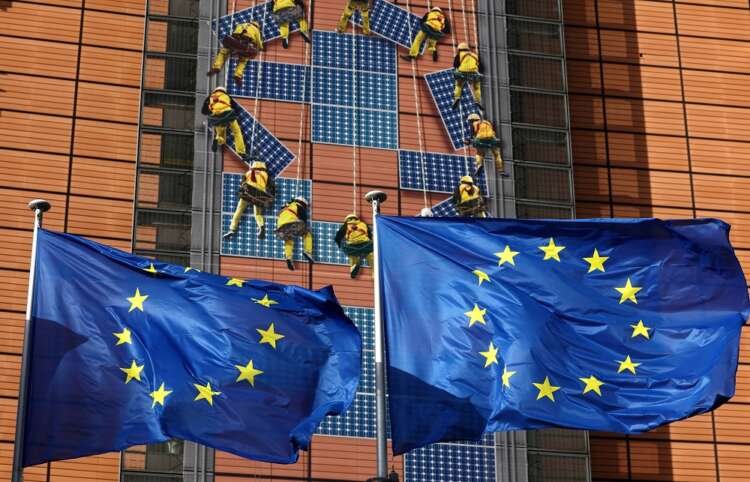
    The image shows European Union flags fluttering outside the EU Commission headquarters in Brussels, highlighting the EU's recent proposal to ban PFAS, or 'forever chemicals', in a significant regulatory move for environmental and public health safety.
    European Union flags outside the EU Commission headquarters in Brussels, symbolizing the EU's PFAS regulations - Global Banking & Finance Review
    Why waste money on news and opinion when you can access them for free?

    Take advantage of our newsletter subscription and stay informed on the go!

    Subscribe

    Tags:sustainabilityenvironmental issuesfinancial communityregulatory frameworkInvestment opportunities

    Quick Summary

    (Reuters) – The European Union on Tuesday started to consider a proposal to ban widely used substances known as PFAS or “forever chemicals” in what could become the bloc’s most extensive piece of regulation of the chemical industry.

    (Reuters) – The European Union on Tuesday started to consider a proposal to ban widely used substances known as PFAS or “forever chemicals” in what could become the bloc’s most extensive piece of regulation of the chemical industry.

    The substances have been used in tens of thousands of products, including aircraft, cars, textiles, medical gear and wind mills due to their long-term resistance to extreme temperatures and corrosion, but PFAS have also been linked to health risks like cancer, hormonal dysfunction and a weakened immune system as well as environmental damage.

    The five countries – Germany, the Netherlands, Denmark, Sweden and non-EU state Norway – which have been collaborating on the proposal said in a joint statement on Tuesday that, if passed, it would become “one of the largest bans on chemical substances ever in Europe”.

    “A ban on PFAS would reduce quantities of PFAS in the environment over the long term. It would also make products and processes safer for humans,” they added.

    Companies will be given between 18 months to 12 years to introduce alternatives substances, depending on the application and availability of alternatives, according to the draft proposal.

    Makers and users of PFAS, which have formed a lobby subgroup under the European chemical makers’ association CEFIC, include BASF, 3M, Bayer, Solvay, Merck KGaA and Synthomer.

    “In many cases, no such alternatives currently exist, and in some they possibly never will,” the five countries said in their statement, adding that companies now need to start to find substitutes.

    The moniker “forever chemicals” stems from their ability to accumulate in water and soils because they do not decompose as a result of an extremely strong bond between carbon and fluorine atoms that characterise them.

    It will likely take years before the ban takes effect.

    According to the draft, a certain number of pharmaceuticals, animal health products, crop protection chemicals and disinfectants would be exempt, or benefit from so-called derogations, because they already fall under existing regulatory regimes.

    DIFFICULT PROCESS

    The countries submitting the dossier said that it reviewed 14 industrial sectors that use PFAS and the “regulatory action” is warranted in all of them.

    They added that once a ban is in place, emissions and accumulation in the environment will go on for many years because PFAS containing gear and vehicles will continue to operate for some time and waste products would continue to shed the molecules.

    The FPP4EU group of 14 companies that make and use PFAS has said that finding alternative substances is a long and difficult process.

    A type of PFAS goes into Bayer’s liver and kidney cancer drug Nexvar, for instance, and finding a replacement would take up to 15 years, according to the lobby group.

    Other uses include cooling agents for large commercial refrigerators. In the aerospace and defence industry as well as in the car industry they are used to make parts resist fire, weather, and aggressive chemicals.

    Within the European Chemicals Agency (ECHA), two scientific committees for Risk Assessment (RAC) and for Socio-Economic Analysis (SEAC) will now review whether the proposal to ban PFAS conforms with wider EU regulation of chemicals known as REACH, followed by a scientific evaluation and consultation with the industry.

    ECHA has said that the two committees may need longer than the usual 12 months to conclude their evaluation. Afterwards, the European Commission and EU member states will decide on potential restrictions.

    In other regions, initiatives to restrict PFAS are also underway. U.S. industrial conglomerate 3M Co in December set itself a 2025 deadline to stop producing them.

    In November, 3M and DuPont de Nemours Inc were among several companies sued by California’s attorney general to recover clean-up costs.

    Shareholders have also called for production of the chemicals to stop. Investors managing $8 trillion in assets earlier this year wrote to 54 companies urging them to phase out their use.

    In August, the United States government said it will propose designating certain forever chemicals as hazardous substances under the U.S. Superfund programme.

    DuPont has said it was limiting the use of PFAS to “essential industrial applications” and working with customers to pursue alternatives.

    Between 140,000 and 310,000 tonnes of PFASs were sold in European markets in 2020, and the overall annual health costs from exposure to PFAS in Europe has been estimated to be 52 billion-84 billion euros ($55.72 billion-$90.01 billion), according to the draft.

    ($1 = 0.9332 euros)

    (Reporting by Ludwig Burger; Editing by Susan Fenton)

    Frequently Asked Questions about EU considers ban on ‘forever chemicals’, urges search for alternatives

    1What are PFAS?

    PFAS, or per- and polyfluoroalkyl substances, are a group of man-made chemicals used in various products for their resistance to heat, water, and oil. They are often referred to as 'forever chemicals' due to their persistence in the environment.

    2What are derogations in chemical regulation?

    Derogations are exemptions from certain regulatory requirements. In the context of chemical regulation, they allow specific products or substances to be excluded from bans or restrictions under certain conditions.

    3What is the role of the European Chemicals Agency (ECHA)?

    The ECHA is responsible for managing the technical, scientific, and administrative aspects of the REACH regulation. It evaluates chemical safety and ensures compliance with EU chemical legislation.

    More from Top Stories

    Explore more articles in the Top Stories category

    Image for Lessons From the Ring and the Deal Table: How Boxing Shapes Steven Nigro’s Approach to Banking and Life
    Lessons From the Ring and the Deal Table: How Boxing Shapes Steven Nigro’s Approach to Banking and Life
    Image for Joe Kiani in 2025: Capital, Conviction, and a Focused Return to Innovation
    Joe Kiani in 2025: Capital, Conviction, and a Focused Return to Innovation
    Image for Marco Robinson – CLOSE THE DEAL AND SUDDENLY GROW RICH
    Marco Robinson – CLOSE THE DEAL AND SUDDENLY GROW RICH
    Image for Digital Tracing: Turning a regulatory obligation into a commercial advantage
    Digital Tracing: Turning a regulatory obligation into a commercial advantage
    Image for Exploring the Role of Blockchain and the Bitcoin Price Today in Education
    Exploring the Role of Blockchain and the Bitcoin Price Today in Education
    Image for Inside the World’s First Collection Industry Conglomerate: PCA Global’s Platform Strategy
    Inside the World’s First Collection Industry Conglomerate: PCA Global’s Platform Strategy
    Image for Chase Buchanan Private Wealth Management Highlights Key Autumn 2025 Budget Takeaways for Expats
    Chase Buchanan Private Wealth Management Highlights Key Autumn 2025 Budget Takeaways for Expats
    Image for PayLaju Strengthens Its Position as Malaysia’s Trusted Interest-Free Sharia-Compliant Loan Provider
    PayLaju Strengthens Its Position as Malaysia’s Trusted Interest-Free Sharia-Compliant Loan Provider
    Image for A Notable Update for Employee Health Benefits:
    A Notable Update for Employee Health Benefits:
    Image for Creating Equity Between Walls: How Mohak Chauhan is Using Engineering, Finance, and Community Vision to Reengineer Affordable Housing
    Creating Equity Between Walls: How Mohak Chauhan is Using Engineering, Finance, and Community Vision to Reengineer Affordable Housing
    Image for Upcoming Book on Real Estate Investing: Harvard Grace Capital Founder Stewart Heath’s Puts Lessons in Print
    Upcoming Book on Real Estate Investing: Harvard Grace Capital Founder Stewart Heath’s Puts Lessons in Print
    Image for ELECTIVA MARKS A LANDMARK FIRST YEAR WITH MAJOR SENIOR APPOINTMENTS AND EXPANSION MILESTONES
    ELECTIVA MARKS A LANDMARK FIRST YEAR WITH MAJOR SENIOR APPOINTMENTS AND EXPANSION MILESTONES
    View All Top Stories Posts
    Previous Top Stories PostCryptoverse: Is bitcoin out of the woods? Consider the options
    Next Top Stories PostFTSE 100 inches towards recent highs as BP shines