Search
00
GBAF Logo
trophy
Top StoriesInterviewsBusinessFinanceBankingTechnologyInvestingTradingVideosAwardsMagazinesHeadlinesTrends

Subscribe to our newsletter

Get the latest news and updates from our team.

Global Banking & Finance Review®

Global Banking & Finance Review® - Subscribe to our newsletter

Company

    GBAF Logo
    • About Us
    • Advertising and Sponsorship
    • Profile & Readership
    • Contact Us
    • Latest News
    • Privacy & Cookies Policies
    • Terms of Use
    • Advertising Terms
    • Issue 81
    • Issue 80
    • Issue 79
    • Issue 78
    • Issue 77
    • Issue 76
    • Issue 75
    • Issue 74
    • Issue 73
    • Issue 72
    • Issue 71
    • Issue 70
    • View All
    • About the Awards
    • Awards Timetable
    • Awards Winners
    • Submit Nominations
    • Testimonials
    • Media Room
    • FAQ
    • Asset Management Awards
    • Brand of the Year Awards
    • Business Awards
    • Cash Management Banking Awards
    • Banking Technology Awards
    • CEO Awards
    • Customer Service Awards
    • CSR Awards
    • Deal of the Year Awards
    • Corporate Governance Awards
    • Corporate Banking Awards
    • Digital Transformation Awards
    • Fintech Awards
    • Education & Training Awards
    • ESG & Sustainability Awards
    • ESG Awards
    • Forex Banking Awards
    • Innovation Awards
    • Insurance & Takaful Awards
    • Investment Banking Awards
    • Investor Relations Awards
    • Leadership Awards
    • Islamic Banking Awards
    • Real Estate Awards
    • Project Finance Awards
    • Process & Product Awards
    • Telecommunication Awards
    • HR & Recruitment Awards
    • Trade Finance Awards
    • The Next 100 Global Awards
    • Wealth Management Awards
    • Travel Awards
    • Years of Excellence Awards
    • Publishing Principles
    • Ownership & Funding
    • Corrections Policy
    • Editorial Code of Ethics
    • Diversity & Inclusion Policy
    • Fact Checking Policy
    Original content: Global Banking and Finance Review - https://www.globalbankingandfinance.com

    A global financial intelligence and recognition platform delivering authoritative insights, data-driven analysis, and institutional benchmarking across Banking, Capital Markets, Investment, Technology, and Financial Infrastructure.

    Copyright © 2010-2026 - All Rights Reserved. | Sitemap | Tags

    Editorial & Advertiser disclosure

    Global Banking & Finance Review® is an online platform offering news, analysis, and opinion on the latest trends, developments, and innovations in the banking and finance industry worldwide. The platform covers a diverse range of topics, including banking, insurance, investment, wealth management, fintech, and regulatory issues. The website publishes news, press releases, opinion and advertorials on various financial organizations, products and services which are commissioned from various Companies, Organizations, PR agencies, Bloggers etc. These commissioned articles are commercial in nature. This is not to be considered as financial advice and should be considered only for information purposes. It does not reflect the views or opinion of our website and is not to be considered an endorsement or a recommendation. We cannot guarantee the accuracy or applicability of any information provided with respect to your individual or personal circumstances. Please seek Professional advice from a qualified professional before making any financial decisions. We link to various third-party websites, affiliate sales networks, and to our advertising partners websites. When you view or click on certain links available on our articles, our partners may compensate us for displaying the content to you or make a purchase or fill a form. This will not incur any additional charges to you. To make things simpler for you to identity or distinguish advertised or sponsored articles or links, you may consider all articles or links hosted on our site as a commercial article placement. We will not be responsible for any loss you may suffer as a result of any omission or inaccuracy on the website.

    1. Home
    2. >Technology
    3. >Efficient Cloud Migrations for Financial Services
    Technology

    Efficient Cloud Migrations for Financial Services

    Published by Wanda Rich

    Posted on September 2, 2021

    5 min read

    Last updated: February 13, 2026

    Add as preferred source on Google

    An abstract image illustrating the integration of smart city technologies and wireless networks, symbolizing the cloud migration trend in financial services. This visual connects to the article's focus on efficient cloud transitions for banks.
    Abstract representation of smart city technology and cloud migration in finance - Global Banking & Finance Review
    Why waste money on news and opinion when you can access them for free?

    Take advantage of our newsletter subscription and stay informed on the go!

    Subscribe

    Tags:innovationfinancial servicescloud computingDigital transformation

    Efficient Cloud Migrations for Financial Services

    By Brian Adler is senior director of cloud market strategy at Flexera and was previously a senior director analyst at Gartner.

    Financial service organizations are facing a time of great change and opportunity. They’re moving away from legacy infrastructure and embracing the transformational capabilities of cloud technologies. Their cloud migrations make vast amounts of data available for new tech that will help them maintain their competitive edge, especially as they face growing pressure from challengers and new FinTechs—banks born in the cloud. 

    As Jamie Dimon, chairman and chief executive officer of JPMorgan Chase, wrote in his 2020 letter to shareholders, refactoring and re-platforming banks’ data “makes data enormously valuable and digitally accessible [for applications such as artificial intelligence and machine learning]. All of this work takes time and money, but it’s absolutely essential that we do it.” 

    Not only is that work essential, it’s essential that the migration to cloud is done efficiently, with an eye toward cloud cost optimization that helps streamline operations—immediately and in the long-term. But that isn’t always happening. What’s going on and how can financial institutions improve their cloud migration goals?

    Trends in Cloud for Financial Services

    The trend toward cloud within financial services has been clear in recent years; COVID-19 added momentum. As found in the Tech Spending During COVID-19: The Road to Normalcy in 2021 report from financial services research and advisory firm Celent, one of the key trends impacting banks as a result of the pandemic is “an acceleration of digital transformation and cloud migration timeline by around 2 years.” Many are “reinvesting into digital customer experience” and into improving some of the shortcomings “in digital delivery” that the pandemic highlighted. 

    When evaluating financial services organizations against other organizations of comparable size and across industries, noteworthy trends appear. As found in the Flexera 2021 State of the Cloud report, financial services organizations: 
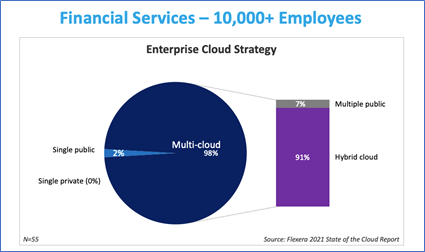
    • Are more likely to run multi-cloud and hybrid. Among survey respondents from organizations with more than 10,000 employees, 98% of those in financial services report using multi-cloud, compared to 94% of all orgs this size; 91% of those in financial services report using hybrid cloud approaches, compared to 82% percent of all organizations this size. This higher rate of multi- and hybrid-cloud usage within financial services may be due, in part, to some industries (such as consumer products, government, retail, and transportation) not having the same “technology DNA” that financial service organizations often have. 

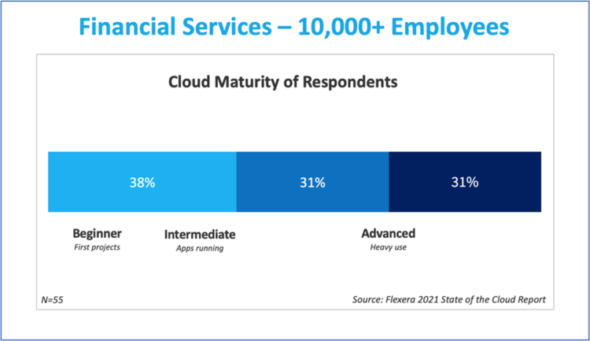
    • Are less “cloud mature.” Among respondents with more than 10,000 employees, within financial services, only about 1/3 (31%) were advanced users of cloud, compared to 2/3 (66%) overall. Among a few important contributing factors to this is that, because their exposure is so great, financial services orgs have been reticent to adopt new technologies. Rather than be the pioneers, they take a “wait and see” approach, evaluating if and how well others have adopted a new service or technology before they are willing to integrate it. As such, from a cloud migration and usage perspective, they’re often less mature or less experienced.

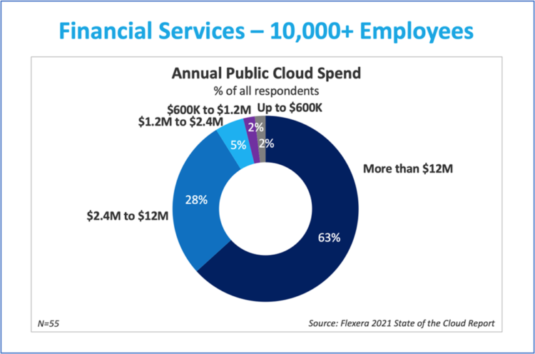
    • Spend more. 63% of financial services organizations with more than 10,000 employees spend more than $12 million a year on public cloud, compared to only 49% of all organizations with more than 10,000 employees. Multiple variables likely contribute to why financial institutions are spending more on public cloud. One possible cause: with a lack of maturity in the cloud comes non-optimal cloud configuration, leading to wasted—or at least non-optimized—cloud spend. The result: spending more than they should—and more than comparably-sized organizations that are more mature in their cloud initiatives.

    Cloud Cost Optimization for Financial Services

    Clearly financial services organizations have many good reasons to move to the cloud, including tapping into the power of AI/ML, enhancing customer experiences, improving operational efficiencies, launching innovative initiatives, and more. But having a lot of use cases that are good fits for cloud technology can mean that a lot of data and workloads are thrown there quickly. This can lead to significant waste of cloud expenditures. Today, public cloud spend is over budget by an average of 24% and predicted to increase in the coming year, according to the Flexera 2021 State of the Cloud report.

    Consider these guidelines as part of your organization’s cloud initiatives:

    • Plan and prioritize the migration. A lift-and-shift approach may not be the most efficient approach. Consider rearchitecting, where necessary, so that what you move is suited to your cloud environment as well as possible. A cloud migration technical assessment can help pinpoint where rearchitecting is appropriate; it can help prioritize which applications should be migrated when.


    • Understand application dependencies. Map the relationships between the applications (including customer-facing apps or applications with shared reporting, for example) that tap into your data. This helps identify what to migrate, the networking impact, and the dependencies that exist across business services.


    • Consider multiple approaches to ongoing cloud cost optimization. There are multiple automated cloud cost optimization policies that can help save money on cloud costs. Begin by identifying ways to get rid of idle resources (such as deprovisioning unused storage or shutting down instances after hours). Multi-cloud management tools can also help rightsize cloud instances, monitor for and eliminate waste (using the lowest-expense clouds and/or regions), and finding the maximum provider discounts available, based on usage and on the various discounts offered by cloud providers such as AWS, Azure, and Google.

    Moving to the cloud is a must today for financial services. Struggling to handle cloud initiatives—and expenses—doesn’t need to be part of the equation.

    This is a Sponsored Feature

    Frequently Asked Questions about Efficient Cloud Migrations for Financial Services

    1Why are financial services organizations moving to the cloud?

    Financial services organizations are moving to the cloud to tap into the power of AI/ML, enhance customer experiences, and improve operational efficiencies.

    2What is essential for cloud migration in financial services?

    It is essential that the migration to cloud is done efficiently, with an eye toward cloud cost optimization that helps streamline operations.

    3What impact did COVID-19 have on cloud adoption in financial services?

    COVID-19 added momentum to the trend toward cloud within financial services, accelerating the shift away from legacy infrastructure.

    4What are some guidelines for cloud initiatives in financial services?

    Organizations should consider guidelines that focus on efficient migration and cost management to ensure successful cloud initiatives.

    5Who is Brian Adler?

    Brian Adler is the senior director of cloud market strategy at Flexera and was previously a senior director analyst at Gartner.

    More from Technology

    Explore more articles in the Technology category

    Image for Innovation Through Partnership: The Role of External Tech Teams
    Innovation Through Partnership: The Role of External Tech Teams
    Image for Nominations Open for Technology Awards 2026
    Nominations Open for Technology Awards 2026
    Image for Nominations Open for Innovation Awards 2026
    Nominations Open for Innovation Awards 2026
    Image for Archie earns industry recognition across G2, Capterra, and SoftwareReviews
    Archie Earns Industry Recognition Across G2, Capterra, and SoftwareReviews
    Image for The Bankaool Transformation: How a Regional Mexican Bank Became a Fintech Disruptor
    The Bankaool Transformation: How a Regional Mexican Bank Became a FinTech Disruptor
    Image for Submit Your Entry Today for Digital Banking Awards 2026
    Submit Your Entry Today for Digital Banking Awards 2026
    Image for Behavioral AI in Financial Services: Moving Beyond Automation Toward Human Understanding
    Behavioral AI in Financial Services: Moving Beyond Automation Toward Human Understanding
    Image for Submit Your Entry for Brand of the Year Awards Technology Bahrain 2026
    Submit Your Entry for Brand of the Year Awards Technology Bahrain 2026
    Image for Entries Now Open for Best Islamic Open Banking Burkina Faso APIs 2026
    Entries Now Open for Best Islamic Open Banking Burkina Faso APIs 2026
    Image for Entrepreneurial Discipline in the AI Economy: Insights from Dmytro Lavryniuk
    Entrepreneurial Discipline in the AI Economy: Insights From Dmytro Lavryniuk
    Image for Entries Now Open for Best New Digital Wallet Innovation Award 2026
    Entries Now Open for Best New Digital Wallet Innovation Award 2026
    Image for Call for Entries: Best Digital Wallet 2026
    Call for Entries: Best Digital Wallet 2026
    View All Technology Posts
    Previous Technology PostThe Impact of Software Releases and Testing on Customers’ Mobile and App Ratings
    Next Technology PostData Science Against Disinformation: How Artificial Intelligence and Machine Learning Can Fact-Check Claims of Digital Election Campaigns