
Top Stories
Edpr Brings Iberia’s First Wind-Solar Power Plant On-Stream
Published by Jessica Weisman-Pitts
Posted on January 13, 2023
3 min readLast updated: February 2, 2026
Add as preferred source on Google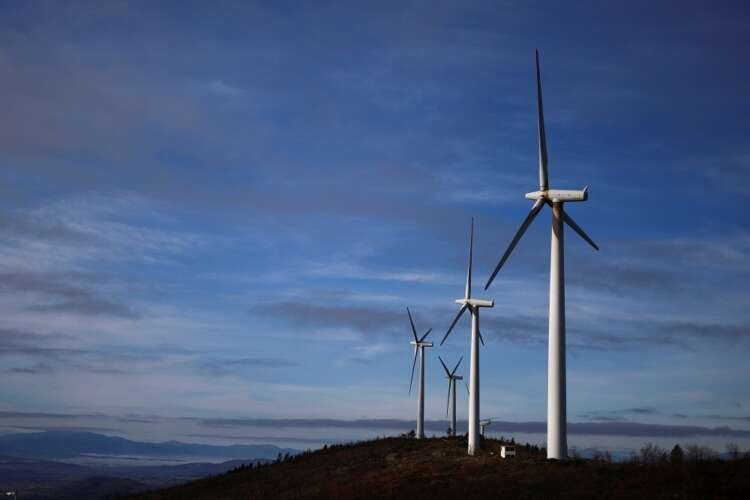
Published by Jessica Weisman-Pitts
Posted on January 13, 2023
3 min readLast updated: February 2, 2026
Add as preferred source on GoogleBy Sergio Goncalves and Miguel Pereira
LISBON (Reuters) – EDP Renovaveis, the world’s fourth-largest renewable power producer, has brought on-stream the first hybrid wind-solar farm in Iberia, adding 36.5 gigawatts (GW) of annual capacity just as Europe is facing an energy crisis.
The Mina de Orgueirel plant, about 300 km (186 miles) northeast of Portugal’s capital Lisbon, combines 17,000 new photovoltaic panels covering an area of roughly six soccer pitches with wind turbines that EDPR already had on the same plot.
Like most European countries, Portugal is accelerating its shift to renewables to reduce reliance on imported fossil fuels whose prices have surged since Russia’s invasion of Ukraine.
Benefiting from abundant sunshine and strong Atlantic winds, Portugal seeks to have 80% of its electricity usage coming from renewable sources by 2026, up from 60% now, which is already one of the highest ratios in Europe.
Duarte Bello, chief operating officer at EDPR-Europe and Latam, told Reuters on Thursday the solar panels about doubled the farm’s capacity to 21 megawatts and its annual generation of 36.5 GW would be enough to supply more than 30,000 people.
IT’S THE FUTURE
He said EDPR’s first hybrid plant has been in full production for a few weeks, the culmination of five years of work.
“It is a great signal and great support to accelerating the energy transition, using existing assets and increasing the energy independence for the region – Portugal and Spain,” he said. “Most of the players understand this is the way going forward.”
He expected more renewable and storage technologies to be added to such projects in the future.
Combined operations reduce production costs as they use no or little additional land and power networks thanks to existing connections to the grid.
He expected Europe’s accelerating push for renewable energies to help streamline the licensing of hybrid projects and shorten their implementation times from up to six years now.
“We haven’t seen the impact yet,” he said, expecting it to materialise this year and next.
EDPR’s medium-sized hybrid farm will serve as a case study for implementing similar projects in all 29 countries where it and its mother company EDP has operations, including Poland, Italy, Brazil and the United States.
It is already building four other parks in Iberia and plans to bring online 1.6 GW of hybrid capacity there this decade.
EDPR has an installed capacity of 3.4 GW in Iberia alone and 14.3 GW globally.
(Reporting by Sergio Goncalves and Miguel Pereira, editing by Andrei Khalip and David Evans)
Renewable energy refers to energy derived from natural sources that are replenished at a faster rate than they are consumed, such as solar, wind, and hydroelectric power.
Solar power is energy harnessed from the sun's rays, typically using photovoltaic cells to convert sunlight into electricity.
A hybrid power plant combines two or more types of energy generation, such as wind and solar, to optimize energy production and efficiency.
Energy independence is the ability of a country or region to meet its energy needs without relying on external sources, often achieved through renewable energy development.
Explore more articles in the Top Stories category











