
Top Stories
Eastern Europe Under Strain as Ukraine Refugees Keep Coming
Published by Jessica Weisman-Pitts
Posted on March 11, 2022
5 min readLast updated: February 8, 2026
Add as preferred source on Google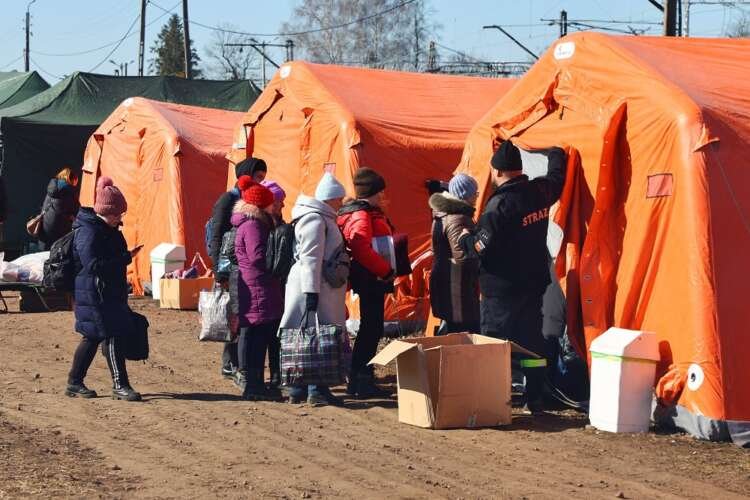
Published by Jessica Weisman-Pitts
Posted on March 11, 2022
5 min readLast updated: February 8, 2026
Add as preferred source on GoogleBy Marek Strzelecki and Jason Hovet
MEDYKA, Poland/PRAGUE (Reuters) -Eastern Europe’s efforts to aid Ukrainians came under strain on Friday, with some cities running out of accommodation as the number of refugees passed 2.5 million and fighting in their homeland.
Relief work in frontline states – Poland, Slovakia, Romania, Hungary and Moldova – has mainly been shouldered by ordinary citizens volunteering to drive, cook or house refugees, with the help of non-governmental organisations and local authorities.
But with the war now in its third week and the number of refugees swelling, it is becoming difficult to provide sufficient help.
In Krakow, Poland’s second-largest city, one NGO described the situation at the train station as “tragic”.
“There is nowhere to direct the refugees. They are stressed and confused, all kinds of help is needed, and above all, premises,” tweeted Fundacja Brata Alberta, an NGO that in normal times helps individuals with mental disabilities.
In Hrubieszow, a Polish town on the Ukrainian border, Mayor Marta Majewska said she had spent all the town’s crisis reserve of 100,000 zlotys ($22,889), as well as 170,000 zlotys from the local province, to run a refugee reception centre.
“I am most worried about electricity bills,” she told Radio Zet. “The city cannot bear it at all.”
FILLING UP FAST
In Warsaw, the biggest temporary reception centre was about 70% full by Thursday. Refugees now make up over 10% of the Polish capital’s population, Mayor Rafal Trzaskowski said.
Close to 4,000 Ukrainian children are now attending school in Warsaw, he added, with city authorities setting up 76 “preparatory classes” in which they learn Polish.
Trzaskowski separately called for other nations to step in, urging airlifts and a global system to manage the influx.
“We’re getting overwhelmed… We cannot improvise anymore,” he told U.S. television network MSNBC. “We need relocation in Europe and we need relocation in the world.”
U.S. President Joe Biden said on Friday the United States would welcome those fleeing the conflict.
“We’re going to welcome Ukraine refugees with open arms if in fact they come all the way here,” he told a group of U.S. lawmakers. He gave no details.
In Przemysl, near Poland’s busiest border crossing and a transit hub for refugees, Vice-Mayor Boguslaw Swiezy said he was seeing a decline in the number of volunteers, some of whom are students, others people taking time off work.
The Polish government will start reimbursing local governments’ costs for handling refugees from next week, once a new law comes into force, the interior ministry said.
Romania’s capital Bucharest was turning a convention centre and indoor arena, Romexpo, into its biggest refugee shelter yet, while Hungary was studying whether to turn museums, sports arenas and public buildings in Budapest into shelters.
The Hungarian government is also providing subsidies to employers who take on refugees to help cover accommodation and travel costs. In the Czech Republic, Prague mayor Zdenek Hrib called for more government funds to help accommodate refugees.
‘I DON’T KNOW WHAT TO DO NEXT’
And the refugees just keep arriving.
Dasha, a 31-year-old psychotherapist from Kyiv, arrived on Friday at Medyka, Poland’s busiest border crossing with Ukraine, where temperatures overnight dropped to -9 degrees Celsius (15.8 degrees Fahrenheit).
She left Kyiv on the first day of the invasion and stayed in the western city of Lviv but has now left Ukraine on the advice of her husband, who is in the army reserve.
“It’s tough in Kyiv, they are encircling the city,” she told Reuters, with two little dogs on their leashes.
“I’m going to Wroclaw (in southwest Poland), I have some friends there,” she said before bursting into tears. “I don’t know what to do next.”
Inna, a 55-year old woman fleeing Dnipropetrovsk, said she had travelled 24 hours to reach Medyka.
“My town was bombed this morning… I just can’t talk, I am so overwhelmed,” she sobbed.
She did not know where she would spend Friday night.
The United Nations bases its relief plans on 4 million people fleeing abroad, but has said it may need to revise the number higher.
The Polish Border Guard said 1.5 million people had entered Poland from Ukraine since Russia began its invasion on Feb. 24.
Nearly 365,000 people have so far fled into Romania, 219,000 to Hungary and 176,000 to Slovakia, officials said. Nearly 200,000 have reached the Czech Republic, which does not share a border with Ukraine.
Others are reaching or are seen getting to German, Sweden and other countries in Western Europe.
Russia calls its actions in Ukraine a special military operation to disarm its neighbour and dislodge its “neo-Nazi” leaders. Kyiv and its Western allies say this is a baseless pretext to invade a country of 44 million people.
($1 = 4.3689 zlotys)
($1 = 345.0000 forints)
(Additional reporting by Mari Saito in Medyka, Anna Wlodarczak-Semczuk in Warsaw, Luiza Ilie in Bucharest, Robert Muller in Prague, Anita Komuves and Krisztina Than in Budapest, Jeff Mason in Washington; Writing by Gwladys Fouche, additional writing by Susan Heavey; Editing by Gareth Jones and Angus MacSwan)
Humanitarian aid refers to assistance provided to people in need, particularly during crises such as natural disasters or conflicts, aimed at alleviating suffering and maintaining human dignity.
A refugee is a person who has been forced to flee their country due to persecution, war, or violence, and is unable to return safely.
Emergency funding is financial assistance provided quickly to address urgent needs during crises, such as natural disasters or humanitarian emergencies.
Refugees can impact local economies by increasing demand for housing, services, and jobs, but they can also contribute positively by filling labor shortages and boosting local businesses.
Explore more articles in the Top Stories category











