Search
00
GBAF Logo
trophy
Top StoriesInterviewsBusinessFinanceBankingTechnologyInvestingTradingVideosAwardsMagazinesHeadlinesTrends

Subscribe to our newsletter

Get the latest news and updates from our team.

Global Banking and Finance Review

Global Banking & Finance Review

Company

    GBAF Logo
    • About Us
    • Profile
    • Privacy & Cookie Policy
    • Terms of Use
    • Contact Us
    • Advertising
    • Submit Post
    • Latest News
    • Research Reports
    • Press Release
    • Awards▾
      • About the Awards
      • Awards TimeTable
      • Submit Nominations
      • Testimonials
      • Media Room
      • Award Winners
      • FAQ
    • Magazines▾
      • Global Banking & Finance Review Magazine Issue 79
      • Global Banking & Finance Review Magazine Issue 78
      • Global Banking & Finance Review Magazine Issue 77
      • Global Banking & Finance Review Magazine Issue 76
      • Global Banking & Finance Review Magazine Issue 75
      • Global Banking & Finance Review Magazine Issue 73
      • Global Banking & Finance Review Magazine Issue 71
      • Global Banking & Finance Review Magazine Issue 70
      • Global Banking & Finance Review Magazine Issue 69
      • Global Banking & Finance Review Magazine Issue 66
    Top StoriesInterviewsBusinessFinanceBankingTechnologyInvestingTradingVideosAwardsMagazinesHeadlinesTrends

    Global Banking & Finance Review® is a leading financial portal and online magazine offering News, Analysis, Opinion, Reviews, Interviews & Videos from the world of Banking, Finance, Business, Trading, Technology, Investing, Brokerage, Foreign Exchange, Tax & Legal, Islamic Finance, Asset & Wealth Management.
    Copyright © 2010-2025 GBAF Publications Ltd - All Rights Reserved.

    Editorial & Advertiser disclosure

    Global Banking and Finance Review is an online platform offering news, analysis, and opinion on the latest trends, developments, and innovations in the banking and finance industry worldwide. The platform covers a diverse range of topics, including banking, insurance, investment, wealth management, fintech, and regulatory issues. The website publishes news, press releases, opinion and advertorials on various financial organizations, products and services which are commissioned from various Companies, Organizations, PR agencies, Bloggers etc. These commissioned articles are commercial in nature. This is not to be considered as financial advice and should be considered only for information purposes. It does not reflect the views or opinion of our website and is not to be considered an endorsement or a recommendation. We cannot guarantee the accuracy or applicability of any information provided with respect to your individual or personal circumstances. Please seek Professional advice from a qualified professional before making any financial decisions. We link to various third-party websites, affiliate sales networks, and to our advertising partners websites. When you view or click on certain links available on our articles, our partners may compensate us for displaying the content to you or make a purchase or fill a form. This will not incur any additional charges to you. To make things simpler for you to identity or distinguish advertised or sponsored articles or links, you may consider all articles or links hosted on our site as a commercial article placement. We will not be responsible for any loss you may suffer as a result of any omission or inaccuracy on the website.

    Home > Finance > COVID-19 Onslaught – A Boon to the Microfinance Industry?
    Finance

    COVID-19 Onslaught – A Boon to the Microfinance Industry?

    COVID-19 Onslaught – A Boon to the Microfinance Industry?

    Published by Wanda Rich

    Posted on September 29, 2021

    Featured image for article about Finance

    By Manoj Jain, Chief Marketing Officer at Panamax Inc

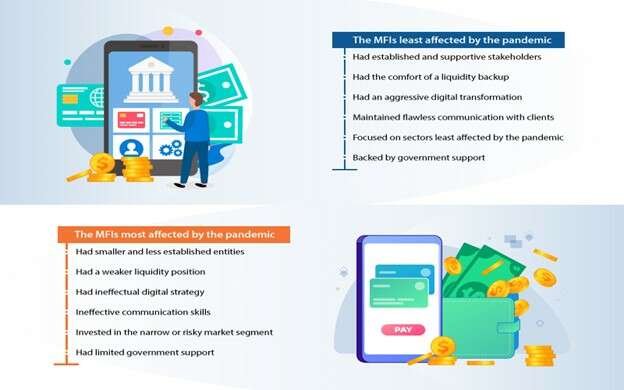
    Renowned development economist Jonathan Morduch said, “Microfinance stands as one of the most promising and cost-effective tools in the fight against global poverty.” While the pandemic did not differentiate between the rich and poor, the latter held onto hope for survival. And Microfinance Industry (MFI) continued to deliver its promise to serve, at first by taking calculated risks but later the industry’s adaptability to navigate the ‘Phygital’ (Physical + Digital) realm became the key to MFIs’ resilience. 

    Amidst the Pandemic, industries expedited their digital transformation game plan to adapt to the new virtual environment. And simple updates to the neglected/less preferred but existent digital payment platforms, in return transformed the credit delivery possibilities for MFIs. Digitization meant connectivity without physical presence. While like most industries, MFIs had to adapt to these new virtual end-to-end processes, the pace at which the MFIs dealt with the transformation and delivered promises in the pandemic became the deciding factor between winning and losing.

    How did the MFIs Survive?

    MFIs’ survival depended on applied measures by Internal Operations and preventative future planning. The smooth operational capabilities were contributed by the new ways of working completely focused on  

    • Implementation of a robust business continuity plan by tweaking existing processes which normalized operations in the chaos. 
    • Seamless virtual operational support kept on building a delivery process that has won the trust of the resources invested in the future of MFIs.
    • Mandated office safety procedures for a workforce that will eventually come back to the office while pushing the operational boundaries around the need-for-physical interactions. 
    • Revisiting Lending Process because of the unavoidable drop in the numbers of clients and constraints on the credit supply in the early days of the pandemic. Later both the numbers of clients and credit supply seem to be on a path of normalization.  The process around changes to the lending procedures and cash management system now seem aligned to the newfound courage to take risks again.
      • Online loan applications and loan approvals
      • Online customer boarding and document verification
      • Digital disbursements and collections via online platforms
      • Clients and repayments Monitoring using Skype, Zoom, WhatsApp, Viber, and similar platforms

    Who Supported MFIs?

    The pandemic’s onslaught also transformed the relationship between microfinance lenders, investors, government, and MFIs. Some of the ways this relationship redefined the survival of MFIs are as follows:

    Microfinance lenders, investors continued lending to MFIs and honoring prior lending agreements. These outstanding commitments to MFIs were respected with additional due diligence and scrutiny. The entities encouraged renegotiating repayment of the debt by MFIs and suspend late payment penalties while rescheduling the debts for later dates. The lenders and investors also provided technical assistance by helping design a plan of action for the customers for a better chance at repayment of loans to MFIs.

    Central banks and regulators issued temporary moratoria on loan repayment allowing the borrowers to suspend loan repayments for a certain period during the pandemic. The regulators also introduced the MFIs to new rules for risk management and loan risk classification treating the loans directly affected by the pandemic and not directly affected as separate categories. Regulators also discounted the rescheduled loans as part of their PAR calculation for the said time. Some of these loans rescheduled due to COVID were not recorded by the credit bureaus as impaired loans and helped customers maintain their credit scores.

    The Government allowed entrepreneurs to optionally defer their tax payments up to a year. The Government supported some employees who were made partial payments for salaries by employers. This may have the least effect on MFI’s clients but the smallest efforts matter to small businesses.

    How did MFIs deliver on their promises? 

    MFIs’ ways to minimize a negative impact of the pandemic helped the customers continue to believe in the MFIs and their efforts during the pandemic, which can be categorized into the well-structured plans under Debt Restructuring and Emergency Lending Debt rescheduling. 

    Loan rescheduling and the internal moratorium on loans:

    Some MFIs offered loan rescheduling to all clients while the majority took a case-by-case approach based on rescheduling requests.

    Introducing new options of emergency loans: 

    There was a limited amount of new lending at the start which expanded into an introduction of new emergency loan products to support their clients with liquidity during the crisis. It was done through channels such as: 

      • Loan officers who kept in touch with clients and offered support.
    • Some MFIs depended on client surveys to understand the ever-evolving challenges and find solutions for the same.
    • Support for clients and their businesses was an unheard tactic in MFIs. But the borrowers were provided support and training on transforming and maintaining the needs of businesses. 

    Yahoo finance quoted the numbers from projections by Reportlinker.com which said the global market reach for Microfinance will be US$394.8 Billion by the Year 2027. Over the period 2020-2027 and at a CAGR of 13.8%, the big numbers of the projected growth are a result of the substantial wealth distribution inequality behind the rise in the number of unbanked people”. Seems like the issue of financial inequality had to blow out of proportion for Microfinance to catch up to its expected outcome in this century.  The estimated value of the U.S. Microfinance market in 2020 was 26.95% share in the global market marked at US$43 Billion. China seems to follow suit with a CAGR of 18.1% through 2027, is projected to become an US$89.3 Billion industry by 2027. Markets of Japan, Canada, and Germany are supposed to grow at 9.7%, 12.1%, and 10.9% CAGR respectively over the 2020-2027 period. These numbers are changing the face of microfinance with one loan at a time. 

    The important factors in the process that differentiate MFIs from fintech, i.e., client communication and personal relationship – dealt a major blow during the pandemic. But armed with technology, the communication channels were redirected to build on the seemingly lost customer relationship. While non-payment and loyalty seemed like a definite doom for MFIs in 2020, the industry has turned everything in its favor with little effort, consideration, and inclusion.

    In the age of digitization and automation, Panamax offers an automated Microcredit solution to individuals or groups with little or no income, thereby driving financial inclusion. The microfinance management software equipped with APIs and development tools for deploying multiple value-added services promises adaptability, a cutting-edge high-quality architecture as well as a highly secured platform. The offering also supports the integration of third-party content while fine-tuning existing processes as required. 

    American industrialist Henry Ford aptly said, “A business that makes nothing, but money, is a poor business.” The Microfinance Industry seems to have managed and transformed finance for all during a pandemic with a touch of humility. 

    Author Bio:  

    Manoj Jain is the Chief Marketing Officer at Panamax Inc. He has a rich experience of over 20 years in marketing and strategic planning for Financial Technology, BSS/OSS, Big Data powered Analytics, Network Solutions, Digital Financial Solution and Value-added Services. Manoj has several accolades under his belt including Special Contribution Award at BSS summit and Ambassador Award at Ericsson. His forte lies in creation of brand awareness and visibility, digital marketing, SEO & SEM, media engagement and communications. He has worked with some of the best names in the industry including Ericsson, Bharti, Idea, and 6D Technologies. You can reach out to Manoj at manoj.jain@panamaxil.com 

    By Manoj Jain, Chief Marketing Officer at Panamax Inc

    Renowned development economist Jonathan Morduch said, “Microfinance stands as one of the most promising and cost-effective tools in the fight against global poverty.” While the pandemic did not differentiate between the rich and poor, the latter held onto hope for survival. And Microfinance Industry (MFI) continued to deliver its promise to serve, at first by taking calculated risks but later the industry’s adaptability to navigate the ‘Phygital’ (Physical + Digital) realm became the key to MFIs’ resilience. 

    Amidst the Pandemic, industries expedited their digital transformation game plan to adapt to the new virtual environment. And simple updates to the neglected/less preferred but existent digital payment platforms, in return transformed the credit delivery possibilities for MFIs. Digitization meant connectivity without physical presence. While like most industries, MFIs had to adapt to these new virtual end-to-end processes, the pace at which the MFIs dealt with the transformation and delivered promises in the pandemic became the deciding factor between winning and losing.

    How did the MFIs Survive?

    MFIs’ survival depended on applied measures by Internal Operations and preventative future planning. The smooth operational capabilities were contributed by the new ways of working completely focused on  

    • Implementation of a robust business continuity plan by tweaking existing processes which normalized operations in the chaos. 
    • Seamless virtual operational support kept on building a delivery process that has won the trust of the resources invested in the future of MFIs.
    • Mandated office safety procedures for a workforce that will eventually come back to the office while pushing the operational boundaries around the need-for-physical interactions. 
    • Revisiting Lending Process because of the unavoidable drop in the numbers of clients and constraints on the credit supply in the early days of the pandemic. Later both the numbers of clients and credit supply seem to be on a path of normalization.  The process around changes to the lending procedures and cash management system now seem aligned to the newfound courage to take risks again.
      • Online loan applications and loan approvals
      • Online customer boarding and document verification
      • Digital disbursements and collections via online platforms
      • Clients and repayments Monitoring using Skype, Zoom, WhatsApp, Viber, and similar platforms

    Who Supported MFIs?

    The pandemic’s onslaught also transformed the relationship between microfinance lenders, investors, government, and MFIs. Some of the ways this relationship redefined the survival of MFIs are as follows:

    Microfinance lenders, investors continued lending to MFIs and honoring prior lending agreements. These outstanding commitments to MFIs were respected with additional due diligence and scrutiny. The entities encouraged renegotiating repayment of the debt by MFIs and suspend late payment penalties while rescheduling the debts for later dates. The lenders and investors also provided technical assistance by helping design a plan of action for the customers for a better chance at repayment of loans to MFIs.

    Central banks and regulators issued temporary moratoria on loan repayment allowing the borrowers to suspend loan repayments for a certain period during the pandemic. The regulators also introduced the MFIs to new rules for risk management and loan risk classification treating the loans directly affected by the pandemic and not directly affected as separate categories. Regulators also discounted the rescheduled loans as part of their PAR calculation for the said time. Some of these loans rescheduled due to COVID were not recorded by the credit bureaus as impaired loans and helped customers maintain their credit scores.

    The Government allowed entrepreneurs to optionally defer their tax payments up to a year. The Government supported some employees who were made partial payments for salaries by employers. This may have the least effect on MFI’s clients but the smallest efforts matter to small businesses.

    How did MFIs deliver on their promises? 

    MFIs’ ways to minimize a negative impact of the pandemic helped the customers continue to believe in the MFIs and their efforts during the pandemic, which can be categorized into the well-structured plans under Debt Restructuring and Emergency Lending Debt rescheduling. 

    Loan rescheduling and the internal moratorium on loans:

    Some MFIs offered loan rescheduling to all clients while the majority took a case-by-case approach based on rescheduling requests.

    Introducing new options of emergency loans: 

    There was a limited amount of new lending at the start which expanded into an introduction of new emergency loan products to support their clients with liquidity during the crisis. It was done through channels such as: 

      • Loan officers who kept in touch with clients and offered support.
    • Some MFIs depended on client surveys to understand the ever-evolving challenges and find solutions for the same.
    • Support for clients and their businesses was an unheard tactic in MFIs. But the borrowers were provided support and training on transforming and maintaining the needs of businesses. 

    Yahoo finance quoted the numbers from projections by Reportlinker.com which said the global market reach for Microfinance will be US$394.8 Billion by the Year 2027. Over the period 2020-2027 and at a CAGR of 13.8%, the big numbers of the projected growth are a result of the substantial wealth distribution inequality behind the rise in the number of unbanked people”. Seems like the issue of financial inequality had to blow out of proportion for Microfinance to catch up to its expected outcome in this century.  The estimated value of the U.S. Microfinance market in 2020 was 26.95% share in the global market marked at US$43 Billion. China seems to follow suit with a CAGR of 18.1% through 2027, is projected to become an US$89.3 Billion industry by 2027. Markets of Japan, Canada, and Germany are supposed to grow at 9.7%, 12.1%, and 10.9% CAGR respectively over the 2020-2027 period. These numbers are changing the face of microfinance with one loan at a time. 

    The important factors in the process that differentiate MFIs from fintech, i.e., client communication and personal relationship – dealt a major blow during the pandemic. But armed with technology, the communication channels were redirected to build on the seemingly lost customer relationship. While non-payment and loyalty seemed like a definite doom for MFIs in 2020, the industry has turned everything in its favor with little effort, consideration, and inclusion.

    In the age of digitization and automation, Panamax offers an automated Microcredit solution to individuals or groups with little or no income, thereby driving financial inclusion. The microfinance management software equipped with APIs and development tools for deploying multiple value-added services promises adaptability, a cutting-edge high-quality architecture as well as a highly secured platform. The offering also supports the integration of third-party content while fine-tuning existing processes as required. 

    American industrialist Henry Ford aptly said, “A business that makes nothing, but money, is a poor business.” The Microfinance Industry seems to have managed and transformed finance for all during a pandemic with a touch of humility. 

    Author Bio:  

    Manoj Jain is the Chief Marketing Officer at Panamax Inc. He has a rich experience of over 20 years in marketing and strategic planning for Financial Technology, BSS/OSS, Big Data powered Analytics, Network Solutions, Digital Financial Solution and Value-added Services. Manoj has several accolades under his belt including Special Contribution Award at BSS summit and Ambassador Award at Ericsson. His forte lies in creation of brand awareness and visibility, digital marketing, SEO & SEM, media engagement and communications. He has worked with some of the best names in the industry including Ericsson, Bharti, Idea, and 6D Technologies. You can reach out to Manoj at manoj.jain@panamaxil.com 

    Related Posts
    Trading Day: Three cheers for 'whacky' inflation
    Trading Day: Three cheers for 'whacky' inflation
    UK car production steadies as JLR recovers and Nissan launches EV production
    UK car production steadies as JLR recovers and Nissan launches EV production
    New Zealand's business confidence hits highest level in 30 years, ANZ survey shows
    New Zealand's business confidence hits highest level in 30 years, ANZ survey shows
    Nike fails to contain margin bleed amid tariffs, turnaround, as shares fall
    Nike fails to contain margin bleed amid tariffs, turnaround, as shares fall
    Fragile yen on tenterhooks ahead of BOJ
    Fragile yen on tenterhooks ahead of BOJ
    Irish central bank raises growth forecasts, says economy resisting US headwinds
    Irish central bank raises growth forecasts, says economy resisting US headwinds
    Kering to buy jewellry producer Raselli Franco
    Kering to buy jewellry producer Raselli Franco
    New Zealand consumer confidence hits highest level in four years
    New Zealand consumer confidence hits highest level in four years
    Italy's Nexi rejects TPG offer for digital banking assets
    Italy's Nexi rejects TPG offer for digital banking assets
    Exclusive-Starbucks supplier Cuisine Solutions hires Morgan Stanley and Rothschild for potential sale, sources say
    Exclusive-Starbucks supplier Cuisine Solutions hires Morgan Stanley and Rothschild for potential sale, sources say
    New EU draft text on Russian assets offers uncapped guarantees for Belgium
    New EU draft text on Russian assets offers uncapped guarantees for Belgium
    Hogan Lovells and Cadwalader plan merger to create law firm with $3.6 billion in revenue
    Hogan Lovells and Cadwalader plan merger to create law firm with $3.6 billion in revenue

    Why waste money on news and opinions when you can access them for free?

    Take advantage of our newsletter subscription and stay informed on the go!

    Subscribe

    More from Finance

    Explore more articles in the Finance category

    Pirelli says 99.3% of 500 million euro bond converted, diluting Sinochem and Camfin stakes

    Pirelli says 99.3% of 500 million euro bond converted, diluting Sinochem and Camfin stakes

    ECB policymakers see steady rates next year but cut not off table, sources say

    ECB policymakers see steady rates next year but cut not off table, sources say

    Britain names Christian Turner as ambassador to the US

    Britain names Christian Turner as ambassador to the US

    Trump administration imposes sanctions on two more ICC judges

    Trump administration imposes sanctions on two more ICC judges

    Norway reaches 2026 fisheries agreement with Russia, cod quota at lowest level since 1991

    Norway reaches 2026 fisheries agreement with Russia, cod quota at lowest level since 1991

    Ukraine-US fund approves investment policies as it eyes first projects in 2026

    Ukraine-US fund approves investment policies as it eyes first projects in 2026

    VW management to continue cost cutting

    VW management to continue cost cutting

    Parliament of Swiss canton Fribourg votes to ban mobile phones at school

    Parliament of Swiss canton Fribourg votes to ban mobile phones at school

    Italy economy minister denies interfering in MPS's bid for Mediobanca

    Italy economy minister denies interfering in MPS's bid for Mediobanca

    Eni and BlackRock's GIP take joint control of carbon capture unit

    Eni and BlackRock's GIP take joint control of carbon capture unit

    Bank of England's Bailey sees inflation near 2% target by May

    Bank of England's Bailey sees inflation near 2% target by May

    Italian judge drops Genoa dam case against Webuild CEO

    Italian judge drops Genoa dam case against Webuild CEO

    View All Finance Posts
    Previous Finance PostAre QR codes the next generation of contactless payments?
    Next Finance PostCanada’s Trudeau says cabinet coming next month; finance minister to stay