Search
00
GBAF Logo
trophy
Top StoriesInterviewsBusinessFinanceBankingTechnologyInvestingTradingVideosAwardsMagazinesHeadlinesTrends

Subscribe to our newsletter

Get the latest news and updates from our team.

Global Banking & Finance Review®

Global Banking & Finance Review® - Subscribe to our newsletter

Company

    GBAF Logo
    • About Us
    • Profile
    • Privacy & Cookie Policy
    • Terms of Use
    • Contact Us
    • Advertising
    • Submit Post
    • Latest News
    • Research Reports
    • Press Release
    • Awards▾
      • About the Awards
      • Awards TimeTable
      • Submit Nominations
      • Testimonials
      • Media Room
      • Award Winners
      • FAQ
    • Magazines▾
      • Global Banking & Finance Review Magazine Issue 79
      • Global Banking & Finance Review Magazine Issue 78
      • Global Banking & Finance Review Magazine Issue 77
      • Global Banking & Finance Review Magazine Issue 76
      • Global Banking & Finance Review Magazine Issue 75
      • Global Banking & Finance Review Magazine Issue 73
      • Global Banking & Finance Review Magazine Issue 71
      • Global Banking & Finance Review Magazine Issue 70
      • Global Banking & Finance Review Magazine Issue 69
      • Global Banking & Finance Review Magazine Issue 66
    Top StoriesInterviewsBusinessFinanceBankingTechnologyInvestingTradingVideosAwardsMagazinesHeadlinesTrends

    Global Banking & Finance Review® is a leading financial portal and online magazine offering News, Analysis, Opinion, Reviews, Interviews & Videos from the world of Banking, Finance, Business, Trading, Technology, Investing, Brokerage, Foreign Exchange, Tax & Legal, Islamic Finance, Asset & Wealth Management.
    Copyright © 2010-2026 GBAF Publications Ltd - All Rights Reserved. | Sitemap | Tags | Developed By eCorpIT

    Editorial & Advertiser disclosure

    Global Banking & Finance Review® is an online platform offering news, analysis, and opinion on the latest trends, developments, and innovations in the banking and finance industry worldwide. The platform covers a diverse range of topics, including banking, insurance, investment, wealth management, fintech, and regulatory issues. The website publishes news, press releases, opinion and advertorials on various financial organizations, products and services which are commissioned from various Companies, Organizations, PR agencies, Bloggers etc. These commissioned articles are commercial in nature. This is not to be considered as financial advice and should be considered only for information purposes. It does not reflect the views or opinion of our website and is not to be considered an endorsement or a recommendation. We cannot guarantee the accuracy or applicability of any information provided with respect to your individual or personal circumstances. Please seek Professional advice from a qualified professional before making any financial decisions. We link to various third-party websites, affiliate sales networks, and to our advertising partners websites. When you view or click on certain links available on our articles, our partners may compensate us for displaying the content to you or make a purchase or fill a form. This will not incur any additional charges to you. To make things simpler for you to identity or distinguish advertised or sponsored articles or links, you may consider all articles or links hosted on our site as a commercial article placement. We will not be responsible for any loss you may suffer as a result of any omission or inaccuracy on the website.

    Home > Finance > Canadians Grapple with the Financial Impact of Inflation
    Finance

    Canadians Grapple with the Financial Impact of Inflation

    Published by Jessica Weisman-Pitts

    Posted on January 16, 2024

    5 min read

    Last updated: January 31, 2026

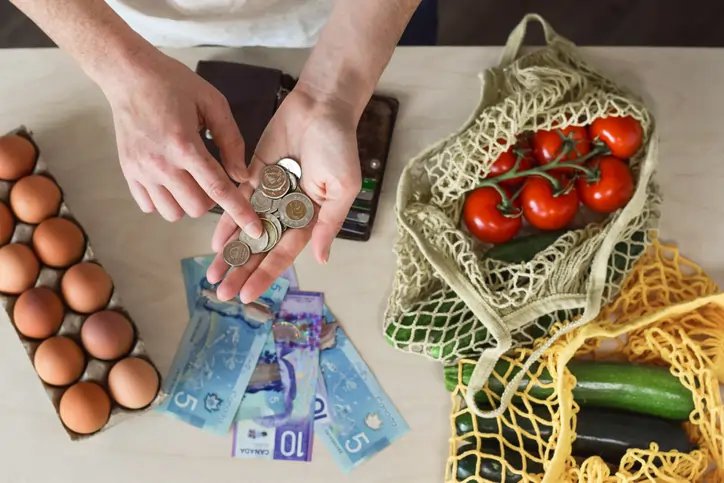
    An image depicting Canadians dealing with financial stress as inflation rises. This visual reflects the challenges discussed in the article about the ongoing cost-of-living crisis and its impact on families and budgets.
    Canadians facing financial challenges due to inflation and rising costs - Global Banking & Finance Review
    Why waste money on news and opinion when you can access them for free?

    Take advantage of our newsletter subscription and stay informed on the go!

    Subscribe

    Tags:Surveyfinancial managementconsumer perceptionsavings

    Quick Summary

    While inflation has slowed since its peak during the pandemic, economists expect cost-of-living hikes to continue in 2024. These predictions spell bad news for Canadians, many of whom are already feeling the crunch.

    Table of Contents

    • Inflation to Remain Elevated in 2024, Especially on Food
    • Canadians Are Draining Savings to Handle the Cost of Living
    • Rebuilding Your Finances During Tough Economic Times
    • 1. Reduce Your Frills
    • 2. Know Your Emergency Response Plan
    • 3. Talk to Your Creditors
    • 4. Increase Your Income

    Canadians Grapple with the Financial Impact of Inflation

    While inflation has slowed since its peak during the pandemic, economists expect cost-of-living hikes to continue in 2024. These predictions spell bad news for Canadians, many of whom are already feeling the crunch.

    According to a 2023 Angus Reid Institute survey, most of the country had to pivot last year when faced with the rising costs of everything, from groceries to gas and gadgets. Two-thirds (67%) of respondents admitted they slashed their discretionary budgets last year. Another 43% delayed a major purchase, like a house or a car.

    With no stop to the cost-of-living crisis on the horizon, Canadians may have to maintain these cost-saving measures for a while yet.

    Inflation to Remain Elevated in 2024, Especially on Food

    Economic forecasts delivered by the annual food report predict inflation will increase between 2.5 and 4.5% in 2024, signalling another costly year for Canadians at the grocery stores.

    These increases will be harder to handle for some. The Angus Reid survey found that more than one-third (34%) of Canadian adults described their financial situation as “bad” or “terrible” in 2023. Amongst those who admitted they were in “terrible shape,” a whopping 94% found it challenging to put food on the table.

    Canadians Are Draining Savings to Handle the Cost of Living

    Angus Ried found that budgeting did not provide enough relief from persistent cost-of-living hikes. Two-fifths (40%) of Canadians withdrew money from savings accounts to balance their budget, while 35% deferred at least one contribution to their RRSP or TFSA.

    Unfortunately, a growing number of people can’t rely on these savings. According to the Chartered Professional Accountants of Canada (CPA Canada), half of the country doesn’t have $2,500 set aside in savings. Meanwhile, 26% can’t come up with $500 in an emergency.

    Without savings, Canadians had to look elsewhere for relief:

    • 13% borrowed from friends or family.
    • 11% sold their belongings to earn extra money.
    • 8% took out a personal loan to handle their bills.

    Rebuilding Your Finances During Tough Economic Times

    Borrowing money isn’t sustainable against the ongoing cost-of-living crisis, nor is withdrawing from or suspending your savings. These momentary stopgaps are best used in singular, unexpected situations that won’t persist.

    For long-term everyday bills, you need to invest in a better budget that prioritizes smart spending. Here’s how:

    1. Reduce Your Frills

    Tracking your spending is the first step to recovery, as this may reveal surprising ways your money disappears in a month. Once you have a good grasp on your expenses, you can identify spending that steals money away from your financial priorities, like housing, food, and healthcare.

    During tough financial times, you should be wary of any non-priority expense in your budget. Every dollar spent on entertainment or home improvement leaves you with less cash to cover your bills.

    How closely you follow this step depends on your unique situation. While most people won’t have to eliminate every discretionary expense in their budget to make ends meet, some sacrifice may be inevitable. You should cut back on non-essentials until you can restart your usual savings contributions.

    2. Know Your Emergency Response Plan

    Ideally, you can create a detailed budget that accounts for every future expense. But sometimes, something unexpected can disrupt even the best-laid plans. Your car can break down, your dog can get sick, or you can need emergency dental surgery out of the blue.

    If you don’t have sufficient savings like most Canadians, a line of credit may provide an additional safety net during these difficult times. You can find out more about this financial product by visiting a website like Fora.

    In a nutshell, you can draw against your limit in place of savings during an emergency if approved for a Fora Credit line of credit. An approved line of credit works quickly and conveniently, and you won’t pay any hidden fees to use it.

    3. Talk to Your Creditors

    A line of credit can create a safety net in a one-off emergency, but it’s less helpful when you consistently cannot pay your regular bills. Think of it as a kind of cash advance that you’re expected to pay back. If you don’t have the cash to cover your bills every month, you won’t have the money to handle your line of credit either. Relying on your line of credit anyways can kickstart a nasty cycle of debt.

    If you can’t handle your typical bills, reach out to your creditors to see if they can provide assistance. Many companies have compassionate financing plans to help low-income individuals who struggle to make ends meet.

    4. Increase Your Income

    According to Angus Reid, age and income play an important role in how well you can rebound from inflation. Younger Canadians and those who earn less than $50,000 a year are in worse financial shape than older, better-paid Canadians.

    If you can’t balance your budget, no matter how many discretionary expenses you eliminate, you need to look at the other factor of your cash flow: income. Consider what you must do in the new year to increase your salary.

    In 2024, you might want to explore the following options:

    • Add a side gig or part-time job to supplement your salary.
    • Ask for a raise with your current employers after honing your negotiation skills.
    • Apply for a high-paying job in your field.
    • Switch careers by upgrading your skills or going back to school when appropriate.

    A new career can be a daunting goal, but it may be the only way you can weather ongoing inflation. Consider it a long-term target while focusing on changes you can make immediately, like a slimmed-down budget and a side gig to earn extra money. This two-pronged approach to your finances yields the best results.

    Frequently Asked Questions about Canadians Grapple with the Financial Impact of Inflation

    1What is inflation?

    Inflation is the rate at which the general level of prices for goods and services rises, eroding purchasing power. It is typically measured annually.

    2What is discretionary spending?

    Discretionary spending refers to non-essential expenses that individuals can choose to spend or not spend, such as entertainment and luxury items.

    3What is an emergency fund?

    An emergency fund is a savings account set aside for unexpected expenses or financial emergencies, providing a financial safety net.

    4What is a budget?

    A budget is a financial plan that outlines expected income and expenses over a specific period, helping individuals manage their finances.

    5What is a major purchase?

    A major purchase is a significant expense, such as buying a home or a car, which typically requires careful financial planning.

    More from Finance

    Explore more articles in the Finance category

    Image for Rugby-Ford shines as England overwhelm dismal Wales
    Rugby-Ford shines as England overwhelm dismal Wales
    Image for Greenland foreign minister says US talks are positive but the outcome remains uncertain
    Greenland foreign minister says US talks are positive but the outcome remains uncertain
    Image for Hungary's opposition Tisza promises wealth tax, euro adoption in election programme
    Hungary's opposition Tisza promises wealth tax, euro adoption in election programme
    Image for Farmers report 'catastrophic damage to crops as Storm Marta hits Spain and Portugal
    Farmers report 'catastrophic damage to crops as Storm Marta hits Spain and Portugal
    Image for If US attacks, Iran says it will strike US bases in the region
    If US attacks, Iran says it will strike US bases in the region
    Image for Olympics-Biathlon-Winter Games bring tourism boost to biathlon hotbed of northern Italy
    Olympics-Biathlon-Winter Games bring tourism boost to biathlon hotbed of northern Italy
    Image for Analysis-Bitcoin loses Trump-era gains as crypto market volatility signals uncertainty
    Analysis-Bitcoin loses Trump-era gains as crypto market volatility signals uncertainty
    Image for NatWest closes in on $3.4 billion takeover of wealth manager Evelyn, Sky News reports
    NatWest closes in on $3.4 billion takeover of wealth manager Evelyn, Sky News reports
    Image for Stellantis-backed ACC drops plans for Italian, German gigafactories, union says
    Stellantis-backed ACC drops plans for Italian, German gigafactories, union says
    Image for US pushes Russia and Ukraine to end war by summer, Zelenskiy says
    US pushes Russia and Ukraine to end war by summer, Zelenskiy says
    Image for Russia launches massive attack on Ukraine's energy system, Zelenskiy says
    Russia launches massive attack on Ukraine's energy system, Zelenskiy says
    Image for Russia launched 400 drones, 40 missiles to hit Ukraine's energy sector, Zelenskiy says
    Russia launched 400 drones, 40 missiles to hit Ukraine's energy sector, Zelenskiy says
    View All Finance Posts
    Previous Finance PostSui Tops $300M in TVL, Passes Bitcoin and Joins Upper Echelon of DeFi Protocols
    Next Finance PostDollarino (DOLS) – The First Anti ETF Crypto Coin Is On The Market