Search
00
GBAF Logo
trophy
Top StoriesInterviewsBusinessFinanceBankingTechnologyInvestingTradingVideosAwardsMagazinesHeadlinesTrends

Subscribe to our newsletter

Get the latest news and updates from our team.

Global Banking & Finance Review®

Global Banking & Finance Review® - Subscribe to our newsletter

Company

    GBAF Logo
    • About Us
    • Profile
    • Privacy & Cookie Policy
    • Terms of Use
    • Contact Us
    • Advertising
    • Submit Post
    • Latest News
    • Research Reports
    • Press Release
    • Awards▾
      • About the Awards
      • Awards TimeTable
      • Submit Nominations
      • Testimonials
      • Media Room
      • Award Winners
      • FAQ
    • Magazines▾
      • Global Banking & Finance Review Magazine Issue 79
      • Global Banking & Finance Review Magazine Issue 78
      • Global Banking & Finance Review Magazine Issue 77
      • Global Banking & Finance Review Magazine Issue 76
      • Global Banking & Finance Review Magazine Issue 75
      • Global Banking & Finance Review Magazine Issue 73
      • Global Banking & Finance Review Magazine Issue 71
      • Global Banking & Finance Review Magazine Issue 70
      • Global Banking & Finance Review Magazine Issue 69
      • Global Banking & Finance Review Magazine Issue 66
    Top StoriesInterviewsBusinessFinanceBankingTechnologyInvestingTradingVideosAwardsMagazinesHeadlinesTrends

    Global Banking & Finance Review® is a leading financial portal and online magazine offering News, Analysis, Opinion, Reviews, Interviews & Videos from the world of Banking, Finance, Business, Trading, Technology, Investing, Brokerage, Foreign Exchange, Tax & Legal, Islamic Finance, Asset & Wealth Management.
    Copyright © 2010-2026 GBAF Publications Ltd - All Rights Reserved. | Sitemap | Tags | Developed By eCorpIT

    Editorial & Advertiser disclosure

    Global Banking & Finance Review® is an online platform offering news, analysis, and opinion on the latest trends, developments, and innovations in the banking and finance industry worldwide. The platform covers a diverse range of topics, including banking, insurance, investment, wealth management, fintech, and regulatory issues. The website publishes news, press releases, opinion and advertorials on various financial organizations, products and services which are commissioned from various Companies, Organizations, PR agencies, Bloggers etc. These commissioned articles are commercial in nature. This is not to be considered as financial advice and should be considered only for information purposes. It does not reflect the views or opinion of our website and is not to be considered an endorsement or a recommendation. We cannot guarantee the accuracy or applicability of any information provided with respect to your individual or personal circumstances. Please seek Professional advice from a qualified professional before making any financial decisions. We link to various third-party websites, affiliate sales networks, and to our advertising partners websites. When you view or click on certain links available on our articles, our partners may compensate us for displaying the content to you or make a purchase or fill a form. This will not incur any additional charges to you. To make things simpler for you to identity or distinguish advertised or sponsored articles or links, you may consider all articles or links hosted on our site as a commercial article placement. We will not be responsible for any loss you may suffer as a result of any omission or inaccuracy on the website.

    Home > Top Stories > Back to the land: Lebanese family turns to farming to survive crises
    Top Stories

    Back to the land: Lebanese family turns to farming to survive crises

    Published by Jessica Weisman-Pitts

    Posted on June 13, 2022

    4 min read

    Last updated: February 6, 2026

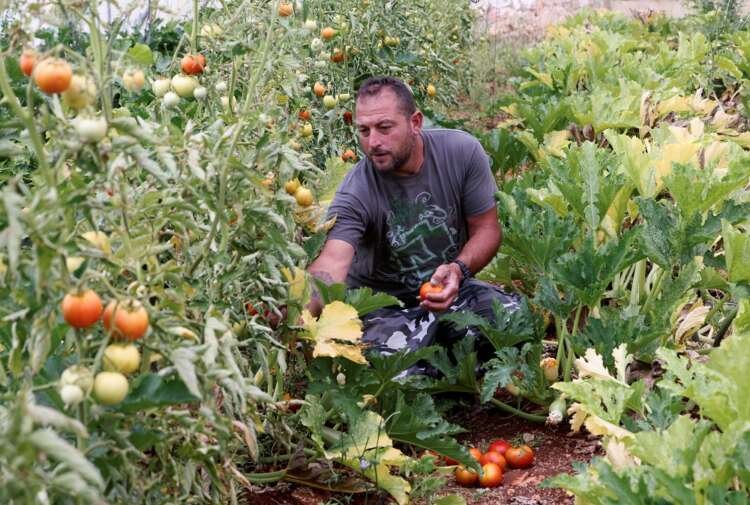
    Qassem Shreim inspects ripe tomatoes in his greenhouse, highlighting a Lebanese family's shift to farming for self-sufficiency during economic turmoil. This image reflects their resilience and adaptation in challenging times.
    Qassem Shreim examining his greenhouse tomatoes, showcasing Lebanese farming amidst economic crisis - Global Banking & Finance Review
    Why waste money on news and opinion when you can access them for free?

    Take advantage of our newsletter subscription and stay informed on the go!

    Subscribe

    Tags:sustainabilityagricultural sectorsfinancial crisiseconomic growthlocal communities

    By Maya Gebeily and Aziz Taher

    HOULA, Lebanon (Reuters) – In a remote village in southern Lebanon, Qassem Shreim crouched low to examine his wheat crop. Food costs have soared amid a global wheat crisis and Lebanon’s own economic meltdown, but the builder-turned-farmer feels shielded by his self-sufficiency.

    Like many families in crisis-plagued Lebanon, Shreim turned to farming after the local pound began to slip in 2019, making his construction work scarce and his grocery runs ever more costly.

    “We couldn’t work, so what did we do? We turned to agriculture,” the 42-year-old told Reuters in his home village of Houla, near the border with Israel.

    Food prices have jumped 11-fold since Lebanon’s crisis began, the World Food Programme says. Lebanese authorities have incrementally increased an official price cap on loaves of the staple pita bread and fears of a wheat shortage have grown since Russia’s invasion of Ukraine derailed grain shipments.

    That crisis feels worlds away in Shreim’s humble home, where slices of melon picked from their garden glisten in the afternoon sun and the kitchen is stocked with flatbread baked by his wife, Khadija, using wheat from their land.

    Their front patio and hallway have been turned into a makeshift shop, where wooden stalls made by Khadija bear fat watermelons and jars of freshly-pressed grapeleaves.

    “Self-suffiency starts at home. I used to buy everything from the shops. Today all the vegetables I need are available here,” said Shreim.

    NO GOING BACK

    Over the last three years, his family has planted everything from wheat and lentils to tiny eggplants and curled green chili peppers.

    The plots are at a lower altitude, where water is more plentiful, and regularly rotated to replenish nutrients in the soil while maximizing the number of harvests.

    But Shreim wasn’t born with green fingers: he learned how to set up greenhouses by watching YouTube videos and has gathered tips and tricks from other farmers.

    Khadija, 39, has also relied on technology to run the shop.

    She sends daily grocery prices every morning to the women of al-Houla through a WhatsApp messenger group by 9 am, and they message back with their requests.

    “They call me the mayor of the village here, I know everyone,” said Khadija.

    For her, sustainability goes beyond farming. She encourages customers to come with their own fabric bags to minimize use of plastic bags and researches preserving techniques on YouTube.

    “As the crisis worsens, I invent new things. For example, I turned what I had remaining from the small eggplants into jam. You wouldn’t believe it – people would tell me ‘what do you mean by eggplant jam?’ I couldn’t keep up with orders,” she said.

    Still, Shreim’s operation is not entirely untouched by Lebanon’s crisis.

    Their home gets one hour of state-provided electricity every day and another four hours from a private generator, which limits how much water they can pump into their gardens.

    Rains were plentiful last winter but Shreim fears a drier winter this time around could wreak havoc on next year’s crops.

    They have cut back on vitamins and some pesticides for cost reasons. Before the crisis, farmers often trucked their produce to Beirut, where they could sell at higher prices.

    “Today, it’s different – if I want to take products down to Beirut’s wholesale market for fruits and vegetables, and assuming the car doesn’t break down, the cost of fuel would be what I earn in an entire season,” Shreim said.

    The tractor he uses to plough his fields runs on diesel and he counts “every second” that he runs it.

    But Shreim shrugged off such worries.

    “I won’t go back to my old job… I want to continue. Farming has a future,” he said.

    (Additional reporting by Maya Saad; Editing by Gareth Jones)

    Frequently Asked Questions about Back to the land: Lebanese family turns to farming to survive crises

    1What is self-sufficiency?

    Self-sufficiency refers to the ability of individuals or communities to meet their own needs without relying on external assistance, particularly in food production.

    2What is economic crisis?

    An economic crisis is a situation in which the economy of a country experiences a sudden downturn, often characterized by high unemployment, inflation, and a decline in consumer confidence.

    3What are agricultural sectors?

    Agricultural sectors encompass all activities related to the production, processing, and distribution of food and other agricultural products.

    More from Top Stories

    Explore more articles in the Top Stories category

    Image for Lessons From the Ring and the Deal Table: How Boxing Shapes Steven Nigro’s Approach to Banking and Life
    Lessons From the Ring and the Deal Table: How Boxing Shapes Steven Nigro’s Approach to Banking and Life
    Image for Joe Kiani in 2025: Capital, Conviction, and a Focused Return to Innovation
    Joe Kiani in 2025: Capital, Conviction, and a Focused Return to Innovation
    Image for Marco Robinson – CLOSE THE DEAL AND SUDDENLY GROW RICH
    Marco Robinson – CLOSE THE DEAL AND SUDDENLY GROW RICH
    Image for Digital Tracing: Turning a regulatory obligation into a commercial advantage
    Digital Tracing: Turning a regulatory obligation into a commercial advantage
    Image for Exploring the Role of Blockchain and the Bitcoin Price Today in Education
    Exploring the Role of Blockchain and the Bitcoin Price Today in Education
    Image for Inside the World’s First Collection Industry Conglomerate: PCA Global’s Platform Strategy
    Inside the World’s First Collection Industry Conglomerate: PCA Global’s Platform Strategy
    Image for Chase Buchanan Private Wealth Management Highlights Key Autumn 2025 Budget Takeaways for Expats
    Chase Buchanan Private Wealth Management Highlights Key Autumn 2025 Budget Takeaways for Expats
    Image for PayLaju Strengthens Its Position as Malaysia’s Trusted Interest-Free Sharia-Compliant Loan Provider
    PayLaju Strengthens Its Position as Malaysia’s Trusted Interest-Free Sharia-Compliant Loan Provider
    Image for A Notable Update for Employee Health Benefits:
    A Notable Update for Employee Health Benefits:
    Image for Creating Equity Between Walls: How Mohak Chauhan is Using Engineering, Finance, and Community Vision to Reengineer Affordable Housing
    Creating Equity Between Walls: How Mohak Chauhan is Using Engineering, Finance, and Community Vision to Reengineer Affordable Housing
    Image for Upcoming Book on Real Estate Investing: Harvard Grace Capital Founder Stewart Heath’s Puts Lessons in Print
    Upcoming Book on Real Estate Investing: Harvard Grace Capital Founder Stewart Heath’s Puts Lessons in Print
    Image for ELECTIVA MARKS A LANDMARK FIRST YEAR WITH MAJOR SENIOR APPOINTMENTS AND EXPANSION MILESTONES
    ELECTIVA MARKS A LANDMARK FIRST YEAR WITH MAJOR SENIOR APPOINTMENTS AND EXPANSION MILESTONES
    View All Top Stories Posts
    Previous Top Stories PostTrump advisers say they told him election fraud claims were illegitimate
    Next Top Stories PostBritain to defy EU with ‘relatively trivial’ N.Ireland law