
Top Stories
Auto Lobby Urges Spain’s Next Government to Commit to Decarbonisation
Published by Uma Rajagopal
Posted on July 14, 2023
2 min readLast updated: February 1, 2026
Add as preferred source on Google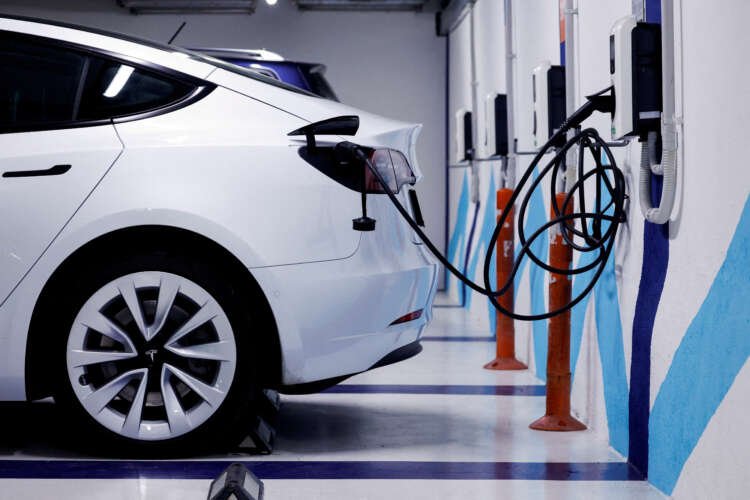
Published by Uma Rajagopal
Posted on July 14, 2023
2 min readLast updated: February 1, 2026
Add as preferred source on Google((This July 12 story has been corrected to clarify that the forecast is for all
((This July 12 story has been corrected to clarify that the forecast is for all car sales in Spain, not just EV sales, in paragraph 8))
(Reuters) – Spanish auto lobby ANFAC on Wednesday called on the government that will emerge from the July 23 general election to commit to decarbonisation fully, saying electric vehicle (EV) sales had yet to reach the number needed to meet emission targets.
“The industry needs (the new government’s) full support and commitment … to speed up decarbonisation under a mobility model where the clean, connected and sustainable vehicle is considered one more solution to move towards zero-emission mobility,” Jose Lopez-Tafall, the group’s director-general, said.
Spain fell short of the electrification levels required to meet last year’s annual emission reduction targets, estimated by ANFAC at 120,000 new EV sales and 45,000 new charging points, he said. Instead, 78,000 EVs were sold and 18,000 charging points installed.
“2022 has been one of the worst years in the sector’s recent history,” he said, as Spanish car manufacturers’ net profit last year dropped by about one third from 2021 to 767 million euros ($845 million).
Last year’s semiconductor shortages and higher energy costs disrupted automakers’ production plans and delayed the market’s recovery from the pandemic’s impact.
Lopez-Tafall said 2023 was crucial to boosting EV sales and turning Spain into an electromobility hub.
“We will never give up on Spain being the second largest car producer in Europe and fulfilling its environmental commitments,” he added.
However, the lobbying group expects full-year car sales in 2023 to reach 950,000, far from the national market target of 1.3 million.
($1 = 0.9079 euros)
(Reporting by Matteo Allievi; Editing by David Latona and Barbara Lewis)
Decarbonisation refers to the process of reducing carbon emissions associated with energy and transportation systems, aiming to mitigate climate change and promote sustainable practices.
Electric vehicles (EVs) are automobiles that are powered by electric motors instead of internal combustion engines, using electricity stored in batteries to operate.
Charging points are designated locations where electric vehicles can recharge their batteries, essential for supporting the use and growth of EVs.
The automotive industry encompasses all companies and activities involved in the design, development, manufacturing, marketing, and selling of motor vehicles.
Explore more articles in the Top Stories category











