Search
00
GBAF Logo
trophy
Top StoriesInterviewsBusinessFinanceBankingTechnologyInvestingTradingVideosAwardsMagazinesHeadlinesTrends

Subscribe to our newsletter

Get the latest news and updates from our team.

Global Banking & Finance Review®

Global Banking & Finance Review® - Subscribe to our newsletter

Company

    GBAF Logo
    • About Us
    • Profile
    • Privacy & Cookie Policy
    • Terms of Use
    • Contact Us
    • Advertising
    • Submit Post
    • Latest News
    • Research Reports
    • Press Release
    • Awards▾
      • About the Awards
      • Awards TimeTable
      • Submit Nominations
      • Testimonials
      • Media Room
      • Award Winners
      • FAQ
    • Magazines▾
      • Global Banking & Finance Review Magazine Issue 79
      • Global Banking & Finance Review Magazine Issue 78
      • Global Banking & Finance Review Magazine Issue 77
      • Global Banking & Finance Review Magazine Issue 76
      • Global Banking & Finance Review Magazine Issue 75
      • Global Banking & Finance Review Magazine Issue 73
      • Global Banking & Finance Review Magazine Issue 71
      • Global Banking & Finance Review Magazine Issue 70
      • Global Banking & Finance Review Magazine Issue 69
      • Global Banking & Finance Review Magazine Issue 66
    Top StoriesInterviewsBusinessFinanceBankingTechnologyInvestingTradingVideosAwardsMagazinesHeadlinesTrends

    Global Banking & Finance Review® is a leading financial portal and online magazine offering News, Analysis, Opinion, Reviews, Interviews & Videos from the world of Banking, Finance, Business, Trading, Technology, Investing, Brokerage, Foreign Exchange, Tax & Legal, Islamic Finance, Asset & Wealth Management.
    Copyright © 2010-2026 GBAF Publications Ltd - All Rights Reserved. | Sitemap | Tags | Developed By eCorpIT

    Editorial & Advertiser disclosure

    Global Banking & Finance Review® is an online platform offering news, analysis, and opinion on the latest trends, developments, and innovations in the banking and finance industry worldwide. The platform covers a diverse range of topics, including banking, insurance, investment, wealth management, fintech, and regulatory issues. The website publishes news, press releases, opinion and advertorials on various financial organizations, products and services which are commissioned from various Companies, Organizations, PR agencies, Bloggers etc. These commissioned articles are commercial in nature. This is not to be considered as financial advice and should be considered only for information purposes. It does not reflect the views or opinion of our website and is not to be considered an endorsement or a recommendation. We cannot guarantee the accuracy or applicability of any information provided with respect to your individual or personal circumstances. Please seek Professional advice from a qualified professional before making any financial decisions. We link to various third-party websites, affiliate sales networks, and to our advertising partners websites. When you view or click on certain links available on our articles, our partners may compensate us for displaying the content to you or make a purchase or fill a form. This will not incur any additional charges to you. To make things simpler for you to identity or distinguish advertised or sponsored articles or links, you may consider all articles or links hosted on our site as a commercial article placement. We will not be responsible for any loss you may suffer as a result of any omission or inaccuracy on the website.

    Home > Top Stories > Australia’s push for faster EV uptake will be slow to charge
    Top Stories

    Australia’s push for faster EV uptake will be slow to charge

    Published by Uma Rajagopal

    Posted on May 18, 2023

    5 min read

    Last updated: February 1, 2026

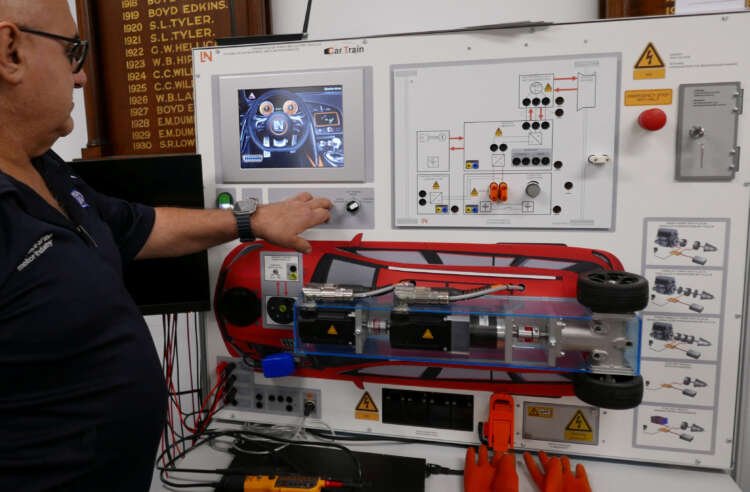
    Anthony Tomassetti from the Motor Trade Association NSW examines an electric vehicle model in Sydney, emphasizing the need for upskilling mechanics amidst Australia's push for faster EV adoption and infrastructure development.
    Electric vehicle model showcased in Sydney to promote EV skills training - Global Banking & Finance Review
    Why waste money on news and opinion when you can access them for free?

    Take advantage of our newsletter subscription and stay informed on the go!

    Subscribe

    Tags:sustainabilityGovernment fundingpublic policyinfrastructure financing

    Quick Summary

    (This May 17 story has been corrected to say the rollout of chargers started small due to grid issues, not scaled back due to grid issues, and changes month to October, not November, in paragraph 18)

    Australia’s push for faster EV uptake will be slow to charge

    (This May 17 story has been corrected to say the rollout of chargers started small due to grid issues, not scaled back due to grid issues, and changes month to October, not November, in paragraph 18)

    By Lewis Jackson

    SYDNEY (Reuters) – Australians are starting to buy electric vehicles in large numbers, and the government is trying to accelerate the adoption of cleaner cars, but industry executives say installing chargers rapidly enough to meet the boom will not be easy.

    Environmentally conscious Australians keen for electric vehicles got a boost last month when the government announced plans to set vehicle emissions standards in the last developed country bar Russia without them, to help fix a shortage of EVs.

    But public charging infrastructure remains sparse and under-powered by global standards, according to International Energy Agency data, a potential deterrent for mass EV takeup in a vast country where chargers remain scarce outside cities.

    Australia has less than a third the number of public chargers for every EV on the road compared with the global average, despite being home to one of the world’s most successful charger manufacturers, Tritium DCFC.

    Challenges obtaining equipment, delays plugging public chargers into the grid and shaky economics mean a mass build-out cannot be done overnight, industry executives said.

    “All of that takes a long time, so you won’t physically see chargers popping up everywhere over the next year,” said Carly Irving-Dolan, chief executive of NRMA Energy and Infrastructure.

    NRMA, a motoring services organisation, is partnering with government to build 135 charging sites across the national highway network over the next two to three years, adding to the 2,392 sites currently available around Australia.

    After a decade under a conservative government that opposed EV adoption, the country’s Labor government, which won power a year ago, has launched a national EV strategy and doubled funding for cleaner transport to A$500 million ($339 million).

    Electric vehicles sales are already trending up, accounting for 8% of all car sales in April, up from 1.1% a year earlier.

    DEMAND UNCERTAINTY

    Despite the government’s EV push, uncertainty remains over how tough its vehicle emission standards will be.

    The risk is weak standards leave Australia a dumping ground for dirty cars, limit the supply of new EVs and undermine the economics of charge operators, said Geoff Brady, chief operating officer at electric charger operator Evie Networks.

    “We’re building infrastructure in advance of demand to support the transition. If the cars aren’t on the road, that’s a risk for our economics,” Brady said.

    If the new standards work to incentivise automakers to import sufficient clean cars, Australians will finally see a wider range of EVs in a market where roughly half of all EVs sold in 2022 were made by Tesla.

    To help get over the cloudy economics of installing chargers, the federal and state governments have been helping fund rollouts, including backing NRMA and Evie Networks.

    PLUGGING IN

    Australia’s abundant sunshine and the world’s highest per capita uptake of rooftop solar means home charging is not a major problem. The challenge is the expansion of public chargers, especially in regional areas, where the power infrastructure to support fast chargers is often scarce or absent.

    The country’s public chargers tend to be underpowered, with 0.5 kilowatts of public charging per EV versus an average 2.4 kw worldwide.

    Expansion of public chargers is slow as operators face long delays connecting to the grid. An Evie report filed to the government funding administrator in October said the process of connecting to the grid was “expensive and inefficient”.

    BP is aiming for roughly 300 chargers across its petrol stations in Australia by the end of 2024. The rollout, which began last October, started with a single 75kW charger per site in part because of issues getting more capacity from the grid, said Andrew Worboyes, EV operations manager at BP Pulse.

    Installing multiple chargers or high-powered units can add up to 12 months to a project, and massive global demand means up to 18-month waits for ultra-fast chargers ordered today, he said. Irving-Dolan said NRMA had four- to six-month waits.

    “The lead times are one of the biggest problems that the average punter who buys an EV and expects to see a fast charger everywhere doesn’t understand,” Worboyes said.

    Numerous studies must be done to make sure chargers, which often use as much power as several homes or businesses, do not dim the lights for existing customers, said Ausgrid Chief Customer Officer Rob Amphlett Lewis, which runs the biggest transmission network in New South Wales, Australia’s most populous state.

    “It’s like the introduction of mass air conditioning in the ’90s and early 2000s, it will take big investment,” Lewis said.

    ($1 = 1.4743 Australian dollars)

    (Reporting by Lewis Jackson; Editing by Praveen Menon and Sonali Paul)

    Frequently Asked Questions about Australia’s push for faster EV uptake will be slow to charge

    1What is electric vehicle (EV) infrastructure?

    Electric vehicle infrastructure refers to the network of charging stations and related facilities that support the use of electric vehicles, enabling drivers to recharge their vehicles conveniently.

    2What is public charging infrastructure?

    Public charging infrastructure consists of charging stations available to the general public, allowing electric vehicle owners to recharge their vehicles outside of their homes.

    More from Top Stories

    Explore more articles in the Top Stories category

    Image for Lessons From the Ring and the Deal Table: How Boxing Shapes Steven Nigro’s Approach to Banking and Life
    Lessons From the Ring and the Deal Table: How Boxing Shapes Steven Nigro’s Approach to Banking and Life
    Image for Joe Kiani in 2025: Capital, Conviction, and a Focused Return to Innovation
    Joe Kiani in 2025: Capital, Conviction, and a Focused Return to Innovation
    Image for Marco Robinson – CLOSE THE DEAL AND SUDDENLY GROW RICH
    Marco Robinson – CLOSE THE DEAL AND SUDDENLY GROW RICH
    Image for Digital Tracing: Turning a regulatory obligation into a commercial advantage
    Digital Tracing: Turning a regulatory obligation into a commercial advantage
    Image for Exploring the Role of Blockchain and the Bitcoin Price Today in Education
    Exploring the Role of Blockchain and the Bitcoin Price Today in Education
    Image for Inside the World’s First Collection Industry Conglomerate: PCA Global’s Platform Strategy
    Inside the World’s First Collection Industry Conglomerate: PCA Global’s Platform Strategy
    Image for Chase Buchanan Private Wealth Management Highlights Key Autumn 2025 Budget Takeaways for Expats
    Chase Buchanan Private Wealth Management Highlights Key Autumn 2025 Budget Takeaways for Expats
    Image for PayLaju Strengthens Its Position as Malaysia’s Trusted Interest-Free Sharia-Compliant Loan Provider
    PayLaju Strengthens Its Position as Malaysia’s Trusted Interest-Free Sharia-Compliant Loan Provider
    Image for A Notable Update for Employee Health Benefits:
    A Notable Update for Employee Health Benefits:
    Image for Creating Equity Between Walls: How Mohak Chauhan is Using Engineering, Finance, and Community Vision to Reengineer Affordable Housing
    Creating Equity Between Walls: How Mohak Chauhan is Using Engineering, Finance, and Community Vision to Reengineer Affordable Housing
    Image for Upcoming Book on Real Estate Investing: Harvard Grace Capital Founder Stewart Heath’s Puts Lessons in Print
    Upcoming Book on Real Estate Investing: Harvard Grace Capital Founder Stewart Heath’s Puts Lessons in Print
    Image for ELECTIVA MARKS A LANDMARK FIRST YEAR WITH MAJOR SENIOR APPOINTMENTS AND EXPANSION MILESTONES
    ELECTIVA MARKS A LANDMARK FIRST YEAR WITH MAJOR SENIOR APPOINTMENTS AND EXPANSION MILESTONES
    View All Top Stories Posts
    Previous Top Stories PostJapanese businesses pledge UK investment ahead of Sunak meeting
    Next Top Stories PostCredit Suisse bond wipe-out will not trigger credit insurance payout