
Top Stories
As Planet Heats, Brazil’s Anteaters Face Rising Extinction Risk
Published by Jessica Weisman-Pitts
Posted on November 7, 2022
7 min readLast updated: February 3, 2026
Add as preferred source on Google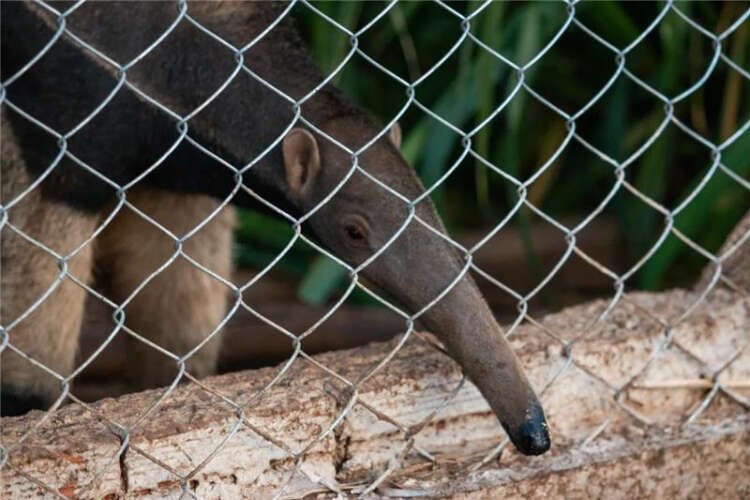
Published by Jessica Weisman-Pitts
Posted on November 7, 2022
7 min readLast updated: February 3, 2026
Add as preferred source on GoogleBy Andre Cabette Fabio
AQUIDAUANA, Brazil (Thomson Reuters Foundation) – As their geolocator device beeps, the team of wildlife rehab experts approach a cluster of trees and spot their quarry: A young giant anteater, sleeping on a hot morning with her luxuriant tail shading her head.
She is a survivor of a fire holocaust that swept through Brazil’s vast southern Pantanal in 2020, killing an estimated 17 million animals and burning nearly a quarter of the drought-parched wetlands and grasslands region, which is about the size of New York state.
Rescued alone on the side of a highway, at an age when she should have been still clinging to her mother’s back, the young anteater has since been cared for by Orphans of Fires, a project in Mato Grosso do Sul state that hopes to help her return permanently to the wild.
Started in Aquidauana by conservationists in the wake of the fires, it now cares for 15 rescued giant anteaters.
“There are termite mounds all around”, notes veterinarian Maria Helena Mazzoni Baldini approvingly – a sign the sleeping young orphan is fending for herself, though she was too young to learn foraging skills from her mother.
In 2020, more than 50 giant anteaters injured or displaced by the Pantanal fires were taken in by state rescue projects – a leap from 13 the previous year, according to Mato Grosso do Sul’s Wild Animals Rehabilitation Center (CRAS).
As fires grow larger and more frequent and as global warming brings hotter and drier conditions, the already endangered anteaters – which also live in the Amazon rainforest – are coming under growing pressure.
Land seizures, and expansion of farming, ranching and mining, have led to their habitat shrinking in the Amazon and the Brazilian savanna, and heat and fires are just one more risk, biologists say.
Flávia Miranda, research coordinator for the Anteater Institute, which runs the orphans rescue project, believes the highly specialized animals are particularly imperiled, not least because they can struggle with temperatures extremes.
“If temperatures rise or lower too much, they will suffer a lot,” she predicted.
The number of giant anteaters in Brazil has already fallen 30% between 1989 and 2015, the latest official population estimate shows.
HOTTER, DEADLIER
Global temperatures have risen more than 1.2 degrees Celsius (2.2 Fahrenheit) since preindustrial times and are now swiftly approaching a 1.5C degrees of warming mark that scientists fear could herald a transition to far costlier and deadlier climate change impacts.
The 2015 Paris Agreement, a pact among almost 200 nations, set a goal of limiting global warming to “well below” 2 degrees Celsius (3.6 Fahrenheit) while “pursuing efforts” for 1.5C.
But with fossil fuel use still rising globally, despite pledges to slash emissions, 1.5C of warming could be passed within a decade, top climate scientists say.
They fear that could trigger irreversible ecological tipping points, from surging sea levels as polar ice melts to spiking temperatures as methane – a potent driver of warming – escapes thawing permafrost.
A hotter planet is also expected to spark more extreme weather, crop failures, species extinctions, migration and soaring personal and financial losses for many people around the planet.
Brazil’s forests, savannas and wetlands contain the richest mix of plants and animals in the world. But many of those species are at growing risk of extinction as their habitat vanishes and climate impacts worsen.
Such potential losses present a danger not just for the species and ecosystems themselves but for millions of people who depend on them for everything from food to reliable rainfall and innovative medicines.
“Most people are completely oblivious to how biology supports their lives. They are completely oblivious to the biological origins of a medication when they go to get a refill at the pharmacy,” biologist Thomas Lovejoy, who coined the term “biological diversity”, said last year before his death.
“Biodiversity is a living library of 4 billion years of evolution, with each organism and species daily working on biological challenges and solutions in their own existence. It’s a pretty powerful way to generate a lot of knowledge,” said the scientist, who worked much of his life in the Brazilian Amazon.
HUNGRY ORPHANS
At the Orphans of Fire rescue center in rural Aquidauana, young giant anteaters being rehabbed press against a chainlink fence at feeding time, waiting to eat a mix of soy, eggs and cow plasma protein until they can dig out ants and termites on their own.
Their probing tongues – up to 60 centimetres (23 inches) long – leave long lines of thick saliva on their carers’ clothes and skin.
“It has to be gluey so the ants stick to it”, noted Mazzoni, the veterinarian.
With a limited high-protein diet of insects in the wild, the animals’ metabolism has evolved to be relatively slow, with their average body temperature around 34 degrees Celsius, low for mammals.
Anteaters in the Pantanal forage mainly in open fields, and hotter days there mean many are on the move fewer daylight hours and need more often to seek trees for shade and rest, something increasingly difficult as more trees are burned or cut.
The Pantanal’s average temperature has risen 2 degrees Celsius since 1980, above the global average, according to Brazilian research institutions and data from the U.S. National Centers for Environmental Information.
A 2020 study in the journal Nature estimates it is one of the areas in South America with the highest percentage of species at risk from climate change.
Andreas Meyer, a Brazilian biodiversity researcher at the University of Cape Town, said more frequent and severe weather extremes are leaving many stressed species with little time to recover between crises.
Soaring forest losses in the Amazon, to the north, are also affecting the Pantanal’s supply of water.
Typically, water vapor rises from the moist Amazon forest and is blown toward southern South America, a phenomenon known as “flying rivers”.
But as the forest vanishes, the rivers are slowing.
According to data from the nonprofit MapBiomas, the area of the Pantanal covered by water during the height of seasonal floods has shrunk by 29% between 1988 and 2018, the last year the region flooded.
WORSENING DROUGHT
Over three centuries, ranching has been the most common agricultural activity in the vast wetland. But as it dries, more land is being converted to grow soy.
Zilca Campos, from the Pantanal branch of the state-owned Brazilian Agricultural Research Corporation (EMBRAPA), said cattle ranching also is becoming more destructive as once-vast farms are divided between heirs or sold in smaller plots.
With the change, more animals are reared per hectare, tree areas are converted to pasture and native grass are replaced by exotic varieties, said Campos.
According to EMBRAPA, 95% of the biome’s areas in Mato Grosso do Sul state is on private land.
The Orphans of Fire is located on one of those private farms, owned by João Ildefonso Pinheiro Murano, who runs 2,400 head of cattle there and operates a hotel.
Droughts are part of life in the Pantanal, he points out. But after a string of dry years, even he concedes that “I have never seen a drought like this one”.
Usually, by the second half of the year, tourists would be visiting a pond called Poção on his property, photographing caiman – cousins of alligators – and birds and watching animals stop by for a drink.
But this year water that was once shoulder-high in the pond has vanished, leaving behind mainly sand – and bones.
“There are no signs of predation. They are dying of hunger”, said Orphans of Fire biologist Manoela Pinho, pointing to the putrefying corpse of a caiman near a remaining pool of thick green water.
At the center of the pond one last starving caiman lingers, its vertebrae easily visible through its back. It is almost completely still except for the occasional blinking of its eyes.
Originally published on:
(Reporting by Andre Cabette Fabio; Editing by Laurie Goering. The Thomson Reuters Foundation is the charitable arm of Thomson Reuters. Visit https://context.news/)
Biodiversity refers to the variety of life in a particular habitat or ecosystem. It includes the diversity of species, genetic variation, and the variety of ecosystems.
Climate change refers to significant changes in global temperatures and weather patterns over time. It is primarily driven by human activities, especially fossil fuel burning.
Wildlife conservation is the practice of protecting animal species and their habitats to prevent extinction and ensure biodiversity.
Habitat loss occurs when natural environments are transformed or destroyed, often due to human activities like deforestation, urban development, and agriculture.
An endangered species is a species that is at risk of extinction due to a drastic decline in population or habitat loss.
Explore more articles in the Top Stories category











