Search
00
GBAF Logo
trophy
Top StoriesInterviewsBusinessFinanceBankingTechnologyInvestingTradingVideosAwardsMagazinesHeadlinesTrends

Subscribe to our newsletter

Get the latest news and updates from our team.

Global Banking & Finance Review®

Global Banking & Finance Review® - Subscribe to our newsletter

Company

    GBAF Logo
    • About Us
    • Profile
    • Privacy & Cookie Policy
    • Terms of Use
    • Contact Us
    • Advertising
    • Submit Post
    • Latest News
    • Research Reports
    • Press Release
    • Awards▾
      • About the Awards
      • Awards TimeTable
      • Submit Nominations
      • Testimonials
      • Media Room
      • Award Winners
      • FAQ
    • Magazines▾
      • Global Banking & Finance Review Magazine Issue 79
      • Global Banking & Finance Review Magazine Issue 78
      • Global Banking & Finance Review Magazine Issue 77
      • Global Banking & Finance Review Magazine Issue 76
      • Global Banking & Finance Review Magazine Issue 75
      • Global Banking & Finance Review Magazine Issue 73
      • Global Banking & Finance Review Magazine Issue 71
      • Global Banking & Finance Review Magazine Issue 70
      • Global Banking & Finance Review Magazine Issue 69
      • Global Banking & Finance Review Magazine Issue 66
    Top StoriesInterviewsBusinessFinanceBankingTechnologyInvestingTradingVideosAwardsMagazinesHeadlinesTrends

    Global Banking & Finance Review® is a leading financial portal and online magazine offering News, Analysis, Opinion, Reviews, Interviews & Videos from the world of Banking, Finance, Business, Trading, Technology, Investing, Brokerage, Foreign Exchange, Tax & Legal, Islamic Finance, Asset & Wealth Management.
    Copyright © 2010-2026 GBAF Publications Ltd - All Rights Reserved. | Sitemap | Tags | Developed By eCorpIT

    Editorial & Advertiser disclosure

    Global Banking & Finance Review® is an online platform offering news, analysis, and opinion on the latest trends, developments, and innovations in the banking and finance industry worldwide. The platform covers a diverse range of topics, including banking, insurance, investment, wealth management, fintech, and regulatory issues. The website publishes news, press releases, opinion and advertorials on various financial organizations, products and services which are commissioned from various Companies, Organizations, PR agencies, Bloggers etc. These commissioned articles are commercial in nature. This is not to be considered as financial advice and should be considered only for information purposes. It does not reflect the views or opinion of our website and is not to be considered an endorsement or a recommendation. We cannot guarantee the accuracy or applicability of any information provided with respect to your individual or personal circumstances. Please seek Professional advice from a qualified professional before making any financial decisions. We link to various third-party websites, affiliate sales networks, and to our advertising partners websites. When you view or click on certain links available on our articles, our partners may compensate us for displaying the content to you or make a purchase or fill a form. This will not incur any additional charges to you. To make things simpler for you to identity or distinguish advertised or sponsored articles or links, you may consider all articles or links hosted on our site as a commercial article placement. We will not be responsible for any loss you may suffer as a result of any omission or inaccuracy on the website.

    Home > Top Stories > Analysis-G7 fails to reach intervention deal to ease pain of soaring dollar
    Top Stories

    Analysis-G7 fails to reach intervention deal to ease pain of soaring dollar

    Published by Uma Rajagopal

    Posted on October 17, 2022

    5 min read

    Last updated: February 3, 2026

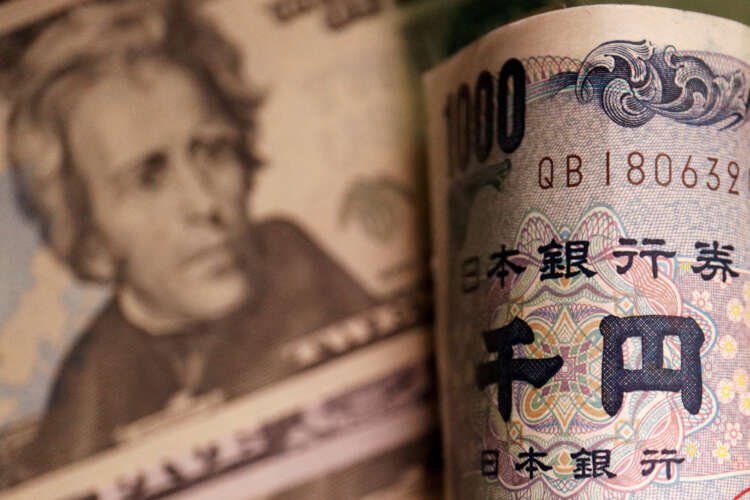
    The image shows Japanese yen and U.S. dollar banknotes, symbolizing the currency volatility discussed at the G7 meetings. The article analyzes the lack of coordinated intervention against the soaring dollar.
    Japanese yen and U.S. dollar banknotes representing currency volatility - Global Banking & Finance Review
    Why waste money on news and opinion when you can access them for free?

    Take advantage of our newsletter subscription and stay informed on the go!

    Subscribe

    Tags:foreign currencymonetary policyfinancial marketsemerging markets

    By Leika Kihara

    WASHINGTON (Reuters) – Japan and other countries facing the fallout from a soaring U.S. dollar found little comfort from last week’s meetings of global finance officials, with no sign that joint intervention along the lines of the 1985 “Plaza Accord” was on the horizon.

    With a strong push from Japan, finance leaders of the Group of Seven advanced economies included a phrase in a statement on Wednesday saying they will closely monitor “recent volatility” in markets.

    But the warning, as well as Japanese Finance Minister Shunichi Suzuki’s threat of another yen-buying intervention, failed to prevent the currency from sliding to fresh 32-year lows against the dollar as the week came to a close.

    While Suzuki may have found allies grumbling over the fallout from the U.S. central bank’s aggressive interest rate hike path, he conceded that no plan for a coordinated intervention was in the works.

    “Many countries saw the need for vigilance to the spill-over effect of global monetary tightening, and mentioned currency moves in that context. But there wasn’t any discussion on what coordinated steps could be taken,” Suzuki said in a news conference on Thursday after attending separate meetings of the G7 and G20 finance leaders in Washington.

    U.S. Treasury Secretary Janet Yellen made clear that Washington had no appetite for concerted action, saying the dollar’s overall strength was a “natural result of different paces of monetary tightening in the United States and other countries.”

    “I’ve said on many occasions that I think a market-determined value for the dollar is in America’s interest. And I continue to feel that way,” she said on Tuesday, when asked if she would consider a Plaza Accord 2.0 agreement.

    NO YEN SUPPORT

    In 1985, a destabilizing surge in the dollar prompted five countries – France, Japan, the United Kingdom, the United States and what was then West Germany – to band together to weaken the U.S. currency and help reduce the U.S. trade deficit. Following the deal, named the Plaza Accord for the famed New York hotel where it was hammered out, the dollar shed roughly 25% of its value over the ensuing 12 months.

    With no current U.S. interest in engineering that kind of deal, other countries have to find ways to mitigate the pain stemming from a strong dollar, which has forced some emerging economies to hike interest rates to defend their currencies even at the cost of cooling economic growth more than they want.

    Emerging Asian nations have seen significant capital outflows this year that are comparable to previous stress episodes, heightening the need for policymakers to build liquidity buffers and take other steps to prepare for turbulence, said Sanjaya Panth, deputy director for the International Monetary Fund’s Asia and Pacific Department.

    “The situation for Asian economies is very different from where they were 20 years ago” as countries accumulated foreign reserves that make them more resilient to external shocks, Panth told Reuters on Thursday on the sidelines of the IMF and World Bank annual meetings in Washington.

    “At the same time, the rising debt levels, particularly in some economies in the regions, are a concern,” he said. “Some form of market stress cannot be ruled out.”

    The Bank of Korea delivered its second-ever 50-basis-point interest rate hike on Wednesday and made clear the won’s 6.5% slide against the dollar in September that drove up import costs played a key role in the decision.

    South Korea’s central bank Governor Rhee Chang-yong said on Saturday he does not sense an interest among U.S. officials to stem the dollar’s strength through joint intervention.

    But he said some kind of international cooperation on the dollar may be needed “after a certain period.”

    “I think a too-strong dollar, especially for a substantial period, won’t be good for the Unites States either, and actually I’m thinking about the long-term implication for the trade deficit, and maybe another global imbalance may happen,” he said.

    In Japan, the onus is on the government to deal with a renewed plunge in the yen, caused in part by the policy divergence between the Federal Reserve’s determination to raise U.S. interest rates and the Bank of Japan’s resolve to keep borrowing costs ultra-low.

    At the news conference where Suzuki issued his warning about sharp yen falls, BOJ Governor Haruhiko Kuroda ruled out anew the chance of a rate hike.

    The dollar jumped about 1% to a fresh 32-year high of 148.86 yen on Friday, testing authorities’ resolve to combat the Japanese currency’s relentless slide. The dollar/yen is now up roughly 2% from levels when Japan intervened on Sept. 22 to buy yen for the first time since 1998.

    Japanese policymakers have said they won’t seek to defend a certain yen level, and instead will focus on smoothing volatility.

    Masato Kanda, the country’s top currency diplomat, told reporters on Friday that authorities were ready to take “decisive action any time” if excessively volatile yen moves continued.

    Even moderating abrupt yen moves, however, could be a challenge as Kuroda’s assurance that the BOJ will keep interest rates in negative territory gives investors a green light to continue dumping the currency.

    “It’s impossible to reverse the yen’s downtrend with solo intervention,” said Daisaku Ueno, chief forex strategist at Mitsubishi UFJ Morgan Stanley Securities.

    “Once the yen falls below 150 to the dollar, it’s hard to predict where its depreciation could stop because there’s no technical chart support until around 160,” he said.

    (Reporting by Leika Kihara; Additional reporting by Daniel Burns in Washington and Tetsushi Kajimoto in Tokyo; Editing by Paul Simao)

    Frequently Asked Questions about Analysis-G7 fails to reach intervention deal to ease pain of soaring dollar

    1What is a strong dollar?

    A strong dollar refers to a situation where the value of the U.S. dollar is high compared to other currencies, making imports cheaper but exports more expensive.

    2What is monetary policy?

    Monetary policy is the process by which a central bank manages the supply of money and interest rates to achieve specific economic objectives.

    3What are emerging markets?

    Emerging markets are economies that are in the process of rapid growth and industrialization, often characterized by lower income levels and higher volatility.

    4What is currency intervention?

    Currency intervention is when a country's central bank buys or sells its own currency in the foreign exchange market to influence its value.

    5What is the Plaza Accord?

    The Plaza Accord was a 1985 agreement among five countries to depreciate the U.S. dollar in relation to other currencies to address trade imbalances.

    More from Top Stories

    Explore more articles in the Top Stories category

    Image for Lessons From the Ring and the Deal Table: How Boxing Shapes Steven Nigro’s Approach to Banking and Life
    Lessons From the Ring and the Deal Table: How Boxing Shapes Steven Nigro’s Approach to Banking and Life
    Image for Joe Kiani in 2025: Capital, Conviction, and a Focused Return to Innovation
    Joe Kiani in 2025: Capital, Conviction, and a Focused Return to Innovation
    Image for Marco Robinson – CLOSE THE DEAL AND SUDDENLY GROW RICH
    Marco Robinson – CLOSE THE DEAL AND SUDDENLY GROW RICH
    Image for Digital Tracing: Turning a regulatory obligation into a commercial advantage
    Digital Tracing: Turning a regulatory obligation into a commercial advantage
    Image for Exploring the Role of Blockchain and the Bitcoin Price Today in Education
    Exploring the Role of Blockchain and the Bitcoin Price Today in Education
    Image for Inside the World’s First Collection Industry Conglomerate: PCA Global’s Platform Strategy
    Inside the World’s First Collection Industry Conglomerate: PCA Global’s Platform Strategy
    Image for Chase Buchanan Private Wealth Management Highlights Key Autumn 2025 Budget Takeaways for Expats
    Chase Buchanan Private Wealth Management Highlights Key Autumn 2025 Budget Takeaways for Expats
    Image for PayLaju Strengthens Its Position as Malaysia’s Trusted Interest-Free Sharia-Compliant Loan Provider
    PayLaju Strengthens Its Position as Malaysia’s Trusted Interest-Free Sharia-Compliant Loan Provider
    Image for A Notable Update for Employee Health Benefits:
    A Notable Update for Employee Health Benefits:
    Image for Creating Equity Between Walls: How Mohak Chauhan is Using Engineering, Finance, and Community Vision to Reengineer Affordable Housing
    Creating Equity Between Walls: How Mohak Chauhan is Using Engineering, Finance, and Community Vision to Reengineer Affordable Housing
    Image for Upcoming Book on Real Estate Investing: Harvard Grace Capital Founder Stewart Heath’s Puts Lessons in Print
    Upcoming Book on Real Estate Investing: Harvard Grace Capital Founder Stewart Heath’s Puts Lessons in Print
    Image for ELECTIVA MARKS A LANDMARK FIRST YEAR WITH MAJOR SENIOR APPOINTMENTS AND EXPANSION MILESTONES
    ELECTIVA MARKS A LANDMARK FIRST YEAR WITH MAJOR SENIOR APPOINTMENTS AND EXPANSION MILESTONES
    View All Top Stories Posts
    Previous Top Stories PostBroadcom banking on early EU approval of $61 billion VMware deal
    Next Top Stories PostEuro zone bond yields fall as ECB policymaker flags recession risk, gilts eyed