Search
00
GBAF Logo
trophy
Top StoriesInterviewsBusinessFinanceBankingTechnologyInvestingTradingVideosAwardsMagazinesHeadlinesTrends

Subscribe to our newsletter

Get the latest news and updates from our team.

Global Banking & Finance Review®

Global Banking & Finance Review® - Subscribe to our newsletter

Company

    GBAF Logo
    • About Us
    • Profile
    • Privacy & Cookie Policy
    • Terms of Use
    • Contact Us
    • Advertising
    • Submit Post
    • Latest News
    • Research Reports
    • Press Release
    • Awards▾
      • About the Awards
      • Awards TimeTable
      • Submit Nominations
      • Testimonials
      • Media Room
      • Award Winners
      • FAQ
    • Magazines▾
      • Global Banking & Finance Review Magazine Issue 79
      • Global Banking & Finance Review Magazine Issue 78
      • Global Banking & Finance Review Magazine Issue 77
      • Global Banking & Finance Review Magazine Issue 76
      • Global Banking & Finance Review Magazine Issue 75
      • Global Banking & Finance Review Magazine Issue 73
      • Global Banking & Finance Review Magazine Issue 71
      • Global Banking & Finance Review Magazine Issue 70
      • Global Banking & Finance Review Magazine Issue 69
      • Global Banking & Finance Review Magazine Issue 66
    Top StoriesInterviewsBusinessFinanceBankingTechnologyInvestingTradingVideosAwardsMagazinesHeadlinesTrends

    Global Banking & Finance Review® is a leading financial portal and online magazine offering News, Analysis, Opinion, Reviews, Interviews & Videos from the world of Banking, Finance, Business, Trading, Technology, Investing, Brokerage, Foreign Exchange, Tax & Legal, Islamic Finance, Asset & Wealth Management.
    Copyright © 2010-2026 GBAF Publications Ltd - All Rights Reserved. | Sitemap | Tags | Developed By eCorpIT

    Editorial & Advertiser disclosure

    Global Banking & Finance Review® is an online platform offering news, analysis, and opinion on the latest trends, developments, and innovations in the banking and finance industry worldwide. The platform covers a diverse range of topics, including banking, insurance, investment, wealth management, fintech, and regulatory issues. The website publishes news, press releases, opinion and advertorials on various financial organizations, products and services which are commissioned from various Companies, Organizations, PR agencies, Bloggers etc. These commissioned articles are commercial in nature. This is not to be considered as financial advice and should be considered only for information purposes. It does not reflect the views or opinion of our website and is not to be considered an endorsement or a recommendation. We cannot guarantee the accuracy or applicability of any information provided with respect to your individual or personal circumstances. Please seek Professional advice from a qualified professional before making any financial decisions. We link to various third-party websites, affiliate sales networks, and to our advertising partners websites. When you view or click on certain links available on our articles, our partners may compensate us for displaying the content to you or make a purchase or fill a form. This will not incur any additional charges to you. To make things simpler for you to identity or distinguish advertised or sponsored articles or links, you may consider all articles or links hosted on our site as a commercial article placement. We will not be responsible for any loss you may suffer as a result of any omission or inaccuracy on the website.

    Home > Top Stories > Analysis-East Europeans count their pennies for Christmas as food costs soar
    Top Stories

    Analysis-East Europeans count their pennies for Christmas as food costs soar

    Published by Jessica Weisman-Pitts

    Posted on December 7, 2022

    5 min read

    Last updated: February 2, 2026

    A herd of Mangalica pigs on a farm in Tiszaeszlar, Hungary, represents the challenges of food price inflation impacting Christmas celebrations in Eastern Europe as costs soar.
    Mangalica pigs on a farm in Hungary amidst rising food costs - Global Banking & Finance Review
    Why waste money on news and opinion when you can access them for free?

    Take advantage of our newsletter subscription and stay informed on the go!

    Subscribe

    Tags:economic growth

    By Krisztina Than

    TISZAESZLAR, Hungary (Reuters) – Consumers in Eastern Europe are saving up to put their favourite carp and pork dishes on the table for Christmas as food price inflation, especially in Hungary and the Baltics, outpaces that in the wider European Union.

    Food prices in Hungary were a staggering 45.2% higher in October than a year earlier, Eurostat data shows, with 10 countries in the EU’s east facing food price inflation of more than 20%. The cost of food was 33.3% higher in Lithuania and up 30% in Latvia compared to October 2021.

    And while there are signs headline inflation may be peaking in some countries, food prices are still rising strongly, adding to a cost-of-living squeeze and forcing central banks to keep interest rates high even as economies start slowing sharply.

    Experts say local factors are exacerbating a global trend driven by rising energy and fertilizer costs, including low food industry productivity in some ex-communist countries, heavy exposure to imports, and surging wages in tight labour markets.

    In Hungary, a severe drought decimated maize and wheat crops this year and caused animal feed prices to rocket, while the weak forint has raised import costs.

    On their farm in Tiszaeszlar, eastern Hungary, Lajos Kander’s family rear more than 2,000 hairy “mangalica” pigs, a traditional breed prized for their meat.

    The Kanders usually grow maize and wheat and produce their own feedstock. But the drought has forced them to buy some feed on the market, where Lajos Kander said maize and autumn wheat prices have nearly doubled from 2021.

    “In 2023 we will face serious difficulties as we will have to buy feed, we’ll see at what price we can make up for the missing amount,” he said, adding that power, wage and veterinary costs had also risen.

    The farm pays 29 forints per KWh for power under a contract which expires on Dec. 31, after which the bill will rise to 138 forints per KWh. Luckily, they have some solar panels. The annual cost of vaccinating their pigs has meanwhile tripled to 4.5 million forints.

    The Kanders have raised prices by about 20-25% but Lajos Kander said further cost increases would be hard to pass on: “Businesses will have to swallow some of these costs … to be able to bridge this situation. We may want to get 2,000 forints for a kilo of pig, (but) no one will buy it.”

    Food is now the main driver of Hungarian inflation, which data on Thursday is expected to show accelerating to 22.2% in November, with the scrapping of a cap on fuel prices set to give a further boost in future.

    Czech headline inflation slowed to 15.1% in October but food prices grew, while in Poland food and non-alcoholic beverages inflation was 22.3% in November, well ahead of overall CPI at 17.4%.

    ** For an interactive graphic:

    National Bank of Hungary Governor Gyorgy Matolcsy said on Monday that inflation would average 15-18% next year, with food accounting for more than 50% of further rises.

    “Hungary’s food industry operates with an unacceptably low productivity, and monopolies, with high share of imports and higher energy input,” he said.

    In Lithuania, one of the Baltic States whose small, open economies are exposed to fluctuations in international commodity markets, central bank governor Gediminas Simkus struck a more optimistic note.

    “Next time, we will see that the monthly inflation will go down a little bit, because the peaks in the prices of energy raw materials and food have already happened and hopefully they will not happen again,” he said last week.

    A POORER CHRISTMAS

    Surging prices have started to dampen consumption.

    Food sales fell 5.6% in Hungary in October as families faced with year-on-year rises of over 34% for meat and fish and 80% for bread made savings. Czech shoppers meanwhile grappled with a 105% rise in sugar prices while flour cost 45.4% more in Poland.

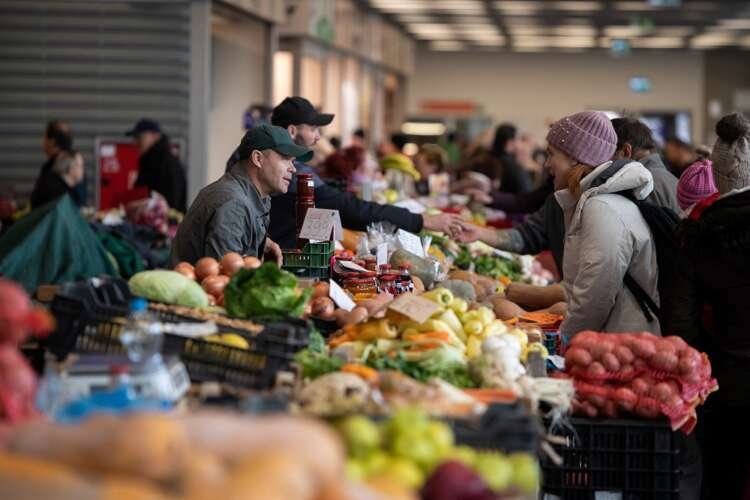
    In a Budapest market, 75-year-old Eva Racz said she could not afford the traditional festive meal of carp this year.

    “This will be a poorer Christmas, as our pensions are small and we need to pay for utilities and our medicine,” she said, adding that she and her husband live on pensions totalling 200,000 forints ($507.74) a month.

    “We will have some broth, stuffed cabbage and roast meat and potatoes over Christmas,” Racz said. “I’m feeling desperate that this continues, and for how long?”

    A survey by Barometr Providenta showed Poles would spend an average 1,259 zlotys ($281) on Christmas this year, 307 zlotys more than a year ago, even though almost half of those surveyed said they would buy cheaper products to keep costs down.

    Inflation in Hungary is expected to start a very slow decline in the first half of next year.

    “There are still no durable signs that the inflation dynamics are improving in Hungary,” Goldman Sachs has said.

    ** For an interactive graphic:

    ($1 = 393.9000 forints)

    ($1 = 4.4741 zlotys)

    (Additional reporting by Krisztina Fenyo, Jason Hovet and Robert Muller in Prague, Andrius Sytas in the Baltics and Alan Charlish in Warsaw; Writing by Krisztina Than; Editing by Catherine Evans)

    Frequently Asked Questions about Analysis-East Europeans count their pennies for Christmas as food costs soar

    1What is inflation?

    Inflation is the rate at which the general level of prices for goods and services rises, eroding purchasing power. It is typically measured by the Consumer Price Index (CPI).

    2What are food prices?

    Food prices refer to the cost of purchasing food items. These prices can fluctuate based on factors like supply, demand, and economic conditions.

    3What is consumer spending?

    Consumer spending is the total amount of money spent by households on goods and services. It is a key driver of economic growth.

    4What is economic growth?

    Economic growth is an increase in the production of goods and services in an economy over a period of time, often measured by GDP.

    More from Top Stories

    Explore more articles in the Top Stories category

    Image for Lessons From the Ring and the Deal Table: How Boxing Shapes Steven Nigro’s Approach to Banking and Life
    Lessons From the Ring and the Deal Table: How Boxing Shapes Steven Nigro’s Approach to Banking and Life
    Image for Joe Kiani in 2025: Capital, Conviction, and a Focused Return to Innovation
    Joe Kiani in 2025: Capital, Conviction, and a Focused Return to Innovation
    Image for Marco Robinson – CLOSE THE DEAL AND SUDDENLY GROW RICH
    Marco Robinson – CLOSE THE DEAL AND SUDDENLY GROW RICH
    Image for Digital Tracing: Turning a regulatory obligation into a commercial advantage
    Digital Tracing: Turning a regulatory obligation into a commercial advantage
    Image for Exploring the Role of Blockchain and the Bitcoin Price Today in Education
    Exploring the Role of Blockchain and the Bitcoin Price Today in Education
    Image for Inside the World’s First Collection Industry Conglomerate: PCA Global’s Platform Strategy
    Inside the World’s First Collection Industry Conglomerate: PCA Global’s Platform Strategy
    Image for Chase Buchanan Private Wealth Management Highlights Key Autumn 2025 Budget Takeaways for Expats
    Chase Buchanan Private Wealth Management Highlights Key Autumn 2025 Budget Takeaways for Expats
    Image for PayLaju Strengthens Its Position as Malaysia’s Trusted Interest-Free Sharia-Compliant Loan Provider
    PayLaju Strengthens Its Position as Malaysia’s Trusted Interest-Free Sharia-Compliant Loan Provider
    Image for A Notable Update for Employee Health Benefits:
    A Notable Update for Employee Health Benefits:
    Image for Creating Equity Between Walls: How Mohak Chauhan is Using Engineering, Finance, and Community Vision to Reengineer Affordable Housing
    Creating Equity Between Walls: How Mohak Chauhan is Using Engineering, Finance, and Community Vision to Reengineer Affordable Housing
    Image for Upcoming Book on Real Estate Investing: Harvard Grace Capital Founder Stewart Heath’s Puts Lessons in Print
    Upcoming Book on Real Estate Investing: Harvard Grace Capital Founder Stewart Heath’s Puts Lessons in Print
    Image for ELECTIVA MARKS A LANDMARK FIRST YEAR WITH MAJOR SENIOR APPOINTMENTS AND EXPANSION MILESTONES
    ELECTIVA MARKS A LANDMARK FIRST YEAR WITH MAJOR SENIOR APPOINTMENTS AND EXPANSION MILESTONES
    View All Top Stories Posts
    Previous Top Stories PostBritish PM Rishi Sunak pledges further action on strikes to ‘protect lives’
    Next Top Stories PostEU agrees law to make airlines pay more to pollute