
Headlines
Ukrainian Graphite Mine Hopes for Trump Deal, but Say Returns Won't Be Instant
Published by Global Banking & Finance Review®
Posted on February 12, 2025
4 min readLast updated: January 26, 2026
Add as preferred source on Google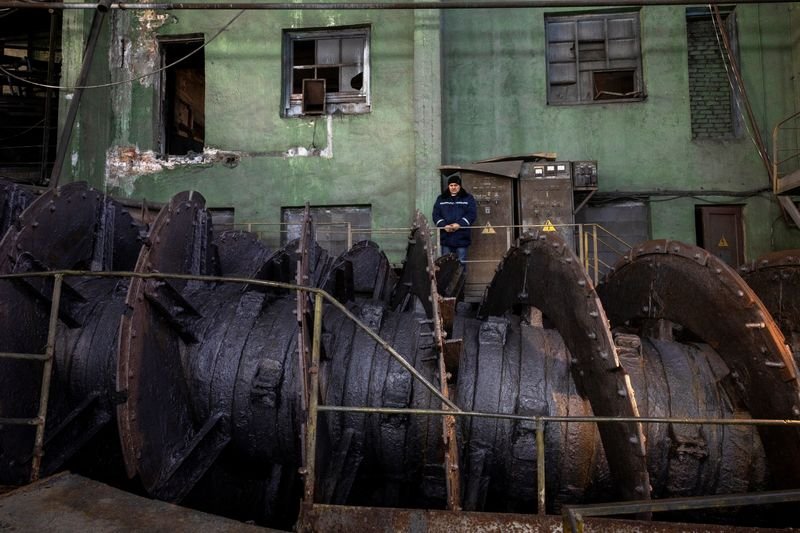
Published by Global Banking & Finance Review®
Posted on February 12, 2025
4 min readLast updated: January 26, 2026
Add as preferred source on GoogleZavallivsky Graphite Mine in Ukraine seeks U.S. investment for battery-grade graphite production. Despite vast mineral wealth, challenges remain due to war and underinvestment.
By Thomas Peter and Vladyslav Smilianets
ZAVALLIA, Ukraine (Reuters) - At the 90-year-old Zavallivsky Graphite Mine in central Ukraine, CEO Ostap Kostyuk dreams of making graphite pure enough to use for lithium batteries, something he compares to trying to "make a Rolls-Royce inside a garage", given the lack of investment.
As U.S. President Donald Trump eyes a major deal on Ukraine's rare earths and critical minerals in return for Washington's continuing support in the war against Russia, operators such as Kostyuk, sitting on one of Europe's largest graphite deposits, see an opportunity - but acknowledge profits will not come quickly for any American investors.
"No matter what, it's a long-term investment," said Kostyuk of the challenges extracting minerals in Ukraine.
During a recent visit, he showed Reuters the sprawling facility in the Kirovohrad region, standing among ageing heavy machinery where every surface was coated in a thin layer of graphite that rubbed off to the touch.
Ukraine's vast undersoil mineral wealth is at the heart of a joint partnership pitch made to Trump by President Volodymyr Zelenskiy who wants security guarantees as part of a deal to end the war.
Trump, in response, has said he wants $500 billion worth of Ukrainian critical resources and dispatched his Treasury Secretary Scott Bessent to Kyiv to meet Zelenskiy this week.
VAST MINERAL WEALTH
In an interview last week, Zelenskiy unfurled a map of Ukrainian minerals, including lithium, graphite, titanium and rare earths, which are important for the manufacture of high-performance magnets, electric motors and consumer electronics.
He said less than 20% of the country's resources - including about half its rare earth deposits - were under Russian occupation and emphasised the need to help Ukraine protect what remains.
But despite what Kyiv says is trillions of dollars of untapped mineral wealth, industry experts say it could take years for investors to make significant profits from a sector reeling from war and chronic underinvestment.
Volodymyr Landa, a senior economist at the Centre for Economic Strategy, said it was important to understand what specifically the United States was interested in gaining access to.
Ksenia Orynchak, head of Kyiv's National Extractive Industries Association, said the mining industry had "stagnated" and lacked inflows of money for all the nine years she has worked in it.
At the State Service of Geology, where she worked from 2017 to 2019, she said the government allocated just a few million hryvnia for all the body's activities, at a time when simple geological exploration would cost 2 billion hryvnias ($48 million).
Orynchak said another problem was that the country's mineral reserves have been classified for more than two decades, making it impossible to accurately assess what Ukraine has.
SOVIET-ERA MACHINERY
The Soviet-era Zavallivsky complex, whose equipment was last modernised in 1965, illustrates the scale of the challenge.
Though the mine is hundreds of miles from the front, it has been scrambling for resources since Russia's February 2022 full-scale invasion prompted its Australian partner to pull its financing.
A number of Kostyuk's workers are also either serving in the military or were killed fighting for Ukraine.
Despite the setbacks, he said his plant is already making a product good enough to be later purified into battery-ready spherical graphite (SPG).
"We are ready for this technology," said Kostyuk, adding that his facility's goal was to eventually produce its own SPG.
Ukraine's reserves of graphite, a key component in electric vehicle batteries and nuclear reactors, represent 20% of global resources.
More immediately, he added, his company was ready to offer U.S. consumers a supply of natural flake graphite, in part to establish a Ukrainian brand on U.S. markets, while U.S. firms probe for new deposits in Ukraine.
New digging projects - whether for graphite or other critical minerals - could take at least five to seven years before they begin to produce, he added.
While his factory badly needs an upgrade, Kostyuk said his workforce has the know-how to leap forward if given the resources.
"I believe in this factory, I believe in these people," he said. "Everybody here wants to work."
($1 = 41.8330 hryvnias)
(Additional reporting by Dan Peleschuk and Pavel Polityuk; Editing by Tom Balmforth and Alex Richardson)
The main goal of the Zavallivsky Graphite Mine is to produce graphite pure enough for lithium batteries, aiming to eventually create its own battery-ready spherical graphite.
The Ukrainian mining industry faces significant challenges, including stagnation, lack of investment, and outdated Soviet-era machinery, which complicates mineral extraction.
Less than 20% of Ukraine's mineral resources, including about half of its rare earth deposits, are currently under Russian occupation.
Industry experts suggest that despite Ukraine's vast mineral wealth, it could take years for investors to see significant profits due to the ongoing war and economic challenges.
The proposed U.S. deal by Trump aims to secure $500 billion worth of Ukrainian critical resources, which is seen as a way to support Ukraine amidst the ongoing conflict with Russia.
Explore more articles in the Headlines category


